











Modernization, Composability & the CommerceFabric™ Model
Learn how established commerce businesses can modernize progressively, compose capabilities, and build an architecture designed to evolve without starting over.
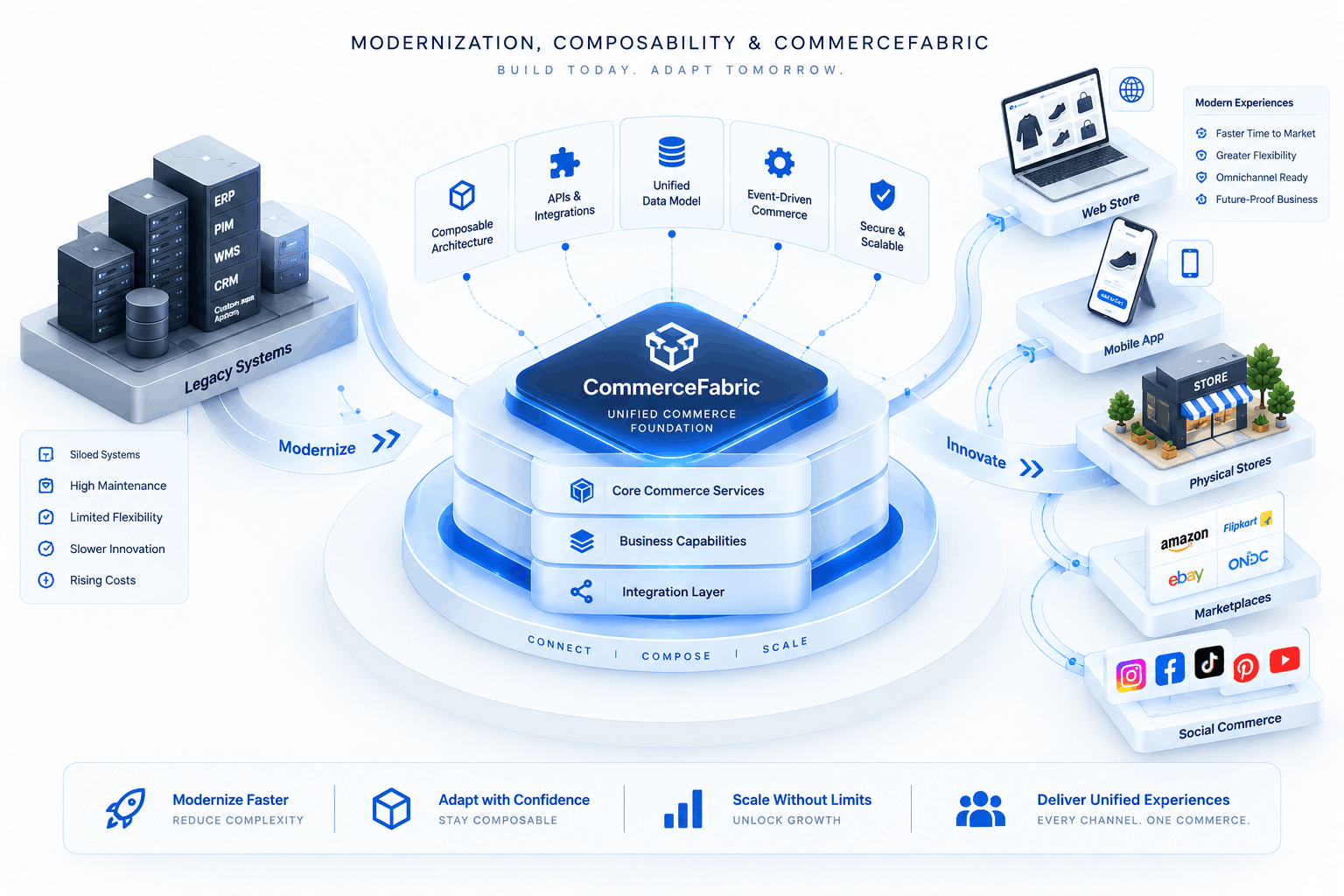
Modernize Without Rebuilding Everything
This may be the most practical principle in this entire guide. Most established commerce businesses already have significant technology investments. ERP. POS. Shopify. CRM. Warehouse management. Payment gateways. Loyalty systems. Marketplace integrations. Replacing everything is expensive, disruptive and often unnecessary.
Unified commerce architecture should therefore support progressive modernization. Keep what works. Connect what is isolated. Replace what is genuinely limiting the business. Introduce new capabilities around the existing core. This approach allows businesses to move toward modern architecture without attempting a risky "big bang" transformation. The objective isn't to create a perfect architecture on day one. It is to create an architecture that can continuously improve.
The Progressive Modernization Matrix
Keep What Works
Preserve high-investment core systems like stable General Ledger ERPs and hardened in-store POS nodes.
Connect What Is Isolated
Bridge siloed inventory databases, point-of-sale customer records, and legacy CRM caches via unified APIs.
Replace What Is Limiting
Decouple brittle custom monolith cart logic and slow legacy checkout rails that choke omnichannel agility.
Introduce New Capabilities
Inject autonomous AI pricing agents, network commerce (ONDC) connectors, and clienteling apps around the periphery.
The Architecture Should Be Composable
A modern commerce ecosystem should not require every capability to evolve at the same speed. Payments may need to change quickly. Search may evolve independently. Personalization may require frequent experimentation. Inventory may require deeper integration. The storefront may need a complete redesign.
If everything is tightly coupled, every change becomes expensive. A composable architecture separates capabilities sufficiently that they can evolve independently while remaining connected through well-defined interfaces. This creates an important organizational benefit: technology teams can change parts of the commerce system without constantly destabilizing the whole.
Core Architectural Truth
"Composable commerce is not simply about microservices. It is about creating a commerce architecture that is capable of change."
A Reference Model for Unified Commerce
Putting the pieces together, a modern unified commerce ecosystem maps cleanly into five coordinated, loosely-coupled architectural layers:
"Experiences consume capabilities. Capabilities consume shared data. Events connect the ecosystem. Intelligence operates across the whole system."

Where CommerceFabric™ Fits
This architectural philosophy is the foundation of CommerceFabric™. CommerceFabric™ is designed around the idea that modern commerce businesses shouldn't have to choose between preserving existing investments and building for the future. The architecture should allow both.

ProCommerce Core
Provides the digital commerce foundation. Powers headless frontends, D2C stores, B2B portals, and frictionless marketplace & ONDC connections.
ProRetail Grid

Extends commerce intelligence directly into physical retail. Real-time store analytics, RFID inventory reconciliation, and unified clienteling.
ProPay Nexus

Orchestrates payments seamlessly across digital checkouts and physical point-of-sale systems with automated multi-vendor reconciliation.
Together, they can participate alongside existing technologies such as Shopify, ERP, CRM, POS, marketplaces, payment providers and logistics platforms. The objective is not to replace the ecosystem. It is to engineer the connective tissue and capabilities that make the ecosystem work as one.
The Unified Commerce Architecture Checklist
Before embarking on a unified commerce transformation, leadership should be able to answer these ten foundational architectural questions:
If the answer is yes, the organization is moving toward genuine unified commerce. If the answer is no, the problem may not be the absence of another commerce application. It may be the architecture itself.
The CommerceFabric™ Perspective
Unified commerce is ultimately not about creating one giant platform. It is about creating one coherent commerce system from many specialized capabilities. The best architecture may contain Shopify. It may contain an ERP. It may contain a traditional POS. It may contain multiple payment providers. It may contain marketplaces. It may contain custom applications. It may contain AI services. What matters is whether these components can participate in a common commercial architecture.
That is the difference between technology accumulation and technology architecture. The first adds systems. The second creates leverage.
At Prologic, We Believe the Next Generation of Commerce is Built Around Three Principles:
01
Connect what matters.
02
Compose what changes.
03
Intelligentize what creates advantage.
And build an architecture that allows the business to evolve without starting over.
What's Next?
A unified architecture gives the business the ability to connect its commerce capabilities. But there is a deeper question:
How should those capabilities be designed so they can evolve independently as the business changes?
That is where composable commerce enters the picture. The next paper in this series explores why modern commerce is moving away from tightly coupled platforms, what "composable" really means, where the approach works, where it doesn't, and how businesses can avoid simply replacing one monolith with a collection of smaller ones.
Chapter Directory
Architect Your Unified Commerce Foundation
Move from disconnected commerce systems to an architecture built around shared capabilities, composability, and connected experiences.
Work with Prologic Technologies to assess your current commerce architecture, identify integration and capability gaps, and define a practical path toward a unified commerce foundation.