







The ABDM Implementation Journey
From Legacy Healthcare Systems to a Connected Digital Health Ecosystem: A structured engineering roadmap for enterprise executives and clinical architects.
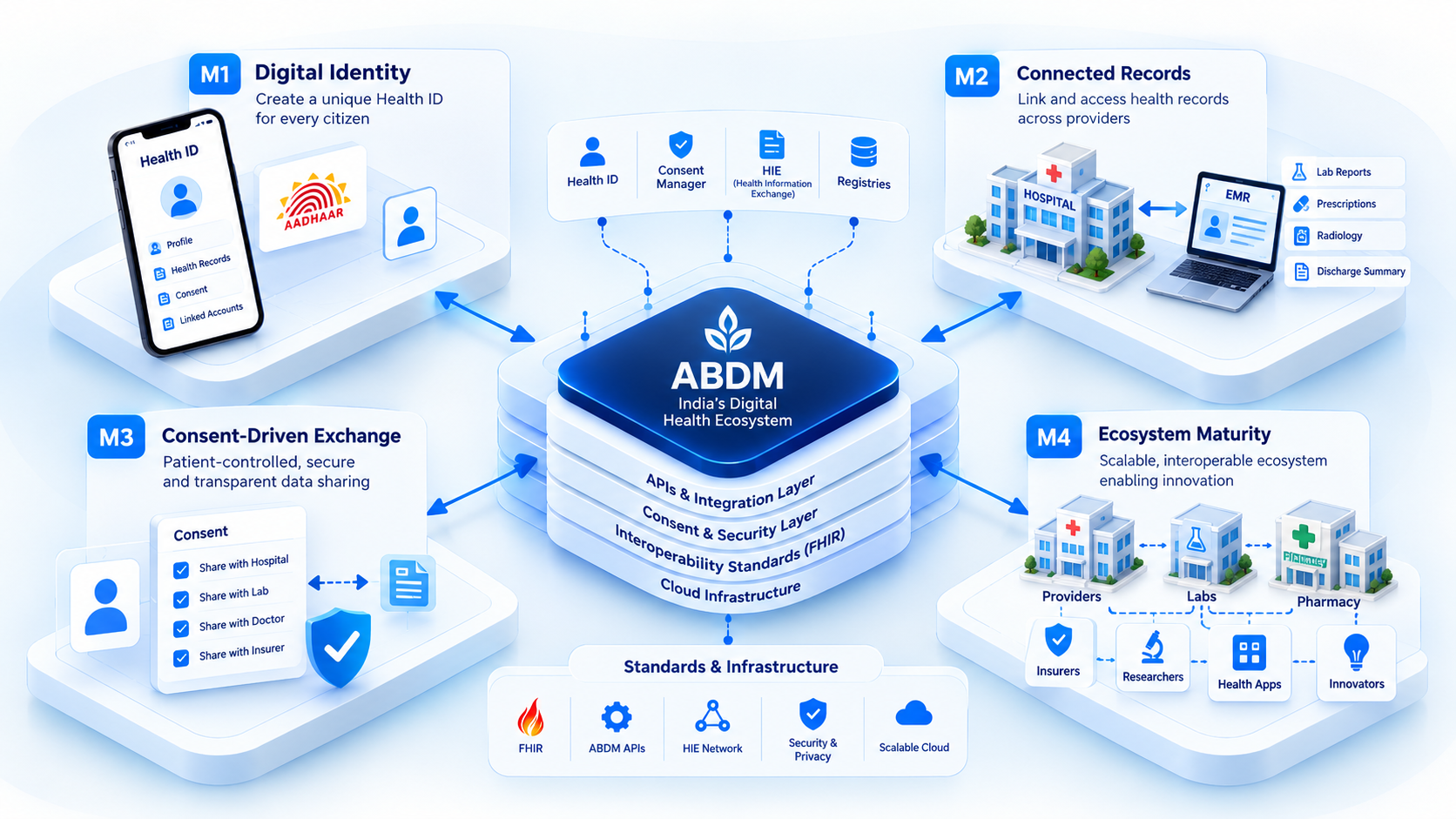
From Legacy Healthcare Systems to a Connected Digital Health Ecosystem
Implementing ABDM is not about completing a series of compliance milestones.
It is about transforming disconnected healthcare systems into participants of India's rapidly evolving digital health ecosystem.
Many organizations approach ABDM with a checklist mindset:
"Let's complete M1."
"Let's complete M1."
"Now implement M3."
While the milestones provide a structured implementation roadmap, the larger objective is much more strategic.
Every milestone gradually increases an organization's ability to participate in nationwide digital healthcare by strengthening identity, interoperability, consent and information exchange.
Viewed together, they represent a progressive journey toward connected healthcare.
India's Blueprint for Digital Health
India's Ayushman Bharat Digital Mission was created to address this challenge.
Rather than building another healthcare application, ABDM establishes the digital foundation upon which every healthcare application can securely connect and exchange information.
"Healthcare information should follow the patient- not remain confined within healthcare institutions." — National Health Authority (NHA), Strategic Mandate
ABDM introduces a national digital health ecosystem built on four foundational principles that redefine institutional data boundaries into standardized citizen-directed highways.
The Four Stages of an ABDM Journey
A progressive capability continuum moving from baseline digital registration to national autonomous orchestration.
STAGE 0
Legacy Hospital
Siloed HIS/EMR, isolated database
MILESTONE 1
Digital Identity
ABHA, HPR, HFR Registries
MILESTONE 2
Connected Records
Care Contexts & Record Discovery
MILESTONE 3
Consent Driven Exchange
HIP & HIU Gateway Flows
MILESTONE 3
National Interoperability
FHIR R4 at Enterprise Scale
Every milestone builds upon the previous one. Together they create a secure, interoperable and patient-centric healthcare ecosystem.
MILESTONE 1
Establishing Digital Identity
Everything begins with trust.
Before healthcare information can be exchanged securely, healthcare organizations must be able to uniquely identify patients and authenticate themselves within the ABDM ecosystem.
Milestone 1 focuses on establishing this trusted digital identity through:
ABHA creation and verification
Health Facility Registry (HFR) onboarding
Health Professional Registry (HPR) integration
Basic ABDM authentication services
At this stage, organizations are not yet exchanging clinical information.
Instead, they are laying the identity foundation required for every subsequent interaction.
Think of M1 as building the front door into India's digital healthcare ecosystem.
Business Outcomes
MILESTONE 2
Connecting Patients with Their Healthcare Records
Once digital identities are established, the next step is enabling patients to discover and link their health records.
Milestone 2 introduces the concept of care contexts and begins connecting healthcare information with the patient's digital identity.
Organizations implementing M2 typically enable:
Care Context Linking
Record Discovery
Patient Linking
Health Record Association
Basic Health Information Exchange readiness
Instead of information remaining isolated within hospital systems, patients begin gaining visibility and control over their healthcare records.
This milestone shifts healthcare from institutional record ownership toward patient-centric information management.
Business Outcomes
MILESTONE 3
Enabling Consent-Driven Health Information Exchange
Healthcare information should only move with patient permission.
This principle sits at the heart of ABDM.
Milestone 3 introduces secure, consent-driven exchange of healthcare information between Health Information Providers (HIPs) and Health Information Users (HIUs).
Rather than organizations exchanging medical information directly, every request passes through standardized consent workflows where patients remain in complete control of who can access their health information.
This represents one of the most significant shifts in India's digital healthcare architecture.
Active Custodians
Patients become active custodians of their personal medical data.
Standardized Gateways
Healthcare providers gain secure, verifiable mechanisms for information exchange.
Embedded Trust
Cryptographic consent artifacts accompany every transactional data request.
Business Outcomes
MILESTONE 4
Towards a Fully Interoperable Healthcare Ecosystem
While M1 through M3 establish the technical and operational foundations, the long-term vision of ABDM extends much further.
Milestone 4 represents organizational maturity where healthcare providers become fully integrated participants within India's national digital health ecosystem.
Organizations at this stage focus on:
Enterprise-wide interoperability
Mature FHIR implementations
Operational governance
Large-scale consent orchestration
Advanced health information exchange
Ecosystem-wide collaboration
AI-ready healthcare infrastructure
Rather than viewing ABDM as a project with an end date, mature organizations treat interoperability as a continuous capability that evolves alongside their digital transformation strategy.
ABDM Is More Than Four Milestones
A common misconception is that completing M1, M2 and M3 means an organization has "finished" its ABDM journey.
In reality, these milestones establish the foundation for much broader digital transformation initiatives. Once connected to the ABDM ecosystem, healthcare organizations can begin expanding into capabilities such as:
It supports:
ABDM should therefore be viewed not as the destination, but as the foundation upon which India's next generation of healthcare services will be built.
Prologic Perspective
The organizations deriving the greatest value from ABDM are those that stop thinking in milestones and start thinking in platforms.
M1, M2 and M3 are not isolated implementation projects. Together, they establish the digital foundation upon which future innovations-ncluding AI, connected care, virtual health and predictive analytics-can be built with confidence.
ABDM Reference Architecture
Implementing ABDM successfully requires more than connecting APIs. Healthcare organizations must understand how identity, consent, interoperability and clinical information exchange work together within a secure, standards-based architecture.
Patient
Unique ABHA Identity Creation / Mobile Auth Verification
Personal Health Record (PHR) App
Self-discovery & consent grant UI
Consent Manager
Standardized consent orchestration
Health Information Provider (HIP)
Health Information User (HIU)
Standardized FHIR APIs (DiagnosticReport, Condition, Encounter, MedicationRequest)

HealthFabric™ Integration Layer
Existing Hospital Information Systems (HIS) & Proprietary Databases remain intact
Healthcare providers continue using their existing systems.
ABDM does not require hospitals to replace their Hospital Information System or Electronic Medical Record. Instead, it introduces standardized interoperability services that allow these systems to participate in a trusted, nationwide healthcare network.
Having understood the overall implementation journey and reference architecture, the next chapter explores the technical engineering principles required to build scalable, secure and future-ready ABDM implementations, including FHIR integration, consent architecture, security, performance and governance.
ABDM does not require hospitals to replace their Hospital Information System or Electronic Medical Record. Instead, it introduces standardized interoperability services that allow these systems to participate in a trusted, nationwide healthcare network.
Chapter Directory
Build Healthcare That Connects India
Whether you are planning your first ABDM implementation, modernizing legacy hospital systems, or preparing your platform for AI-powered clinical workflows, let’s build healthcare that is connected, interoperable, and engineered for the future.