










Understanding ABDM
India's Blueprint for Connected Digital Healthcare
An authoritative analysis of Ayushman Bharat Digital Mission (ABDM)—deconstructing the foundational protocols, patient-mediated consent mechanics, and interoperability standards powering India’s national healthcare grid.
The Problem with Disconnected Healthcare
Healthcare has entered an era where information must move as seamlessly as patients do.
Yet in many healthcare systems, medical information remains locked inside individual hospitals, clinics and diagnostic centers. Every new consultation often requires patients to repeat their medical history, carry physical reports or undergo duplicate investigations simply because systems cannot communicate effectively.
Siloed Data Tax
Up to 18% of routine diagnostic imaging and lab tests conducted during specialist consultations in tier-1 institutions are unintentional duplicates caused exclusively by the inability to retrieve preceding investigations.
India's Blueprint for Digital Health
India's Ayushman Bharat Digital Mission was created to address this challenge.
Rather than building another healthcare application, ABDM establishes the digital foundation upon which every healthcare application can securely connect and exchange information.
99
"Healthcare information should follow the patient—not remain confined within healthcare institutions."— National Health Authority (NHA), Strategic Mandate
ABDM introduces a national digital health ecosystem built on four foundational principles that redefine institutional data boundaries into standardized citizen-directed highways.
Four Foundational Principles
This architectural philosophy is the foundation of CommerceFabric™. CommerceFabric™ is designed around the idea that modern commerce businesses shouldn't have to choose between preserving existing investments and building for the future. The architecture should allow both.
Digital Identity
Every citizen can create a unique ABHA (Ayushman Bharat Health Account), enabling accurate identification across participating healthcare providers while reducing duplicate patient records.
Impact:Universal Master Patient Index (MPI)
Patient-Controlled Consent
Patients remain in control of their health information. Medical records are shared only after explicit digital consent, creating transparency, trust and stronger privacy protections.
Impact:Granular Consent Artifacts & Audits
Interoperability
Healthcare organizations exchange information using standardized APIs and internationally recognized standards such as FHIR, allowing systems developed by different vendors to communicate effectively.
Impact:HL7 FHIR R4 Bundle Validation
Interoperability
Rather than replacing existing Hospital Information Systems or Electronic Medical Records, ABDM connects them through a common framework, enabling innovation while preserving previous technology investments.
Impact:Zero Legacy Disruption Model
Why ABDM Matters Beyond Compliance
Many organizations initially view ABDM as another regulatory requirement. In reality, it is much more than that.
ABDM enables healthcare organizations to participate in India's digital healthcare future. It establishes high-bandwidth rails that eliminate operational drag across clinical and fiscal operations.
It supports:
Healthcare providers implementing ABDM today are preparing their organizations for the next decade of digital healthcare innovation rather than simply meeting current compliance requirements.
Prologic Perspective
ABDM is not a software implementation project. It is an interoperability transformation.
Organizations that approach ABDM as a strategic engineering initiative will unlock far greater long-term value than those treating it solely as a regulatory milestone.
The ABDM Ecosystem Explained
Understanding the Building Blocks of India's Digital Health Network
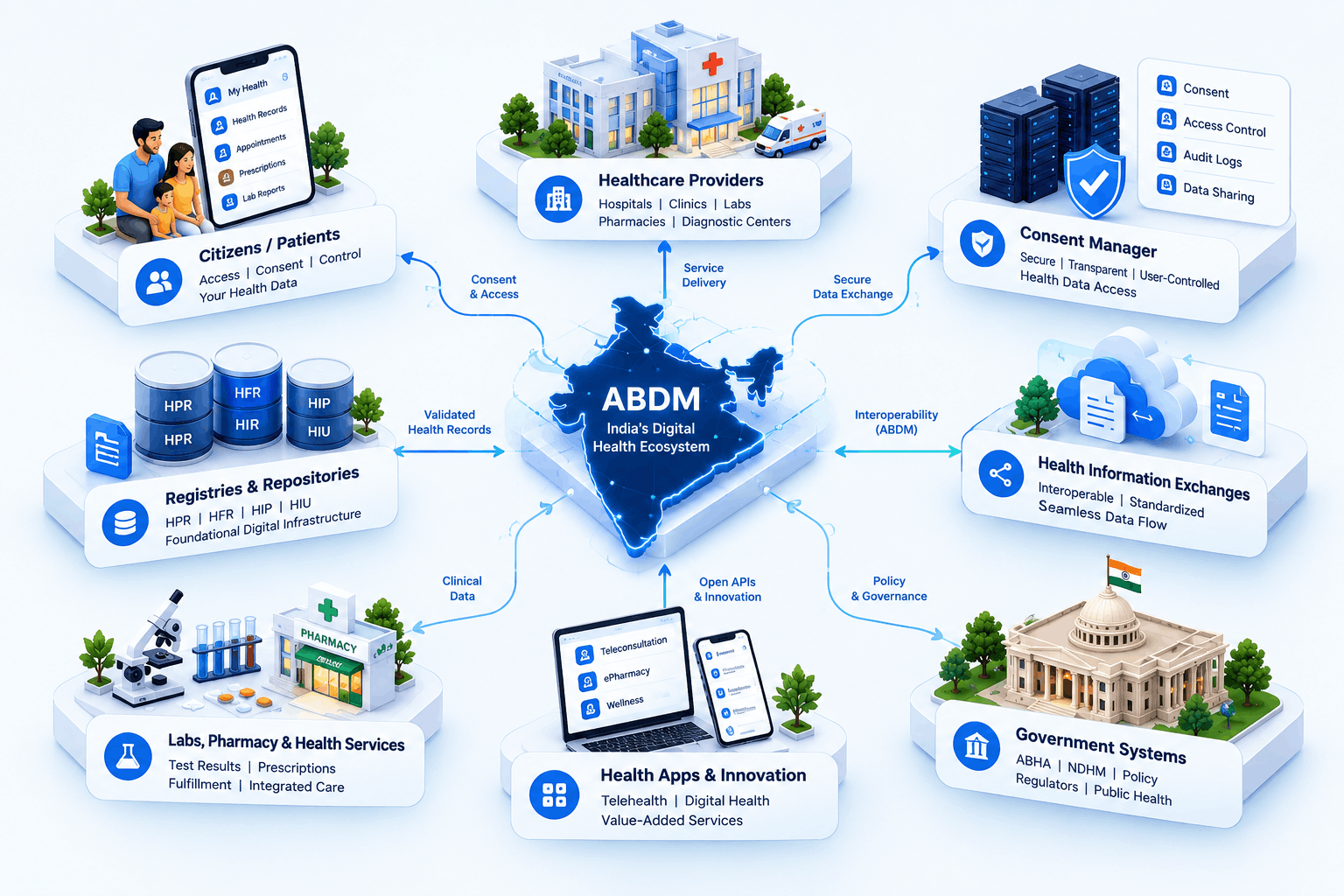
One of the reasons ABDM appears complex is that it consists of several interconnected components, each serving a distinct role within the healthcare ecosystem. Understanding how these components work together is essential before beginning any implementation.
ABHA (Ayushman Bharat Health Account)
ABHA serves as the digital health identity for patients participating in the ABDM ecosystem. It enables healthcare providers to uniquely identify individuals while reducing duplicate records and improving continuity of care across different organizations.
Architectural Nuance: An ABHA ID does not store medical records itself. Instead, it acts as the trusted identity that connects patients to their health information across participating healthcare providers.
Health Professional Registry (HPR)
The Health Professional Registry is a verified national directory of licensed healthcare professionals. It enables healthcare applications to authenticate doctors and other healthcare practitioners, improving trust across digital healthcare interactions.
Supports standardized provider identification for telemedicine platforms, hospitals and digital health applications.
Health Facility Registry (HFR)
The Health Facility Registry provides a standardized directory of healthcare organizations including:
Simplifies institutional interoperability and guarantees facility trust verification.
Health Information Provider (HIP)
A Health Information Provider is any healthcare organization responsible for creating and maintaining health records. Examples include:
Hospitals
Clinics
Diagnostic Centers
Laboratories
When a patient grants consent, HIPs securely share authorized health information with approved recipients through the ABDM framework.
Health Information User (HIU)
Health Information Users consume healthcare information after receiving patient consent. Examples include:
Specialists
Referral Hospitals
Telemedicine Platforms
Insurance Platforms
HIUs request information only after patients explicitly authorize data sharing.
Consent Manager
Consent lies at the heart of ABDM. Rather than allowing unrestricted data exchange, every request for health information is governed by explicit patient consent.
1. Approve & Reject
Instant validation or outright denial of any request.
2. Granular Scope
Filter by diagnostic category, doctor, or record date.
3. Revocation Rights
Real-time withdrawal of previously issued approvals.
This consent-driven architecture strengthens privacy while giving patients meaningful control over their healthcare information.
Personal Health Record (PHR) Applications
PHR applications provide patients with a digital interface to:
These applications become the patient's gateway into the broader ABDM ecosystem.
Health Information Exchange
When these components operate together, healthcare information flows securely between providers without compromising patient privacy.
Instead of isolated healthcare organizations exchanging information through manual processes, ABDM creates a standardized, consent-driven digital ecosystem capable of supporting nationwide healthcare interoperability.
Backed by encrypted TLS tunnels and ephemeral data pipelines.
Chapter Directory
Build Healthcare That Connects India
Whether you are planning your first ABDM implementation, modernizing legacy hospital systems, or preparing your platform for AI-powered clinical workflows, let’s build healthcare that is connected, interoperable, and engineered for the future.