








Beyond the AI Wrapper:Intelligence as Architecture
How our PAINE Framework replaces bolt-on AI integrations with a structured, agent-driven engineering pipeline governed by human expertise at every critical layer.
Executive Summary
Most organisations today are building with AI on top. Prologic Technologies builds with AI within - a foundational difference that determines whether an engineered system scales, audits, and adapts, or becomes an expensive liability.
The Prologic AI Native Engineering (PAINE) framework is a proprietary, six-stage agentic pipeline that automates architecture generation, data modelling, UI/UX prototyping, code production across multiple stacks, and QA - while embedding human governance at every decision-critical junction. The result is production-grade software delivered at a fraction of conventional timelines without sacrificing reliability or regulatory compliance.
60% Savings
Average Time and Cost savings
2 WEEKS
Face Recognition Biometric Attendance App
Pilots in 8 WEEKS
5 Pilot Web and Mobile Apps delivered
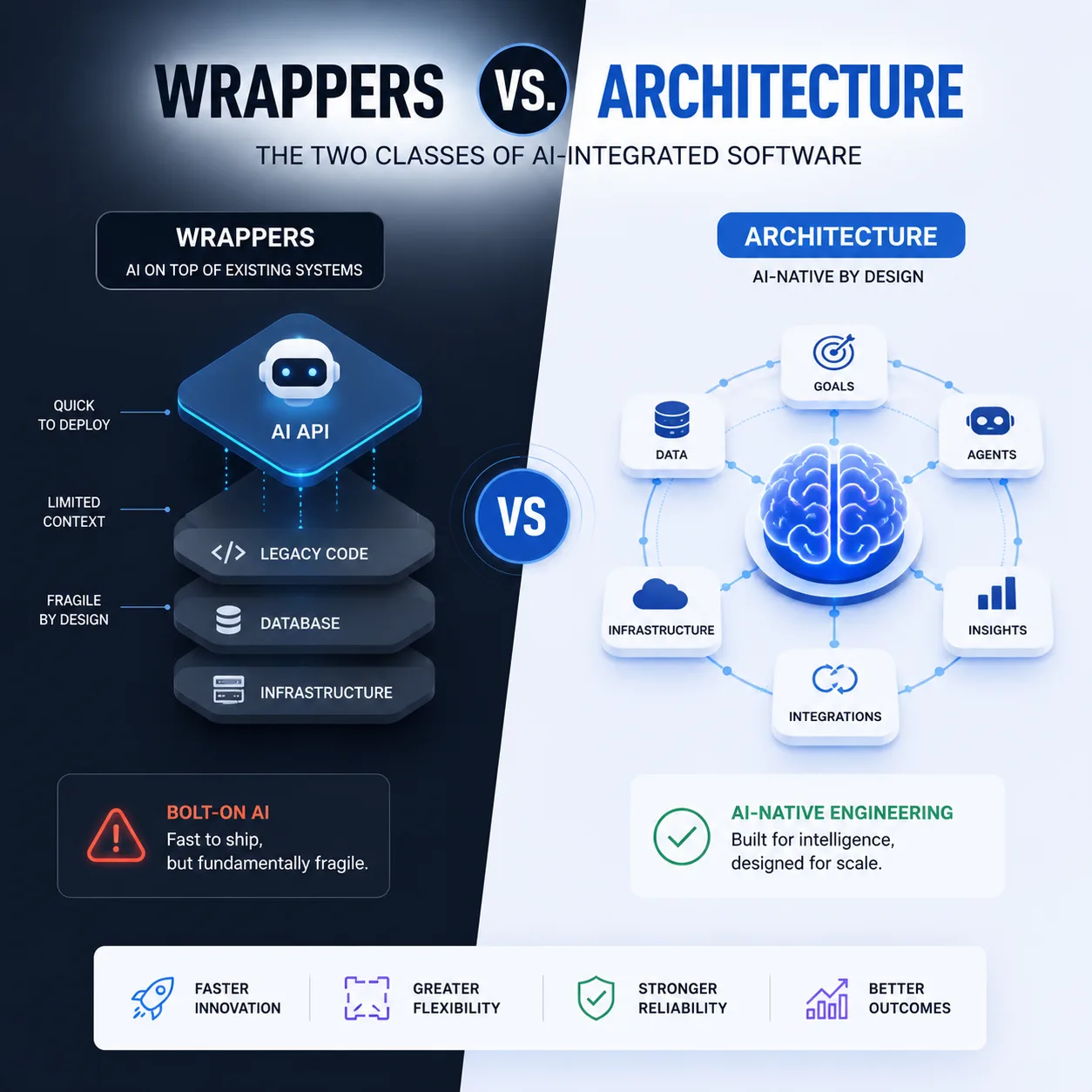
Wrappers vs. Architecture: The Two Classes of AI-Integrated Software
The generative AI boom has created two classes of software organisations.
The First - Majority; integrates AI through simple API calls layered onto existing codebases. This is bolt-on AI: fast to ship, but fundamentally fragile.
The Second- Far rarer; architects the entire engineering process around AI agents from day 1. This is AI-native engineering.The distinction matters enormously in production. Bolt-on integrations accumulate AI technical debt - fragile prompt chains with no version control, unauditable inference pipelines, and zero alignment between the AI layer and the underlying data schema. AI-native architecture eliminates this debt before it accrues.
Comparison: Bolt-On AI vs. PAINE AI-Native Architecture

Introducing the PAINE Framework
PAINE - Prologic AI Native Engineering - is a structured agentic delivery methodology. It is not a tool, a product, or a single model. It is a complete engineering operating system built around a coordinated ecosystem of specialized AI agents.
Each agent in the PAINE pipeline is scoped to a discrete phase of the software delivery lifecycle: requirement synthesis, structural engineering, visual architecture, code production, quality assurance, and human governance. This scoping prevents the model collapse and context-drift failures that plague monolithic AI approaches.
PAINE's core insight: Generalist AI models fail at precision engineering tasks not because of capability limits, but because of context overload. Specialized, scoped agents - each with a bounded domain - produce architecturally consistent, industry-standard outputs that a single model cannot.
The Six-Stage PAINE Pipeline
The PAINE pipeline is a strictly sequenced, stage-gated delivery system. Each stage produces structured outputs that become the verified inputs for the next - creating a coherent, traceable chain from client requirement to deployed software.
Engineered Flow
One connected delivery chain, from brief to governed release.
Instead of isolated teams handing work across silos, PAINE turns each delivery phase into a verified step in a single architecture-aware system. Every output is shaped for the next stage, which reduces drift, rework, and late-stage integration failures.
6 Stages
From requirement synthesis to final governance review.
2 Review Gates
Human validation at structural design and final delivery.
1 Traceable System
Architecture, design, code, QA, and compliance stay aligned.
Requirement Synthesis
Agentic AI interprets client requirements - written briefs, user interviews, and existing system documentation - into structured technical blueprints. Ambiguities are surfaced and resolved before any structural decisions are made, eliminating rework downstream.
Output: a clarified technical blueprint aligned to business intent.
Requirement Analysis
Research
Scoping
Blueprint Generation
Structural Engineering
AI agents generate Data Flow Diagrams (DFD), database schema, and system architecture in concert. All outputs pass through a mandatory Human-in-Loop review gate before progression - ensuring structural decisions are contextually sound and compliance-ready.
Output: DFDs, schema, and architecture approved through the first review gate.
System Architecture
DFD Generation
DB Schema
Human Review Gate
Visual Architecture
UI/UX screens are generated in alignment with the user journey defined in Stage 01 and the data schema defined in Stage 02. This creates a coherent visual layer that is architecturally honest - no design decisions that contradict the underlying data model.
Output: interface flows and screens mapped directly to system structure.
UI/UX Generation
User Journey Mapping
Prototyping
Agentic Code Production
Specialised coding agents generate industry-standard software across React, Python, and Node.js stacks. Code is generated in alignment with the approved architecture, with a continuous human feedback loop enabling course correction without full regeneration cycles.
Output: implementation-ready code across approved stacks and integrations.
React
Python
Node.js
API Integration
Human Feedback Loop
Automated QA & Deployment
Agentic QA engines run functional, security, and performance test suites against the generated codebase. CI/CD pipeline integration ensures deployment gates are automated and auditable.
Output: tested builds with automated release controls and audit visibility.
Functional Testing
Security Testing
Performance Testing
CI/CD Pipeline
Human Governance Layer
Senior engineers conduct final system review, validate compliance outputs, and maintain full time-tracking and audit documentation. This layer is the mission-critical trust anchor making PAINE outputs suitable for regulated industries.
Output: a signed-off, auditable system ready for regulated production use.
Human Review
Governance
Compliance Audit
Time Tracking

The Human-in-Loop (HiL) Governance Layer
The PAINE framework's most strategically important feature is not its automation - it is its governance. AI-generated outputs, regardless of sophistication, carry inference risk: hallucinated architecture patterns, subtly incorrect DB relationships, or security-adjacent code that passes syntax checks but fails regulatory scrutiny.
PAINE's HiL governance model inserts senior engineering review at two mandatory checkpoints: after Structural Engineering (Stage 02) and at final delivery (Stage 06). These checkpoints are structured review sessions with documented sign-off, creating the audit trail that regulators and enterprise clients require.
This governance model also addresses the growing concern of Explainable AI (XAI) in enterprise procurement. Clients and regulators increasingly require that AI-generated software be auditable - that there is a human signature on every structural decision. PAINE provides this by design, not as an afterthought.
For regulated industries: HiL governance means every PAINE-built system ships with a documented decision trail - who reviewed what, when, and against which compliance standard. Non-negotiable for HIPAA-grade telehealth, ABDM-compliant health platforms, or financial-grade commerce systems.

Why AI-Native Architecture Wins on Cost and Velocity
The economics of PAINE are straightforward. Conventional software development accumulates cost at the architecture and QA stages - where senior engineering time is most expensive. By automating DFD generation, DB schema design, UI/UX prototyping, and QA test creation, PAINE compresses the most expensive development phases without reducing their quality.
The practical result: Prologic delivered a Facial Recognition attendance system in 3 weeks with a mobile app and web admin dashboard - a build that would require at least 5-7 months using conventional methods. Client-side cost savings average 60%, derived not from reduced scope but from reduced engineering hours on tasks that AI agents execute faster, more consistently, and with lower error rates than manual approaches.
Ready to build beyond the AI wrapper?
Talk to Prologic about AI-native product architecture, regulated software delivery, and agentic engineering pipelines designed for production.