











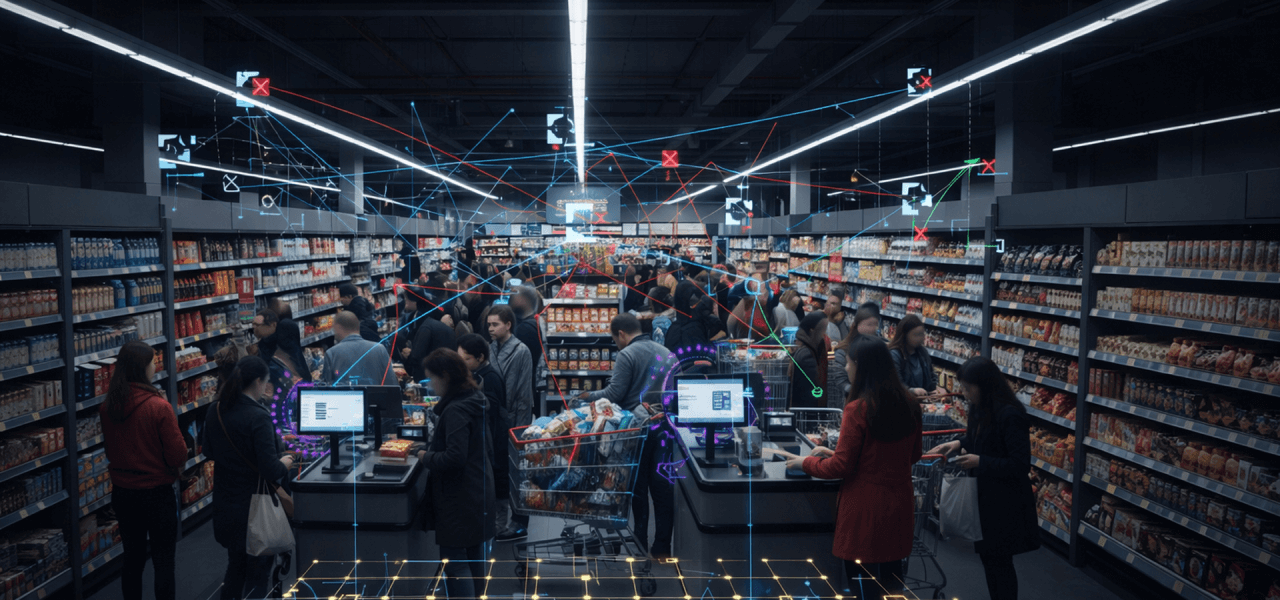
Why Computer Vision Alone Fails Autonomous Retail at Scale
Retail AI doesn’t fail because cameras are inaccurate.
It fails because stores are chaotic systems, not controlled labs.
Autonomous retail checkout systems built on computer vision alone collapse under:
- Occlusion
- Crowds
- Lighting variance
- Edge latency
- Theft scenarios
This article explains why sensor-fused autonomous retail AI is the only scalable approach.
Vision sees. Systems understand.
The Myth of Vision-Only Checkout

Pure computer vision assumes:
- Clear sightlines
- Stable environments
- Predictable shopper behavior
Retail reality offers none of these.
Successful autonomous retail AI systems treat vision as one signal, not the truth.
What Production-Grade Systems Do Instead
1. Sensor Fusion Is Mandatory
Reliable autonomous retail systems combine:
- Computer vision
- Shelf weight sensors
- Proximity tracking
- Temporal behavior analysis
Each signal compensates for the others’ blind spots.
2. Uncertainty Is Modeled, Not Ignored
Instead of forcing a decision:
- Systems slow down
- Trigger secondary checks
- Preserve billing integrity
This reduces false charges and customer disputes.
3. Theft Detection Is Behavioral, Not Visual
Shrinkage prevention relies on:
- Pattern deviations
- Dwell time analysis
- Multi-signal correlation
Vision alone cannot capture intent.
Deployment Insight
In a multi-store rollout:
- False positives dropped significantly
- Assisted interventions decreased
- Customer trust improved measurably
The key was engineering humility, not AI ambition.
What Retail Leaders Should Ask Vendors

- How does your system behave under uncertainty?
- What happens when sensors disagree?
- How do you recover from edge failures?
If answers are vague, walk away.
Retail / E-commerce
Evaluate Autonomous Retail AI Systems