











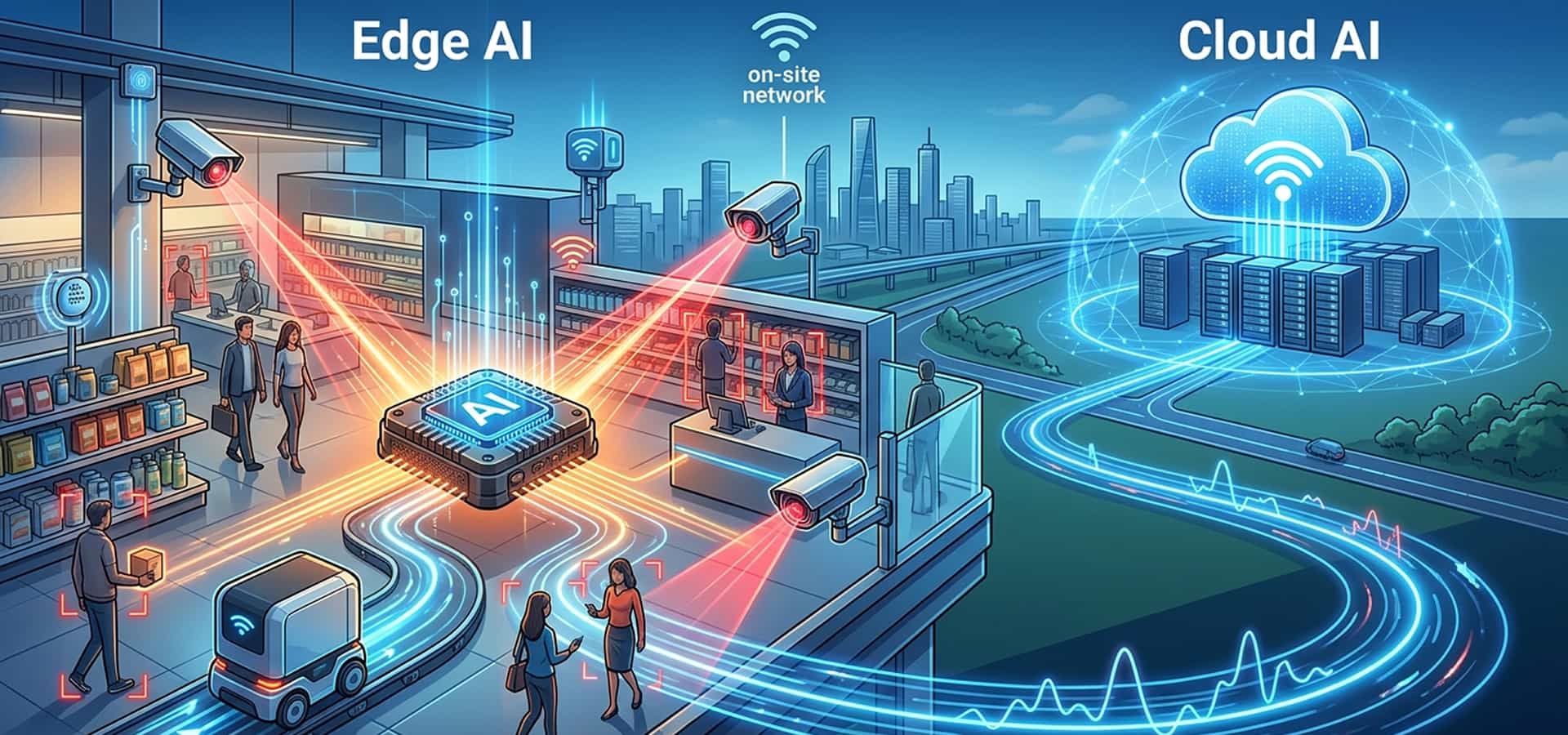
Why Edge AI Is Becoming Mandatory for Real-World Autonomous Systems
Cloud AI is powerful.
It is also too slow, too distant, and too fragile for many real-world systems.
Autonomous retail, physical security, and sensor-driven platforms operate where:
- Latency matters
- Connectivity fluctuates
- Decisions must be immediate
This is why edge AI is no longer optional.
Intelligence delayed is intelligence denied.
The Latency Fallacy
Many enterprise AI initiatives assume:
- Reliable connectivity
- Acceptable round-trip latency
- Centralized inference
In physical environments, none of these hold.
Where Cloud-Only AI Breaks Down
- Checkout latency frustrates customers
- Safety systems miss critical windows
- Sensor floods overwhelm backends
Edge AI solves this by bringing intelligence closer to action.
What Edge AI Enables That Cloud Cannot

1. Deterministic Response Times
Edge inference guarantees predictable latency-critical for physical systems.
2. Local Fault Tolerance
Systems continue operating even when connectivity degrades.
3. Privacy & Data Minimization
Sensitive data can be processed locally, reducing compliance exposure.
Engineering Edge AI the Right Way
Successful edge AI systems:
- Run lightweight models locally
- Sync summaries, not raw data
- Support remote governance and updates
This architecture balances autonomy with oversight.
Deployment Insight
In an autonomous physical system deployment:
- Latency-related failures dropped sharply
- System uptime improved
- Cloud costs stabilized
Because decisions happened where reality unfolds.
The Trap to Avoid
Edge AI is not:
- Just deploying models on devices
- Removing the cloud entirely
It is distributed intelligence with centralized governance.
Organizations evaluating edge-first architectures often begin with system feasibility reviews:
https://www.prologic-technologies.com/book-meeting-ecom/
What Enterprise Leaders Should Ask

- Which decisions must be local?
- Which can tolerate delay?
- How do we govern distributed intelligence?
Edge AI is not about speed alone.
It’s about control under uncertainty.