










- How does Prologic Technologies integrate AI software and ML into its solutions?Prologic Technologies offers AI software and Machine Learning innovation services, guiding clients from Proof of Concept (PoC) and Minimum Viable Product (MVP) development to full-scale AI application deployment. We leverage AI/ML to enhance operational intelligence, customer experience, and predictive capabilities across various industries, driving data-driven decision-making.
- What differentiates Prologic Technologies as a software development company?As a seasoned software development company with over 15 years of experience, Prologic Technologies distinguishes itself by delivering secure, fast, and buyer-centric commerce solutions. Our strategic approach has consistently led clients to achieve significant business impacts, such as up to 2.5X conversion increases and substantial reductions in cart abandonment.
- Can Prologic Technologies help scale D2C fashion brands with their platforms?Absolutely. We specialize in evolving apparel retail and wholesale businesses with custom technology. This includes Shopify-powered D2C stores with theme customization, app integrations, SEO, and white-labeled Android/iOS apps, all designed for enhanced customer engagement and accelerated growth.
- What are Prologic Technologies' capabilities in B2B wholesale solutions?For B2B wholesale, we develop robust portals and dashboards featuring multi-tiered pricing, purchase approvals, credit terms, inventory synchronization, and advanced order management. These solutions are specifically designed to streamline operations for resellers and distributors in the fashion industry and beyond.
- How does Prologic Technologies address logistics and taxation in its platforms?Our platforms offer critical integrations with major logistics providers such as ShipRocket, Delhivery, and FedEx APIs. Furthermore, we ensure compliance with GST/VAT and other state-specific tax regulations, providing comprehensive and seamless solutions for managing the complexities of the supply chain.
- Does Prologic Technologies offer team augmentation or dedicated development teams?Yes, businesses can 'Hire A Captive Team' through Prologic Technologies. This service allows organizations to strategically augment their existing capabilities with dedicated experts tailored to their specific project needs and long-term strategic objectives, ensuring continuity and specialized skill sets.
- What is Prologic Technologies' experience with product engineering?We offer comprehensive product engineering services, guiding clients from initial Proof of Concept (PoC) and Minimum Viable Product (MVP) development through to full-scale product deployment. Our structured approach ensures efficient market entry and robust product evolution for innovative solutions.
- Does Prologic Technologies offer HIPAA-compliant software development for healthcare?Yes, Prologic Technologies specializes in developing HIPAA-compliant health tech solutions. We ensure robust data security and regulatory adherence for applications, including potential patient care apps, crucial for healthcare providers and clinic owners seeking to modernize their digital infrastructure.
- What custom software development services does Prologic Technologies provide?Prologic Technologies offers comprehensive custom software development services, encompassing web and mobile application development, bespoke SaaS platforms, and low-code solutions. We craft custom solutions tailored to specific business needs, ensuring strategic alignment, operational efficiency, and a competitive edge for our clients.
- What kind of app development services are available for businesses?We provide extensive app development services, covering both custom web and mobile applications for various platforms (Android/iOS). Our expertise extends to D2C stores with mobile apps, B2B wholesale portals, and specialized solutions for industries like healthcare and e-commerce, designed to enhance user engagement and business reach.
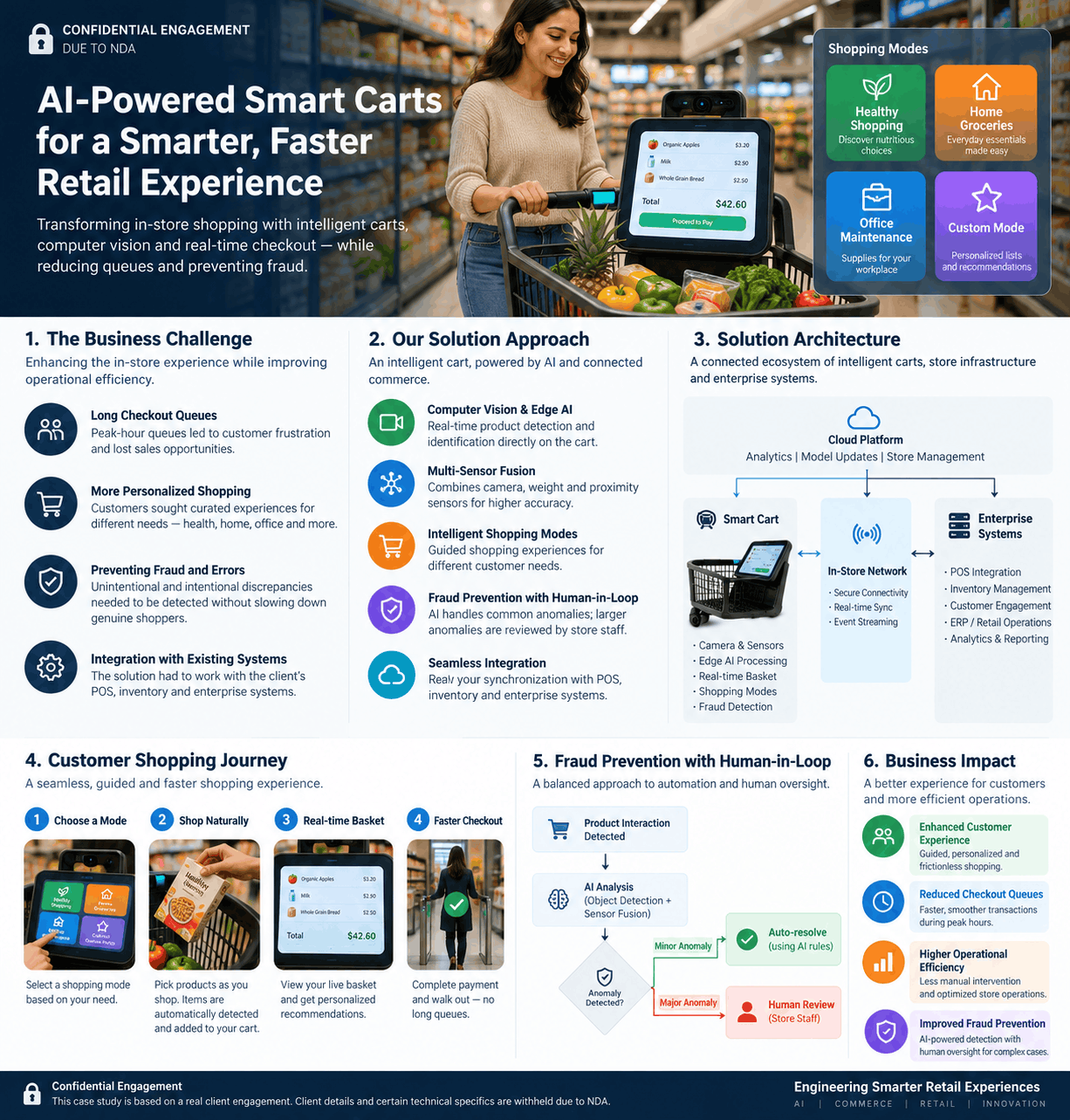
AI-Powered Smart Carts for a Smarter, Faster Retail Experience
A Confidential Retail Automation Engagement
Prologic Technologies | CommerceFabric™- ProRetail Grid | Intelligent Retail Engineering
* Confidential engagement. Client identity and certain implementation details are withheld due to a non-disclosure agreement (NDA). The solution is currently undergoing pilot testing in stores.
Project Overview
Retail is evolving beyond traditional checkout counters toward shopping experiences that are more personalized, intelligent, and frictionless. Customers increasingly expect convenience, relevant product discovery, and faster transactions, while retailers must balance operational efficiency, inventory accuracy, and fraud prevention.
In a confidential retail technology engagement, Prologic Technologies is engineering an AI-powered smart-cart solution designed to transform how customers shop inside physical stores.
The initiative brings together computer vision, Edge AI, intelligent shopping modes, sensor-assisted product recognition and real-time basket management. Its objective is to help customers shop more naturally, reduce dependence on conventional checkout queues and introduce intelligent safeguards against transaction discrepancies.
The experience is designed around an important principle: technology should make shopping easier for genuine customers while helping retailers maintain control over transactions and operational risks.
The Challenge
The engagement addresses four interconnected retail challenges.
01
Reducing checkout friction
Conventional checkout can create queues during peak periods, interrupt the shopping journey and increase dependence on manual scanning and billing. The goal is to move toward a more seamless experience in which products are recognized and added to a live shopping basket as customers shop.
02
Making shopping more personal
Different customers shop for different reasons. A family buying weekly groceries has different needs from an individual focused on healthy eating or an office manager replenishing workplace supplies. A single, generic shopping experience does not adequately address these differences.
03
Preventing fraud without inconveniencing customers
Automated retail must identify suspicious or inconsistent activity without treating every minor anomaly as a reason to interrupt the customer. The solution is being designed around risk-based detection, with AI handling routine discrepancies and store personnel reviewing more significant anomalies.
04
Connecting the shopping experience to retail operations
Smart carts must operate as part of a wider retail ecosystem. Product information, pricing, transaction records and inventory workflows need to integrate with relevant store systems, including POS and enterprise platforms.
The Solution: Intelligent Carts With Context-Aware Shopping Modes
The proposed solution combines an interactive smart cart with AI-enabled product recognition and a connected commerce architecture.
Rather than serving only as a digital basket, the cart is designed to become an intelligent shopping companion.
01
Healthy Shopping Mode
Supports customers who want to make more health-conscious shopping choices. The experience can be designed to surface relevant product information, nutritional attributes and recommendations based on the available product catalogue and the customer's selected preferences.
02
Home Groceries Mode
Supports routine household shopping through a more convenient and organized experience. Potential capabilities include reusable shopping lists, frequently purchased items, category-based discovery and live basket tracking.
03
Office Maintenance Mode
Supports workplace and facilities-related purchasing, such as cleaning supplies, stationery, pantry essentials and other recurring office requirements. This mode can be extended to support predefined lists, quantity requirements and business-oriented purchasing workflows.
04
Custom Shopping Mode
Allows customers to tailor the shopping journey to their own requirements, with personalized lists, product discovery and relevant recommendations.
These modes are intended to make the cart responsive to the customer's purpose, rather than forcing every customer through the same shopping workflow.
AI-Powered Product Recognition and Live Basket Management
The solution is being engineered to use computer vision and object detection to recognize products during the shopping journey. Complementary sensor inputs, where deployed, can provide additional evidence to help validate product interactions.
Recognized items can then be reflected in the customer's live basket, with applicable pricing and transaction information presented through the cart interface.
The intended experience allows customers to select products naturally while maintaining visibility into what has been added to their basket and the expected transaction total.
The underlying engineering challenge is to handle visually similar products, packaging variations, partially obscured items, and ambiguous interactions without allowing uncertainty to undermine the customer experience.
Risk-Based Fraud Prevention With Human Oversight
Fraud prevention is a central design consideration, but the approach is deliberately balanced.
The system is being designed to distinguish between routine, low-severity discrepancies and anomalies that warrant human review.
Minor anomalies: Object-detection AI and configured validation rules are intended to resolve routine discrepancies automatically where confidence and risk thresholds permit.
Major anomalies: Events that exceed defined risk thresholds, remain ambiguous, or require additional judgment can be escalated to store staff for review.
This approach seeks to reduce unnecessary interruptions while preserving human oversight for complex or higher-risk cases. The precise detection rules, escalation thresholds, and resolution workflows will depend on the final implementation and validation.
Connected Retail Architecture
The smart-cart experience is being designed as part of a broader retail technology ecosystem.
Key architectural components include:
Smart-cart interface
Shopping modes, basket visibility and transaction interaction.
Computer vision and Edge AI
Product recognition and responsive processing.
Sensor integration
Additional signals to support validation of product interactions.
Basket and transaction engine
Product additions, removals, pricing and transaction-state management.
Fraud and anomaly management
Risk classification, automated resolution and human escalation.
Enterprise integration
Connectivity with relevant POS, inventory and retail systems.
Centralized services
The architectural foundation for monitoring, analytics, configuration and future multi-store expansion.
The design objective is to create a modular retail platform that can evolve as product catalogues, store operations and business requirements change.
Intended Business Value
The engagement is designed to support several strategic outcomes:
These are intended outcomes of the engagement, not claims of completed deployment or independently measured performance.
Project Status and Confidentiality
This engagement is currently in progress. In accordance with the NDA, the client's identity and certain project-specific technical and commercial details are not disclosed.
The case study describes the solution's objectives, architectural approach, and intended value. Final capabilities, deployment scope, and measurable results will be confirmed as the engagement progresses.
The Prologic Perspective
At Prologic Technologies, we believe the next generation of retail will be shaped by the intelligent connection of customer experiences, physical-store operations and commerce infrastructure.
An AI-powered smart cart is not simply a device that recognizes products. It is a potential interface between the customer, the product catalogue, the transaction engine and the wider retail ecosystem.
Through our CommerceFabric™ vision, we are working toward retail architectures that connect intelligent in-store experiences with digital commerce, inventory operations and payment capabilities.
The objective is not merely to make checkout faster. It is to make the entire shopping journey smarter, more convenient and more responsive to customer needs.
Ready to Make Retail Smarter with AI?
Transform in-store shopping with AI-powered product recognition, intelligent shopping experiences, and connected retail systems. Prologic Technologies helps businesses engineer innovative commerce solutions that improve customer convenience, streamline operations, and support smarter retail experiences.