






- What is your approach to product engineering for new ventures or existing product enhancements?Our product engineering services cover the entire lifecycle, from initial Proof-of-Concept (PoC) and Minimum Viable Product (MVP) development to full-scale product evolution. We partner with clients to define product roadmaps, validate concepts, and build scalable, market-ready products that meet user needs and business objectives efficiently.
- How do you facilitate seamless enterprise integrations and legacy system modernization?We specialize in enterprise integrations, including API-led integration strategies to connect disparate systems and applications across your ecosystem. Additionally, we offer robust legacy system modernization services, transforming outdated infrastructures into agile, scalable, and secure platforms that enhance interoperability and operational efficiency without disrupting critical business functions.
- What are your capabilities in Web3.0 development and its applications across various sectors?We provide comprehensive Web3.0 development services, exploring its transformative potential across industries such as HealthTech, E-commerce, Law Firms, Retail, Media & Entertainment, Shipping, Climate Tech, and EdTech. Our expertise enables businesses to leverage decentralized technologies for enhanced security, transparency, and innovative user experiences.
- Do you offer ready-to-deploy solutions or options to augment our internal IT teams?Beyond custom development, we offer off-the-shelf platforms like HRMS and ProTasker for immediate deployment to streamline operations. Furthermore, clients can opt to hire a captive team from us, providing dedicated, skilled resources that seamlessly integrate with their existing operations to accelerate project delivery and scale capabilities efficiently.
- Can you elaborate on your expertise in building custom e-commerce solutions, particularly with Shopify?We excel in developing bespoke e-commerce solutions, including custom Shopify theme development and integration with mobile applications. Our focus is on creating premium, personalized shopping experiences with features like advanced product personalization tools, corporate gifting workflows, and streamlined logistics integrations to boost conversion and client satisfaction, as demonstrated by our El Obsequio case study.
- How can your custom software development services drive strategic growth for my enterprise?We specialize in delivering bespoke software solutions, including custom web and mobile applications, SaaS platforms, and comprehensive product engineering from Proof-of-Concept (PoC) to full-scale deployment. Our approach focuses on developing tailored systems that address unique business challenges, optimize operational efficiencies, and create distinct competitive advantages, ensuring alignment with your long-term strategic objectives.
- What expertise do you offer in developing HIPAA-compliant software for healthcare organizations?Our specialized services include the development of robust, HIPAA-compliant health tech solutions, such as patient care applications and secure data platforms. We ensure stringent adherence to regulatory standards, safeguarding patient data privacy and security while delivering scalable and user-friendly applications that enhance healthcare delivery and operational efficiency for hospital IT heads and clinic owners.
- What kind of app development services do you provide for businesses aiming for digital transformation?We offer comprehensive app development services encompassing custom web and mobile application development. Our expertise covers creating intuitive user interfaces, robust backend systems, and scalable architectures designed to support your digital transformation initiatives, improve user engagement, and streamline critical business processes across various platforms.
- How can your AI software development capabilities create innovative solutions for my business?Our AI/ML innovation services span from Proof-of-Concept (PoC) and Minimum Viable Product (MVP) development to full-scale AI application deployment. We leverage advanced machine learning models and artificial intelligence to build intelligent software solutions that automate complex tasks, provide predictive insights, and drive data-driven decision-making, offering a significant competitive edge for executives and founders.
- As a software development company, what range of industries do you serve with your technology solutions?As a full-spectrum software development company, we cater to diverse industries including Healthcare, E-commerce, Climate Tech, Law Offices, Shipping & Logistics, Apparel (Retail & Wholesale), Media & Entertainment, and EdTech. Our deep industry knowledge allows us to develop targeted, high-impact technology solutions that address specific sector challenges and opportunities for IT directors and CXOs.

ABDM-Aligned Digital Ayurveda & Teleconsultation Platform
Engineering Interoperable Digital Healthcare for Ayurveda, Practitioner-Led Care, and Personalized Wellness
Prologic Technologies | HealthFabric™ - Pro ABDM | ABDM-Aligned Digital Health Engineering
Connecting Ayurveda-led care with India's evolving digital health ecosystem.
India's digital healthcare transformation is moving beyond online appointments and video consultations. The larger opportunity lies in building connected health experiences where patients, healthcare professionals, digital health applications, and health information systems can work together through interoperable digital infrastructure.
The Ayushman Bharat Digital Mission (ABDM) provides a national framework for advancing this vision through digital health identities, registries, standardized health information exchange, and interoperable healthcare systems.
Within this evolving landscape, Ayurveda presents a distinctive opportunity. Traditional systems of medicine often emphasize individual constitution, lifestyle, diet, and ongoing practitioner-led guidance. Bringing these experiences into the digital health ecosystem requires more than a conventional telemedicine interface: it calls for purpose-built workflows, structured health information, and an architecture designed with interoperability in mind.
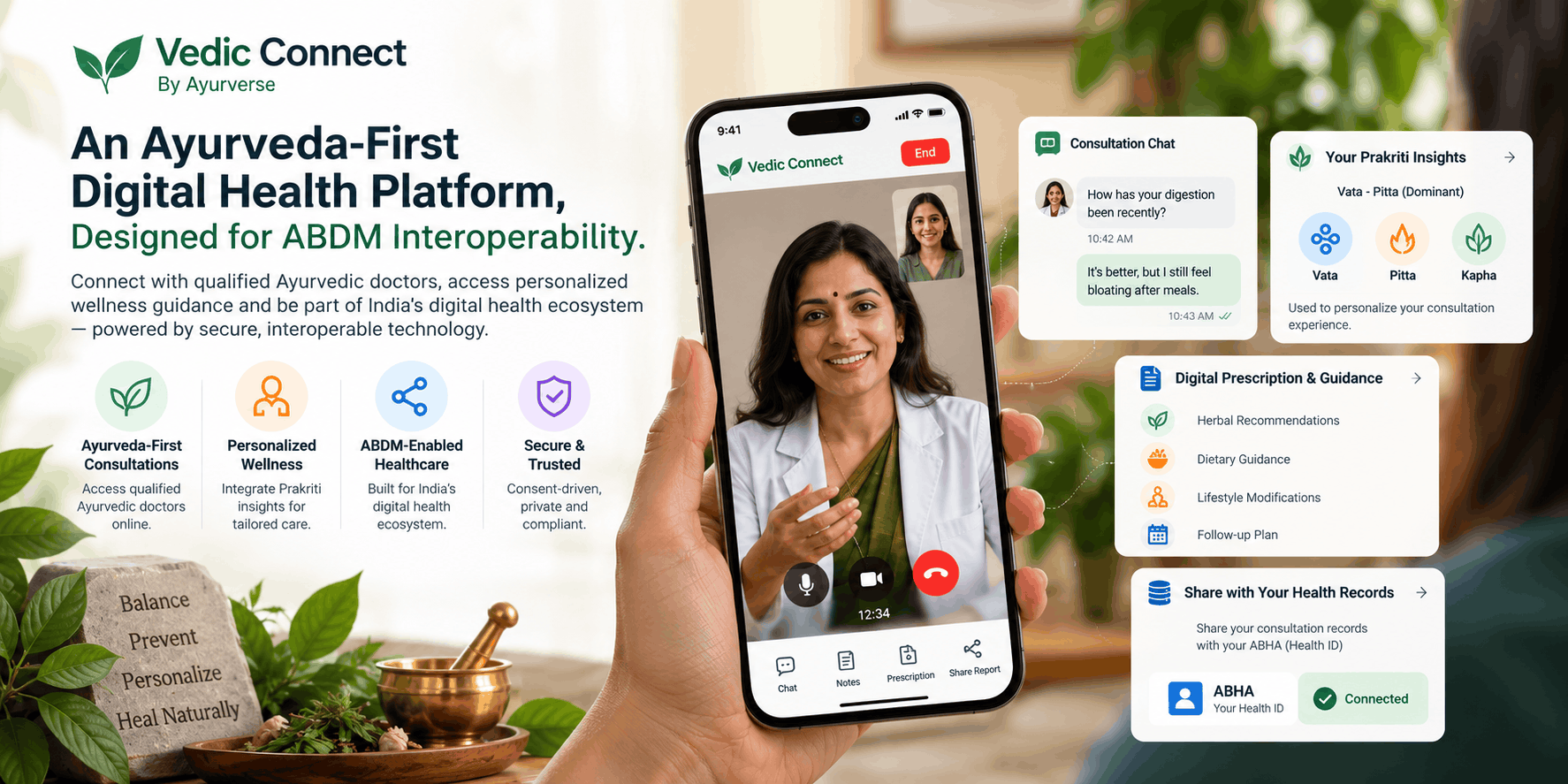
Vedic Connect, part of the Ayurverse ecosystem, addresses this opportunity through an Ayurveda-first digital consultation platform developed with Prologic Technologies' digital health engineering capabilities.
The platform connects users with Ayurvedic doctors and other wellness practitioners through digital consultation workflows. It complements the broader Ayurverse experience, including Prakriti Analysis, and creates a technology foundation for bringing traditional-system consultations into a more connected digital environment.
Prologic's engineering approach centres on building an ABDM-aligned digital health platform designed to support interoperability, while accommodating the specific needs of Ayurveda-led care, practitioner workflows, patient engagement, and digital consultation.
The objective is to bridge two important priorities: preserving the individuality of traditional wellness consultations and enabling their evolution within India's emerging interoperable digital health infrastructure.
The Challenge: Bringing Ayurveda Into an Interoperable Digital Health Ecosystem
A digital healthcare platform can facilitate a video consultation and still remain disconnected from the broader health information ecosystem.
For Ayurveda-focused platforms, the challenge is even more nuanced: the solution must support traditional-system workflows while preparing for the standards, registries, identity mechanisms, and consent-driven information exchange associated with India's digital health architecture.
01
Digital consultations without ecosystem-level interoperability
Online consultations improve access, but a consultation application operating in isolation can limit the portability and connected use of health information across compatible healthcare systems.
The engineering challenge is to move beyond a standalone digital service towards an architecture designed to participate in a wider interoperable ecosystem.
02
Patient identity and practitioner discoverability
Digital health requires reliable ways to identify participants, discover registered professionals where applicable, and connect relevant services.
ABDM introduces national digital health infrastructure, including ABHA and the Healthcare Professionals Registry (HPR). A platform must implement the applicable integration pathways correctly rather than assume that ordinary application registration automatically provides these capabilities.
03
Ayurveda-specific information and workflows
Ayurveda consultations may involve constitution-related information, lifestyle context, diet, symptoms, practitioner observations, and wellness guidance.
These information flows must be represented in a structured and usable manner wherever appropriate, while maintaining the distinction between traditional-system assessments, patient-reported information, and formal clinical records.
04
Consent-driven health information exchange
Interoperability is not simply the ability to move data between applications. Health information must be shared through appropriate consent, authorization, security, and purpose-specific workflows.
A digital health platform must account for these requirements when designing its data architecture and any connections to external health systems.
05
Compliance-aware engineering without compromising usability
ABDM-related integration introduces technical and operational considerations that must be addressed alongside appointment management, practitioner experiences, patient-facing workflows, and secure consultation services.
The challenge was to engineer a platform that could support its immediate Ayurveda-focused purpose while following an architecture and implementation approach aligned with the direction of India's digital health infrastructure.
The Solution: An Ayurveda-First Platform Designed for ABDM Interoperability
Prologic Technologies approached Vedic Connect as a digital health platform whose architecture must accommodate both practitioner-led Ayurveda workflows and the wider interoperability requirements of the Indian healthcare ecosystem.
01
Ayurveda-Centred Patient and Practitioner Workflows
Vedic Connect provides the digital foundation for users to discover relevant practitioners and access online consultations.
The platform's Ayurveda-first positioning influences the overall experience: practitioner expertise, traditional-system consultations, personalized wellness discussions, and continuity of engagement are central to the journey.
From an engineering perspective, this means building patient and practitioner workflows that can operate as a cohesive application while allowing for future expansion of digital health capabilities.
02
ABDM-Aligned Architecture and Interoperability Readiness
A core consideration is designing the platform with India's national digital health ecosystem in view.
ABDM promotes a connected digital health environment through identity mechanisms, registries, standards, and consent-based exchange of health information. A platform designed for this ecosystem needs to consider how its application data, identity workflows, and integration services can work with applicable ABDM interfaces and specifications.

The relevant engineering considerations include:
Module 2.1
ABHA-Related Workflows
Support for applicable digital health identity and linking journeys, subject to implemented integration pathways and user consent.
Module 2.2
Healthcare Professional Discovery
Consideration of relevant registries and professional identifiers where supported and applicable.
Module 2.3
Structured Health Information
Data modelling that supports organized health information and mapping to applicable standards when exchanging information with compatible systems.
Module 2.4
Consent-Aware Exchange
Integration with ABDM Consent Managers for user-initiated, granular consent requests, automated revocations, and audit-compliant data transfers.
Module 2.5
Interoperability Services
Gateway abstraction providing dual capabilities as both Health Information Provider (HIP) to publish care bundles and Health Information User (HIU) to request patient history.
Module 2.6
Security and Traceability
End-to-end cryptographic integrity, immutable access logs, and complete audit trails ensuring non-repudiation across all transactions.
These are architectural and implementation considerations-not automatic consequences of being an online healthcare platform. Each capability depends on the relevant integration, validation, and operational configuration.
The strategic objective is clear: build for interoperability rather than treat it as an afterthought.
03
Structured Digital Health Information for Ayurveda-Led Care
Interoperability becomes meaningful when health information can be represented and exchanged consistently.
Vedic Connect's broader engineering direction considers how information generated during a consultation can be organized for practical use and, where supported, compatible digital health exchange.
Depending on the consultation and implemented workflows, relevant information may include patient-reported concerns, consultation notes, practitioner observations, and appropriate care documentation.
Where information is intended for standards-based exchange, it must be mapped to the applicable data structures and specifications rather than transmitted as unstructured text alone.
For Ayurveda-related information, this requires care in distinguishing traditional-system concepts from standardized clinical terminology. The objective is to preserve meaningful context without implying that every Ayurvedic assessment or recommendation has a direct equivalent in a conventional clinical data model.
This approach creates a foundation for more consistent documentation and future integration with compatible digital health systems.
04
Prakriti-Based Personalization Within a Connected Wellness Journey
Ayurverse's Prakriti Analysis experience complements Vedic Connect by allowing users to explore their Ayurvedic constitution.
Within a connected digital wellness journey, such information may provide additional context for a practitioner-led consultation when the user chooses to share it.
The intended journey connects four stages:
Stage 01
Assess
Explore Prakriti through the relevant Ayurverse assessment experience.
Stage 02
Connect
Find and consult a suitable practitioner through Vedic Connect.
Stage 03
Discuss
Consider relevant constitution and lifestyle information during professional consultation.
Stage 04
Continue
Support appropriate follow-up and wellness engagement.
This personalization layer complements the platform's interoperability direction. It does not replace ABDM identity, consent, or health information exchange requirements, and Prakriti results should not automatically be treated as a formal clinical diagnosis or standardized health record.
05
Secure Digital Consultations and Continuity of Care
Digital consultation remains a foundational capability of Vedic Connect.
The platform supports a digital journey around practitioner discovery, appointment-related workflows, and online interaction. The wider engineering objective is to connect these activities with appropriate documentation and follow-up processes.
Where health information is shared with external systems, the workflow must account for applicable authorization, consent, data protection, and interoperability requirements.
This distinction is important: secure digital consultations, internal application records, and ABDM-mediated health information exchange are related but separate capabilities. Each must be implemented and verified according to its own requirements.
The Engineering Architecture: From Ayurveda Consultation to Interoperable Digital Health
Prologic's engineering approach brings together the application experience, digital health workflows, and an integration-oriented architecture.
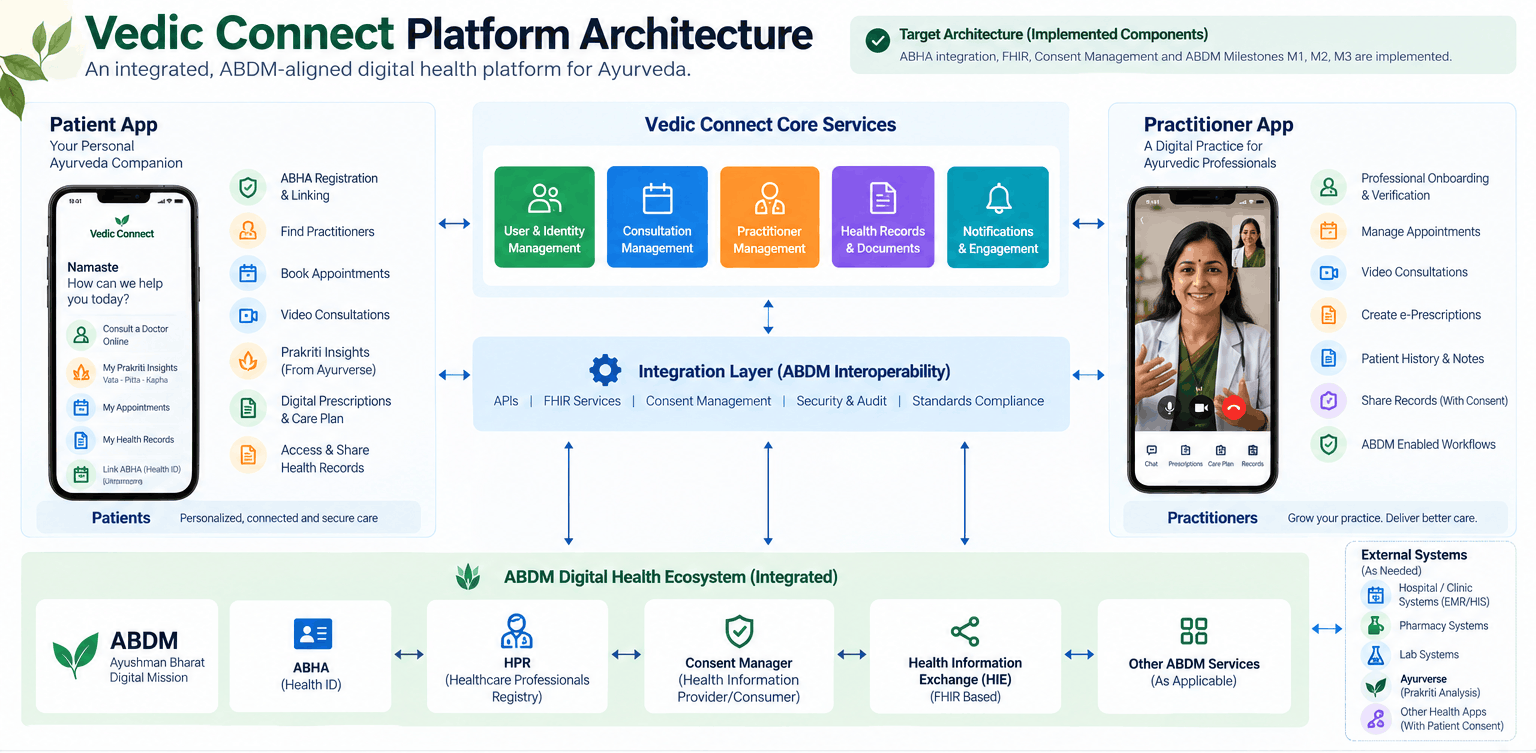
Layer 1
Patient Experience Layer
Provides the user-facing journey for practitioner discovery, consultation access, and relevant wellness interactions.
Layer 2
Practitioner experience layer
Supports practitioner profiles, consultation workflows, and appropriate digital documentation.
Layer 3
Consultation and workflow services
Coordinate appointment-related activities, digital interactions, and the information generated through the platform's workflows.
Layer 4
Health information and data model
Organizes relevant information for application use and supports mapping to applicable health information standards where exchange is implemented.
Layer 5
ABDM integration layer
Provides the architectural boundary for connecting supported identity, registry, consent, and health information exchange services as required by the implemented use cases.
Layer 6
Security, consent, and audit layer
Supports identity and access controls, appropriate handling of sensitive information, authorization, and traceability across relevant workflows.
This layered approach helps separate core application functionality from external interoperability dependencies. It also provides a more maintainable foundation for evolving the platform as its supported use cases and integration requirements expand.
The exact ABDM capabilities available in a deployed environment depend on the integrations implemented, the applicable ABDM specifications, required approvals or verifications, and the status of the relevant services.
The Role of ABDM in Vedic Connect's Strategic Positioning
ABDM is not merely a compliance label to attach to a healthcare product. Its broader significance is the move towards a digital health environment in which identity, discoverability, and authorized information exchange can operate across compatible systems.
For an Ayurveda-focused platform, this creates an opportunity to build services that are not confined to isolated appointment and consultation workflows.
An ABDM-aligned engineering approach can help establish a foundation for:
More connected patient journeys
where supported identity and information-sharing workflows can complement the consultation experience.
Improved ecosystem compatibility
through the use of applicable standards and supported interfaces rather than relying exclusively on proprietary data structures.
Better-structured health information
through deliberate data modelling and appropriate mappings for supported exchange scenarios.
A foundation for future integration
allowing the platform to evolve as new interoperability requirements and compatible services become relevant.
Responsible health information sharing
by treating consent, access control, and security as integral design considerations.
These opportunities depend on actual implementation and interoperability with the relevant services. ABDM alignment should therefore be demonstrated through the platform's verified capabilities, not inferred solely from its architecture or product category.
Intended Value for Patients, Practitioners, and the Digital Health Ecosystem
By harmonizing Ayurvedic traditions with national standards, Vedic Connect provides measurable utility across all key healthcare stakeholder groups:
For Patients
For Practitioners
For healthcare technology ecosystems
These points describe the intended platform value and architectural direction. They should not be interpreted as evidence that every ABDM capability is currently live or that specific clinical, operational, or commercial outcomes have been measured.
Why This Matters: Traditional Healthcare Needs Connected Digital Infrastructure
The future of digital healthcare will not be defined by consultation applications alone. It will also depend on whether systems can organize information responsibly, connect to compatible services, and support continuity across the patient's wider care journey.
Ayurveda brings its own concepts, consultation practices, and personalization requirements to this transformation. Successfully digitizing those experiences requires a platform that respects the underlying care model while adopting appropriate digital health engineering principles.
Vedic Connect represents this intersection: an Ayurveda-first consultation experience built with a broader digital health vision and an emphasis on ABDM-aligned architecture and interoperability readiness.
For Prologic Technologies, the engineering challenge is not simply to deliver digital consultations. It is to create a maintainable, secure, integration-oriented platform that can evolve with the needs of practitioners, patients, and India's digital health ecosystem.
The Prologic Perspective: HealthFabric and Interoperability focused Engineering
At Prologic Technologies, we believe that digital health platforms must be engineered for the ecosystem in which they are expected to operate.
This means considering identity, structured health information, consent, integration boundaries, and security alongside user experience and core application functionality.
Through HealthFabric™ and our digital health engineering capabilities, we focus on building connected healthcare applications, interoperability-oriented architecture, and workflow-driven systems designed for real operational environments.
Vedic Connect demonstrates the importance of combining domain-specific healthcare experiences with an architecture that considers the direction of India's digital health infrastructure.
The goal is to bring Ayurveda-led care into a more connected digital future—where personalization, professional judgment, and responsible interoperability work together.
Build Your ABDM-Aligned HealthTech Platform
Whether you are building specialized telemedicine services, EHR solutions, or enterprise digital health platforms, our HealthFabric™ engineering team is ready to architect your ABDM enabled ecosystem.