








ABDM M2 Milestone Implementation Guide- Appointment Booking, Facility Linking, and Prescription Upload
The Sequel to Our M1 Workflow The natural next step after ABHA creation is turning digital identity into an actual care journey. In the earl...
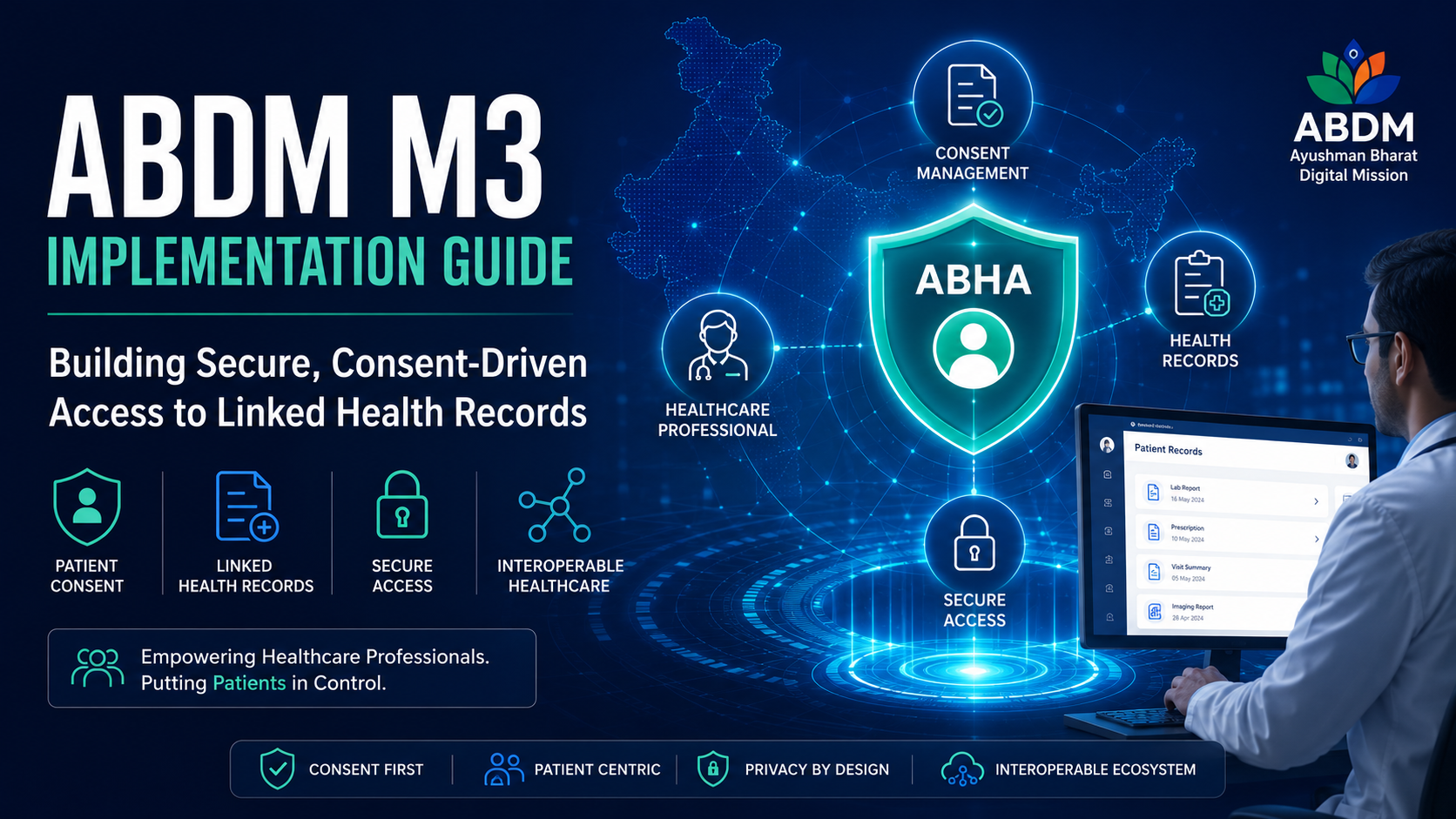
The first two milestones of the Ayushman Bharat Digital Mission (ABDM) established the essential building blocks of India’s Digital Health ecosystem.
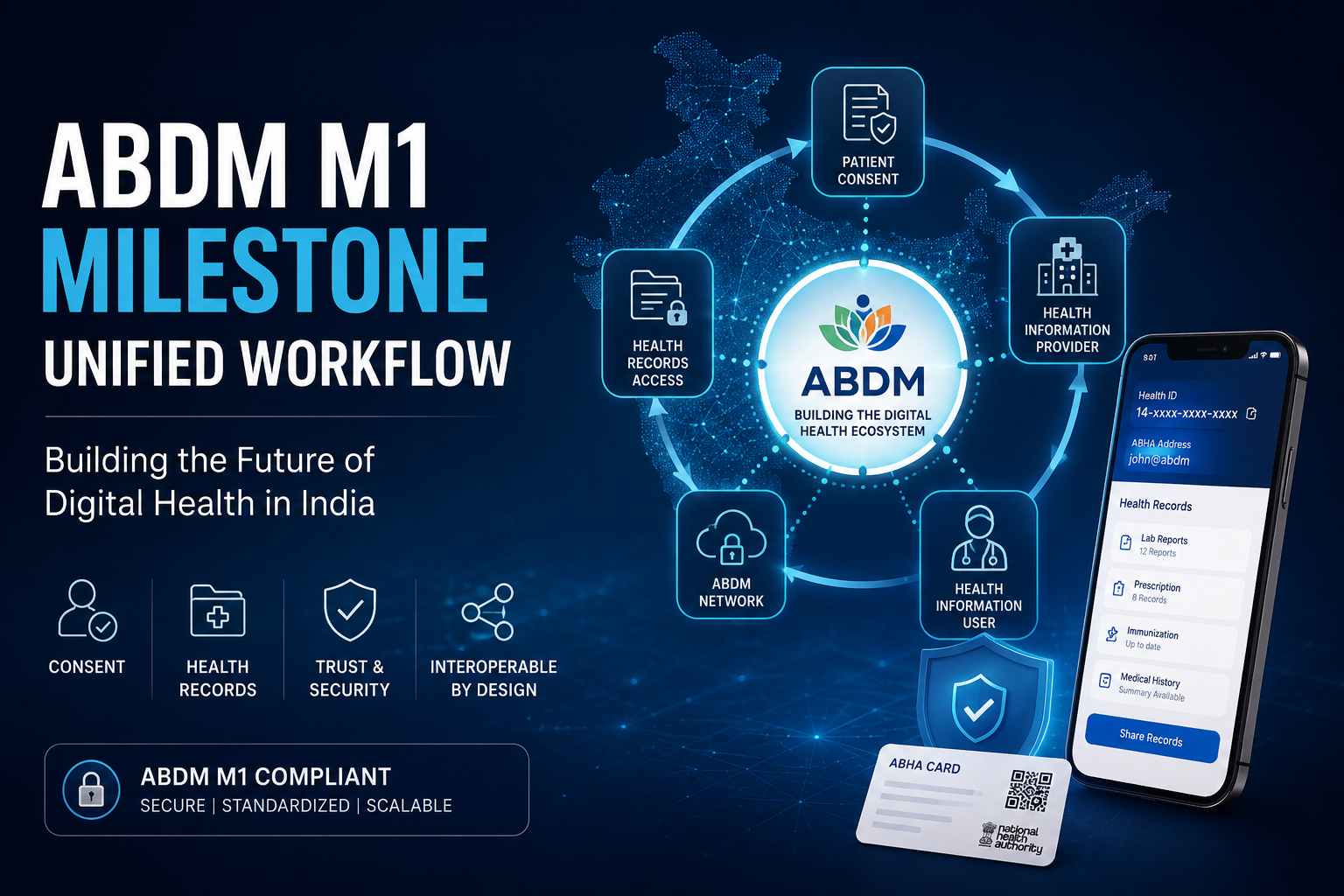
M1 introduced digital identity by enabling healthcare applications to create and verify ABHA numbers, onboard healthcare professionals and healthcare facilities, and establish trusted digital identities.
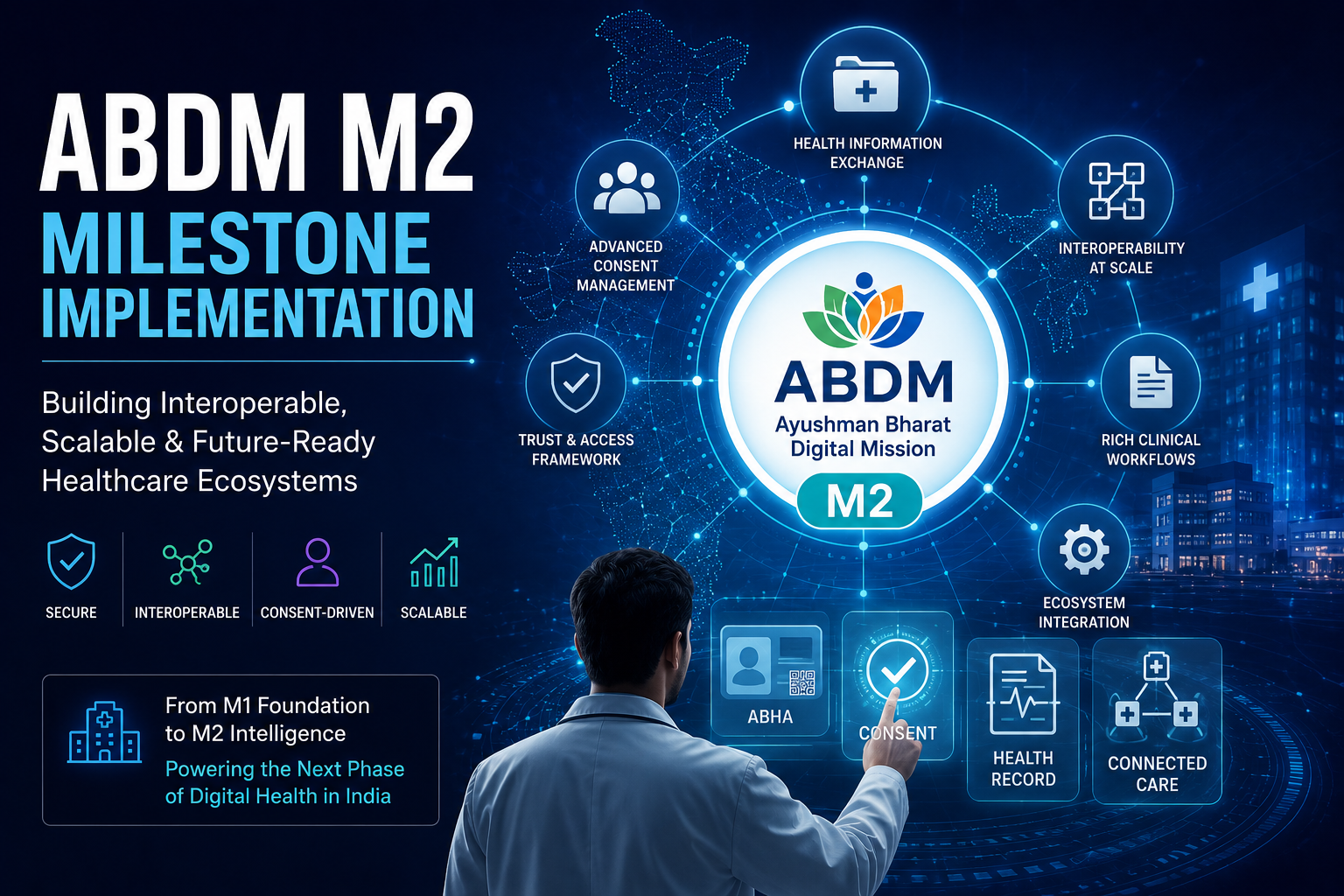
M2 strengthened this foundation by introducing standardized workflows for patient discovery, consent initiation, and secure health information exchange.
Now comes arguably one of the most meaningful milestones in the ABDM journey.
ABDM M3 transforms interoperability from a promise into a practical clinical capability.
For the first time, healthcare professionals can securely retrieve a patient’s linked health records from multiple Health Information Providers (HIPs), provided the patient grants explicit consent.
This seemingly simple capability fundamentally changes how care can be delivered across hospitals, clinics, diagnostic centers, telemedicine platforms, and digital health applications.
Healthcare doesn’t become connected simply because systems can communicate. It becomes connected when the right healthcare professional can securely access the right patient information at the right time—with the patient’s informed consent.
That is precisely what M3 enables.
Imagine a patient who has:
Until now, these records largely remained isolated inside individual healthcare systems.
Healthcare providers frequently relied on patients to:
The consequences include:
ABDM M3 addresses this fragmentation by enabling authorized healthcare applications to retrieve linked health records securely through a consent-driven workflow.
Instead of asking,
“Where are your reports?”
the conversation becomes,
“May I request your permission to securely access your health records?”
This is a significant shift in how digital healthcare is delivered.
Unlike M2—which primarily focuses on establishing consent requests and exchange workflows—M3 focuses on the actual retrieval and presentation of linked health records after consent has been granted.
The entire workflow revolves around one fundamental principle:
The patient always remains in control of who accesses their health information.
No records are fetched until explicit consent has been approved.
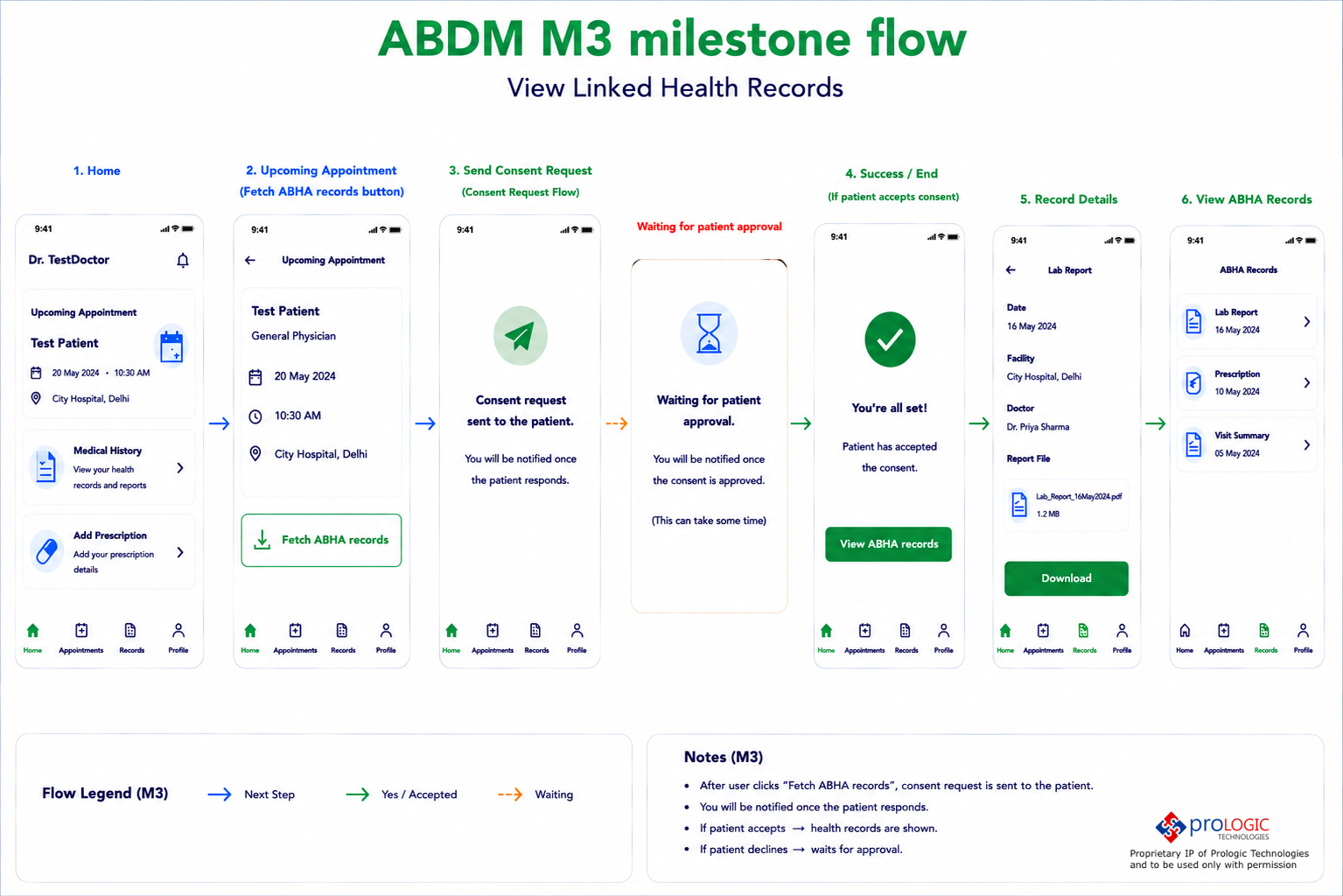
The workflow you’ve shared represents a typical implementation for a healthcare provider application.
Let’s walk through each stage.
The healthcare provider (HPR) logs into a HIPAA/ABDM-compliant healthcare application.
This could be:
The provider opens the patient’s appointment or consultation screen.
At this stage, the application already knows:
No health records have been accessed yet.
The provider clicks:
Fetch ABHA Records
This action does not retrieve any patient data.
Instead, it initiates a consent request through the ABDM ecosystem.
The application prepares:
These details are securely transmitted through the Consent Manager.
The patient receives a notification through their registered ABDM communication channel.
Depending on implementation, this may include:
The consent request clearly communicates:
This transparency is fundamental to ABDM’s patient-first philosophy.
Unlike traditional healthcare systems where records are often exchanged without patient visibility, ABDM ensures patients remain informed participants throughout the process.
This stage is often underestimated during implementation.
From an engineering perspective, the application must now handle an asynchronous workflow.
The patient may:
The healthcare application therefore cannot assume a synchronous API response.
Instead, it must:
Poor implementation of this stage often leads to confusing user experiences.
A thoughtfully designed workflow keeps clinicians informed without interrupting patient care.
Once the patient approves the request:
Only now can health information be requested.
This architecture ensures:
✔ Privacy by Design
✔ Patient Ownership
✔ Explicit Authorization
✔ Complete Auditability
After authorization, the application can retrieve records available from participating Health Information Providers.
Depending on availability, this may include:
A modern healthcare application should present these records in a clean, clinician-friendly interface rather than overwhelming users with raw documents.
Good user experience matters just as much as successful API integration.
Many organizations view ABDM implementation as a compliance exercise.
In reality, M3 introduces entirely new product capabilities.
Applications can now evolve beyond isolated record systems into connected healthcare platforms capable of supporting longitudinal patient care.
Some examples include:
The technical implementation is important.
But the real opportunity lies in redesigning healthcare workflows around patient-authorized continuity of care, rather than fragmented data silos.
Successfully implementing ABDM M3 Milestone is far more than consuming a few REST APIs.
By this stage, your healthcare platform is expected to participate in a national health information exchange ecosystem where multiple independent organizations—patients, healthcare providers, hospitals, diagnostic centres, Consent Managers, and Health Information Providers (HIPs)—interact securely while maintaining privacy, traceability, and interoperability.
Unlike a typical enterprise integration where two applications exchange data directly, M3 introduces multiple actors, asynchronous workflows, consent validation, token exchanges, document retrieval, and audit requirements that must all work seamlessly together.
For engineering teams, this means shifting from thinking about API integration to designing distributed healthcare workflows.
A robust ABDM M3 implementation generally consists of several independent services rather than a single monolithic application.
A typical architecture includes:
This is the interface used by:
The interface should focus on patient workflows—not ABDM terminology.
Clinicians should simply experience:
rather than understanding backend consent exchanges.
This service handles:
Rather than spreading this logic across multiple controllers, it is advisable to centralize consent orchestration into a dedicated service.
Doing so significantly simplifies future maintenance as ABDM specifications evolve.
Once consent has been granted, this layer becomes responsible for:
This layer should remain isolated from business logic wherever possible.
Once records are retrieved, the application must decide:
Should records be cached?
Or should every request fetch fresh information?
Both approaches have advantages.
Many production systems combine:
to balance performance and privacy.
One of the biggest architectural differences between M3 and conventional APIs is that patients control the pace of the workflow.
The clinician requests records.
The application waits.
The patient decides.
Only then can the workflow continue.
Many development teams initially assume this behaves like a synchronous API.
It doesn’t.
The application must gracefully handle situations where patients:
Your product UX should accommodate every one of these possibilities.
Many healthcare applications fail not because of technical limitations—but because they expose technical complexity to clinicians.
Doctors don’t want to understand:
They simply want to know:
“Can I access this patient’s previous records?”
Good product design abstracts the complexity.
Instead of technical messages, present meaningful workflow states such as:
🟢 Records Ready
🟡 Waiting for Patient Approval
🔴 Consent Declined
⚪ Request Expired
Small UX improvements dramatically reduce support requests.
Consent isn’t permanent.
Your implementation should continuously monitor:
Rather than assuming access remains available indefinitely.
Applications should clearly display:
This improves both transparency and compliance.
Healthcare documents are fundamentally different from traditional business files.
Some patient records may include:
Your document handling layer should support:
✔ Progressive downloads
✔ Streaming large files
✔ Secure temporary storage
✔ Encryption at rest
✔ Encryption in transit
✔ Automatic cleanup of temporary files
Every interaction with patient records should generate immutable audit events.
Examples include:
A production implementation should answer questions like:
Who accessed this record?
When?
From which healthcare facility?
For what purpose?
Using which consent?
Without reliable audit logs, troubleshooting becomes nearly impossible—and regulatory investigations become unnecessarily difficult.
M3 introduces additional network hops.
A single workflow may involve communication with:
Network latency is inevitable.
Applications should therefore avoid blocking clinician workflows.
Recommended practices include:
These techniques improve responsiveness without compromising reliability.
Not every failure is a technical failure.
For example:
Patient rejected consent.
This is not an application error.
Similarly:
Consent expired.
Again—not a technical issue.
Applications should distinguish between:
This distinction improves user confidence and significantly reduces unnecessary support tickets.
Having worked on healthcare interoperability projects, several implementation patterns appear repeatedly.
It’s a workflow project.
APIs are merely one component.
Many applications retrieve records successfully but fail when consent expires.
Consent lifecycle management should be automated.
Applications often freeze while waiting for patient approval.
Instead, clinicians should continue working while the request progresses asynchronously.
Logging only API responses isn’t enough.
Clinical workflows must be fully traceable from request initiation to document retrieval.
Simply downloading PDFs does not improve patient care.
Healthcare professionals benefit far more from intelligently organized, searchable, and context-aware clinical information.
Perhaps the most overlooked consideration is future readiness.
Healthcare platforms should not hard-code today’s workflows into permanent architecture.
Instead, design modular services that can accommodate:
Applications built this way evolve with the ecosystem instead of requiring expensive rewrites every time specifications change.
The organizations that benefit most from ABDM won’t necessarily be the first to integrate. They’ll be the ones that design their platforms to evolve as India’s digital health ecosystem evolves.
At this stage, your healthcare application can successfully request patient consent, retrieve linked health records, and display them to an authorized healthcare professional.
From an ABDM milestone perspective, you’ve achieved M3 functionality.
But from an enterprise healthcare software perspective, you’re only halfway there.
Production-grade healthcare platforms aren’t judged by whether they can call APIs. They’re judged by whether they can protect patient privacy, scale reliably, survive audits, and deliver a seamless experience to clinicians every single day.
This is where many healthcare products struggle—not because of poor engineering talent, but because they underestimate the operational realities of building software for healthcare.
Healthcare data is among the most sensitive categories of personal information. A single security lapse can affect patient trust, disrupt clinical operations, and expose organizations to significant legal and reputational risk.
A secure ABDM M3 Milestone Implementation should adopt a Security by Design approach rather than treating security as a deployment checklist.
This includes:
The objective isn’t simply to pass a compliance audit. It’s to make unauthorized access extremely difficult without affecting the clinician’s workflow.
One of the defining principles of ABDM is that patients own their health data.
Healthcare applications should reinforce this principle through thoughtful product design.
For example, clinicians should clearly see:
Patients, in turn, should feel confident that every access request is transparent and traceable.
When privacy becomes visible within the product—not hidden behind legal documents—it builds long-term trust.
Healthcare platforms often experience unpredictable spikes in activity.
Examples include:
Your ABDM M3 Milestone Implementation should therefore support horizontal scaling.
Some recommended architectural practices include:
These decisions become increasingly important as your platform grows beyond a single hospital or clinic.
A production healthcare platform should answer operational questions before users raise support tickets.
Examples include:
Modern observability combines:
Without visibility into production behaviour, diagnosing issues becomes reactive instead of proactive.
M3 is not the final destination.
India’s Digital Health ecosystem will continue evolving with:
Healthcare software companies should avoid tightly coupling ABDM logic throughout the application.
Instead, isolate national health integrations into dedicated services so future milestones can be adopted with minimal disruption.
Platforms designed with modularity today will adapt faster tomorrow.
One of the biggest misconceptions surrounding healthcare technology is that compliance alone creates a successful product.
It doesn’t.
A platform may be fully compliant yet remain frustrating to use.
The most successful healthcare applications combine:
ABDM provides the framework.
Exceptional product design creates the experience.
Before going live, ensure your healthcare platform can confidently answer Yes to the following questions:
Completing this checklist significantly improves the likelihood of a smooth production rollout.
The introduction of ABDM M3 marks another important step in India’s journey toward a truly interoperable digital healthcare ecosystem.
For software teams, the milestone represents much more than another API specification. It introduces a patient-first model where health records become securely accessible across organizations without compromising privacy or consent.
For healthcare providers, it reduces information silos and creates opportunities for more informed clinical decisions.
For patients, it offers greater control over personal health information while reducing the need to repeatedly carry reports across hospitals and clinics.
And for Digital Health companies, it presents an opportunity to build products that are not only ABDM-compliant but genuinely connected, scalable, and future-ready.
Organizations that approach M3 as an architectural evolution—rather than a compliance exercise—will be better positioned for the next phase of India’s digital health transformation.
If you’re planning to implement ABDM M3, or you’re designing a new EMR, HIS, Telemedicine, or Digital Health platform with interoperability at its core, investing in the right architecture from the beginning will save significant engineering effort as the ecosystem continues to mature.
Our engineering teams have been building interoperable healthcare platforms with a strong focus on FHIR standards, ABDM workflows, consent-driven architectures, scalable APIs, and patient-centric digital experiences. If you’re evaluating your ABDM roadmap or looking for a technology partner to accelerate implementation, we’d be happy to discuss your requirements.
👉 Request an ABDM Discovery call with our Expert:
https://www.prologic-technologies.com/book-meeting/
👉 Book a ProABDM Demo:
https://www.prologic-technologies.com/book-demo/
The ABDM M3 Milestone enables healthcare providers to securely access a patient’s linked health records after receiving explicit patient consent through the ABDM Consent Manager.
While M2 focuses on initiating consent requests and enabling secure health information exchange, M3 extends the workflow by allowing authorized retrieval and viewing of linked health records after consent approval.
M3 is relevant for:
Yes. ABDM follows a consent-first architecture. No linked health records can be retrieved without explicit patient authorization.
Yes. Existing healthcare platforms can adopt M3 by implementing the required consent workflows, interoperability standards, secure APIs, and user experience enhancements without rebuilding their entire application.
The Sequel to Our M1 Workflow The natural next step after ABHA creation is turning digital identity into an actual care journey. In the earl...
India’s Ayushman Bharat Digital Mission (ABDM) and the ABHA (formerly Ayushman Bharat Health Account) are reshaping digital healthcare in th...
