






- What is a human-AI engineering team?A human-AI engineering team is a software delivery team in which human engineers and AI systems contribute to connected engineering activities. Humans provide product understanding, judgment and accountability, while AI agents assist with tasks such as analysis, implementation, testing and documentation.
- How is this different from using an AI coding assistant?An AI coding assistant typically supports an individual developer during a task. A human-AI engineering team coordinates AI contributions across a wider workflow, with shared context, defined responsibilities and mechanisms for validating the combined result.
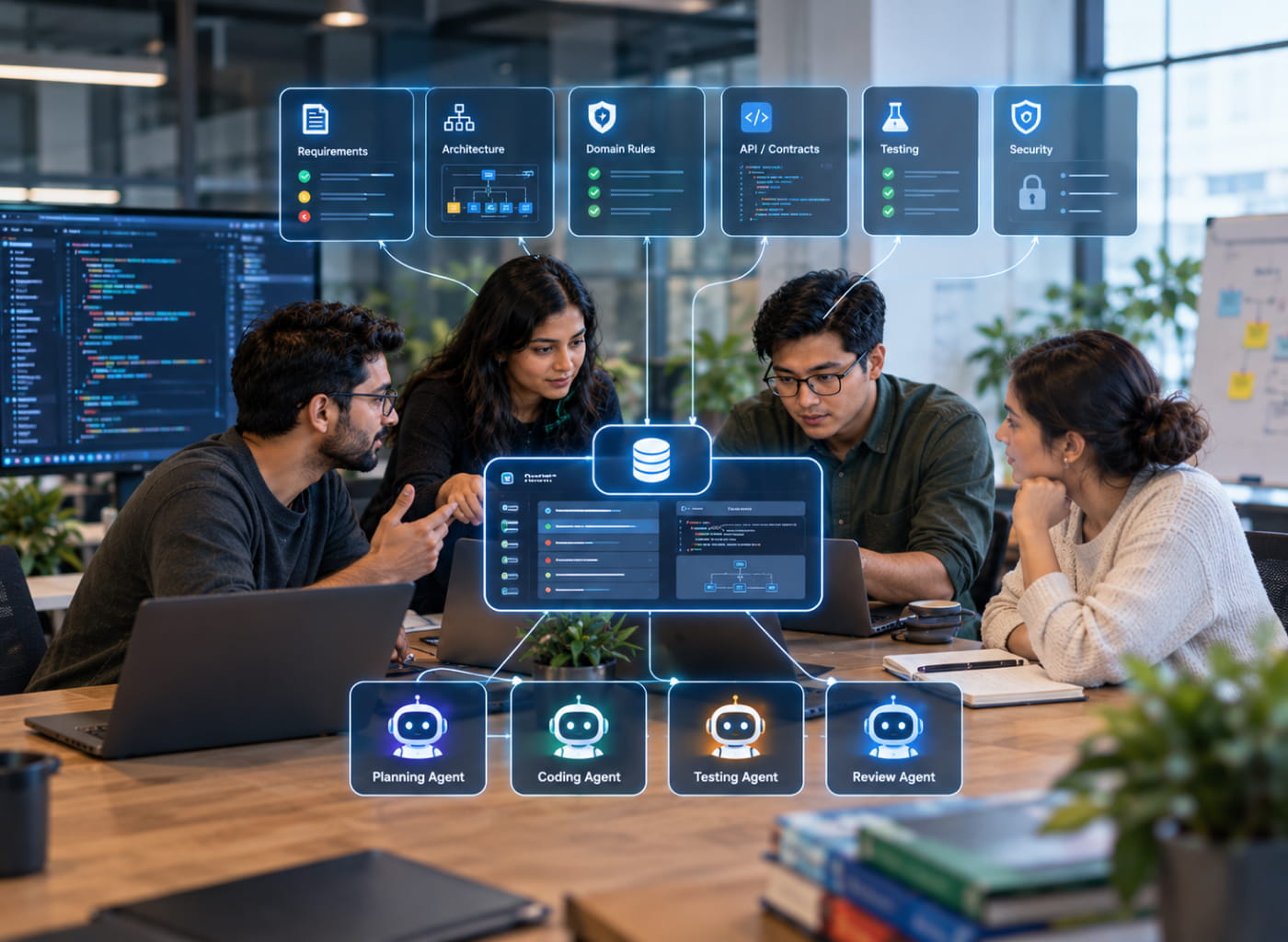
- Why is shared context important?Shared context helps people and agents work from consistent requirements, architectural decisions and business rules. Without it, separate contributions may be individually plausible but incompatible when integrated into the product.
- Can AI agents work independently?AI agents can perform some well-defined tasks with substantial autonomy, particularly when the risks are low and the results can be validated reliably. Higher-risk changes require stronger controls and appropriate human review.
- How should engineering teams measure success?Teams should evaluate reliable delivery outcomes, including cycle time, rework, defect rates, review effort and deployment confidence. Code volume and AI usage alone do not establish that the engineering process has improved.
- What does PAINE contribute to this approach?PAINE, Prologic AI Native Engineering, represents Prologic's approach to integrating AI across the engineering lifecycle through structured context, workflows, validation and governance, rather than limiting AI to code generation.
Reading Time: 13 min
Software Is Becoming a Team Sport Between Humans and AI
Why the next generation of engineering teams will depend less on individual coding speed and more on coordinated intelligence, shared context, and reliable execution.
For a long time, the most recognizable unit of software development was the individual developer. A developer received a requirement, understood the problem, designed an implementation, wrote the code, tested the result, and submitted it for review. Other engineers contributed through architecture discussions, code reviews, testing, and collaboration, but the developer remained the primary unit of execution. Engineering organizations were built around hiring talented people, dividing work among them and creating processes that allowed their contributions to come together.
AI is beginning to change this arrangement. A developer can now delegate code exploration, implementation, test generation, debugging, and documentation to AI systems, sometimes working with several agents on different parts of a problem. The developer’s work increasingly involves deciding what should be done, supplying the right context, evaluating intermediate results, and ensuring that the final implementation meets the requirements of the product.
This change is often described as an improvement in individual productivity. That description is accurate, but incomplete. The larger opportunity emerges when AI is no longer treated as a private assistant used by each developer and becomes a coordinated participant in the engineering process. At that point, software development starts to resemble a team sport in which humans and AI systems contribute different capabilities toward a shared outcome.
The difficult part is not getting several agents to produce code. It is making their work coherent, verifiable, and aligned with the same product, architecture, and business objectives.
1. Individual Productivity Is Only the Beginning
The first wave of AI-assisted development naturally focused on the individual developer. Code completion reduced typing, conversational interfaces made unfamiliar technologies easier to explore, and AI-generated examples helped engineers move through routine implementation tasks. These capabilities improved the experience of writing software, particularly when developers needed to work through repetitive code or understand an unfamiliar library.
However, software delivery is not a collection of independent coding tasks. A change to a payment workflow can affect the data model, API contracts, user interface, transaction handling, security controls, automated tests, and operational monitoring. Even a seemingly small feature may depend on decisions made elsewhere in the system. An individual developer can use AI to accelerate each task, but the overall result still depends on how well those tasks fit together.
Consider a team developing a new payment capability for an ecommerce platform. One engineer is responsible for the checkout experience, another is modifying the payment service, and a third is updating transaction reconciliation. AI agents can help each engineer understand the relevant code, prepare implementation options, and generate tests. Yet if the three workstreams interpret payment status differently, the team may deliver code that is individually plausible but collectively inconsistent. The checkout might report a successful payment while reconciliation expects a different state transition, leaving the business with an operational defect that no single implementation task reveals.
The implication is that increasing the output of individual developers does not automatically increase the reliability or throughput of the entire engineering team. AI can accelerate local execution while leaving coordination problems untouched, or even making them more difficult by increasing the volume of changes that need to be reviewed.
The next stage of AI-assisted development therefore requires a shift in focus. Instead of asking how much more code an individual engineer can produce, engineering leaders need to examine how effectively the entire team moves from a validated requirement to a reliable product capability. Individual productivity remains important, but it becomes one component of a larger system.
2. A Human-AI Team Needs Shared Context
Effective teams work because their members understand the objective, recognize their responsibilities and share enough information to coordinate their decisions. Software teams build this understanding through requirements, architecture documents, technical discussions, issue trackers, code reviews, tests, and experience accumulated over time. Much of that knowledge can be imperfect or fragmented, but experienced engineers learn how to navigate it.
AI agents need a more deliberate approach to the same problem. Giving an agent access to a repository does not mean it understands the product. The code may reveal how a feature currently behaves, but it may not explain why a particular business rule exists, which compatibility constraint must be preserved, or which architectural decision the team has already made. If those details are missing, an agent can confidently produce a solution that satisfies the immediate instruction while violating the broader intent.
This is why context engineering becomes essential to human-AI collaboration. Requirements, domain rules, architectural constraints, interface contracts, testing expectations and security policies must be available in forms that can guide both human decisions and machine execution. The objective is not to document every detail of a software system. It is to make the information necessary for reliable decisions accessible at the point where those decisions are made.
Shared context also creates consistency between agents. If one agent investigates a feature, another implements it, and a third reviews the change, they should not work from conflicting assumptions. Their responsibilities may differ, but their understanding of the intended outcome must remain aligned. This requires structured task definitions, explicit acceptance criteria, and a common reference for architectural and product decisions.
For example, an engineering team might define a payment capability through a clear contract that specifies supported payment states, error handling, idempotency expectations, audit requirements, and the conditions under which a transaction can be considered complete. An implementation agent can use that contract to generate code, a testing agent can derive scenarios from it, and a review agent can evaluate whether the implementation respects it. The shared specification becomes a coordination mechanism rather than a document that is written once and gradually forgotten.
As engineering organizations adopt more agents, the quality of this shared context will increasingly determine how well the team performs. Better models may improve the capability of individual participants, but shared context helps ensure that their contributions serve the same system.
3. Coordination Becomes an Engineering Discipline
A human-AI engineering team cannot be managed simply by assigning the same task to multiple agents and combining their outputs. Work needs to be decomposed into responsibilities that can be performed independently where appropriate and coordinated where dependencies exist. The team also needs a clear way to determine when one activity is complete, when another can begin, and when a decision requires human involvement.
This is familiar territory for experienced engineering leaders. Teams already coordinate through interface contracts, branching strategies, continuous integration, code review, and release controls. AI does not remove the need for these mechanisms. Instead, it increases the importance of designing them deliberately because agents can produce changes faster and in greater volume than a conventional workflow may be equipped to absorb.
A practical human-AI workflow might begin with an agent analysing a requirement and identifying affected modules, dependencies, and unresolved assumptions. A developer or architect validates the analysis before implementation begins. Separate agents can then prepare changes for well-defined components, while another agent generates tests against the agreed acceptance criteria. Automated checks evaluate the combined result, and a human reviewer examines architectural choices, business implications, and areas where the evidence remains incomplete.
The exact sequence will vary by project, but the principle remains the same: each participant needs a defined responsibility, a known input, an expected output and a way to expose uncertainty. An agent should not silently make a consequential assumption simply because it can continue executing. When requirements conflict or the task exceeds its permissions, the workflow should allow it to stop and request clarification.
Parallel execution can improve throughput, but only when dependencies are understood. If several agents modify the same module without coordination, they may introduce conflicting changes or duplicate work. If implementation begins before the architecture is sufficiently clear, faster execution can simply produce rework sooner. The engineering leader must therefore decide where parallelism creates genuine value and where a deliberate sequence is necessary.
This is where software engineering becomes a coordination problem as much as an implementation problem. The strongest teams will not necessarily be those with the greatest number of agents. They will be those that distribute work intelligently, preserve a shared understanding of the system, and make it easy to detect when separate contributions are no longer aligned.
4. Trust Must Be Designed Into the Team
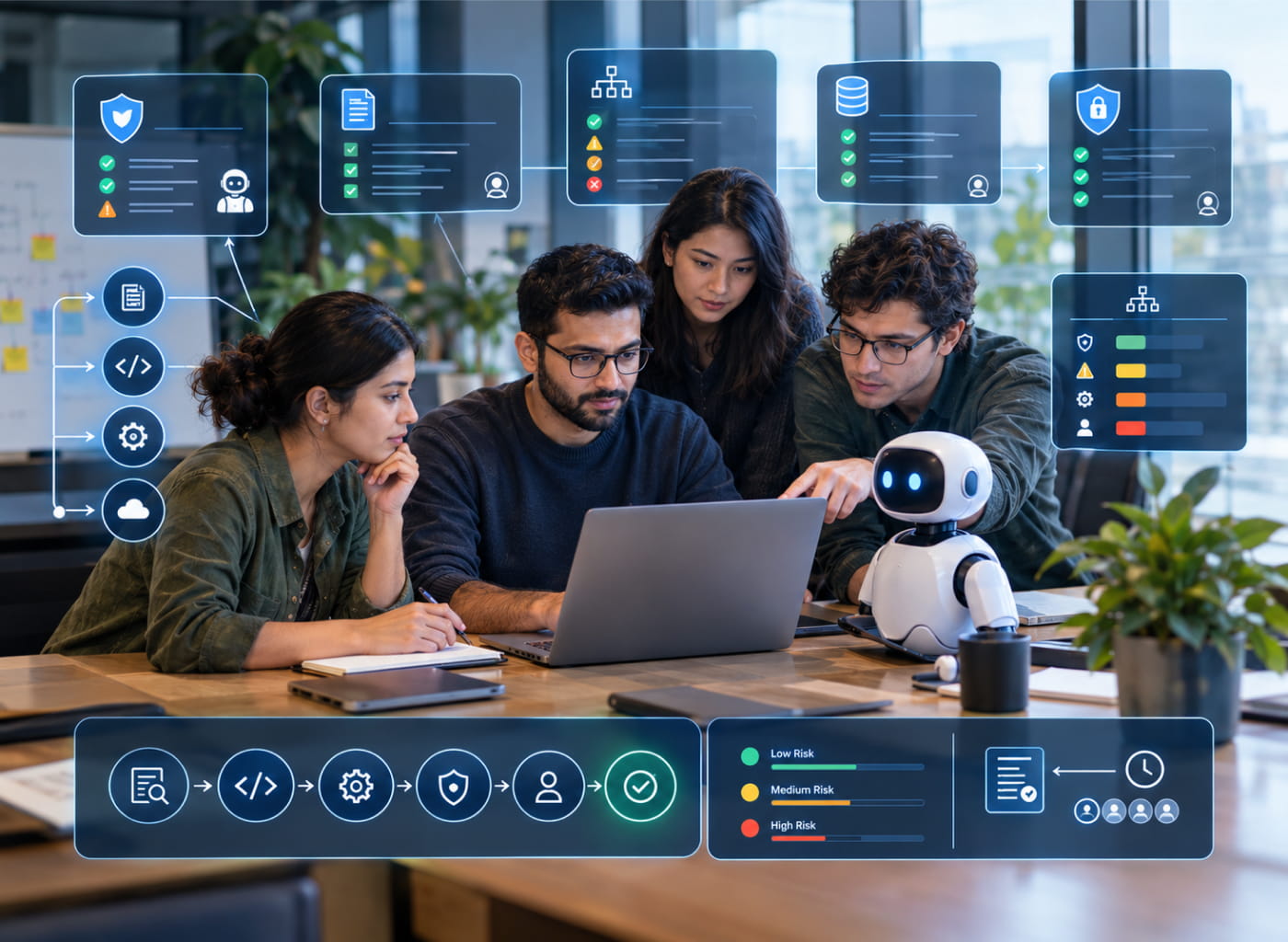
Human colleagues build trust through experience, communication, and demonstrated competence. AI agents require a different form of trust because their output can be persuasive without being correct, and their performance may vary substantially across tasks. A team cannot assume that an agent that performs well on routine code generation will also make reliable architectural decisions or identify every security risk.
Trust in a human-AI engineering team must therefore be based on evidence and boundaries rather than confidence alone. The organization needs to know which tasks an agent performs reliably, what kinds of mistakes it tends to make, which tools and data it can access, and how its output will be checked before it affects a production system. The level of autonomy should reflect the risk of the task, the quality of the available validation, and the consequences of an incorrect result.
A low-risk documentation update may require little more than an automated check and a quick review. A change to authentication, payment processing, or patient data handling deserves a much stronger validation process. The agent may still assist with analysis and implementation, but the workflow should require appropriate tests, security checks, and human approval before release. This is not an argument for treating every AI-generated change as dangerous. It is an argument for applying the same risk-based discipline that responsible engineering already demands. This approach reflects the importance of engineering for predictable failure, with validation checks, clearly defined boundaries, and controlled recovery paths designed into the system before failures occur.
The team must also preserve traceability. Engineers should be able to determine which requirement led to a change, what assumptions informed the implementation, which tests were executed and who or what approved the result. When a defect emerges, the organization needs to investigate the engineering process rather than simply attribute the outcome to AI. Was the requirement ambiguous? Was critical context missing? Did the agent exceed its permissions? Did the tests fail to cover the relevant scenario? Did the review process overlook a known risk?
These questions turn failures into evidence that can improve the system. Without traceability, AI adoption becomes difficult to govern because the organization cannot reliably explain how important changes were produced or why a control failed.
A mature human-AI team does not depend on the assumption that every participant will always be right. It depends on a process that makes errors detectable, limits their impact, and helps the organization learn from them.
5. Engineering Leadership Must Optimize the Whole System
As AI takes on more implementation work, the responsibilities of engineers will evolve, but they will not converge into a single role. This shift requires engineering leaders to become skilled at orchestrating humans and AI agents, ensuring that responsibilities, decision-making authority, and collaboration remain clear as AI becomes more deeply integrated into delivery. Some developers will spend more time defining requirements and evaluating generated solutions. Architects will need to make constraints and decisions understandable to both people and agents. Quality engineers will increasingly design automated evaluation systems and investigate gaps in coverage. Engineering managers will need to understand how delegated work flows through the team, where bottlenecks appear, and whether increased generation is creating additional review or maintenance costs.
The CTO and engineering leadership team must connect these activities into a coherent operating model. Providing AI tools is only the starting point. The organization must determine how tasks are assigned, how context is maintained, how quality is measured, how agents are evaluated, and how responsibility is distributed between human and machine participants. It must also invest in the underlying engineering practices that make automation dependable, including version control, continuous integration, observability, security controls, and well-defined interfaces.
Measurement needs to evolve alongside the workflow. Counting generated lines of code or tracking how frequently developers use AI tools says little about whether the engineering organization is becoming more effective. More useful measures include the time required to deliver a validated capability, the amount of rework generated by AI-assisted changes, the effort spent reviewing those changes, escaped defects, deployment confidence, and the frequency with which agents complete tasks successfully within defined constraints. These measures should be interpreted together because improving one metric can weaken another. Faster delivery is not a success if it produces more incidents or creates a maintenance burden that the team must absorb later.
The ultimate objective is reliable engineering throughput: the organization’s ability to turn a clear business need into software that works as intended and remains maintainable. AI can contribute substantially to that objective, but only when its capabilities are integrated with sound engineering practices and human accountability.
This is also where the competitive advantage will develop. Access to capable AI models will become increasingly common. Organizations will differentiate themselves through the quality of their engineering context, the structure of their workflows, the reliability of their evaluation mechanisms, and the effectiveness with which humans and AI agents collaborate.
The Prologic Perspective
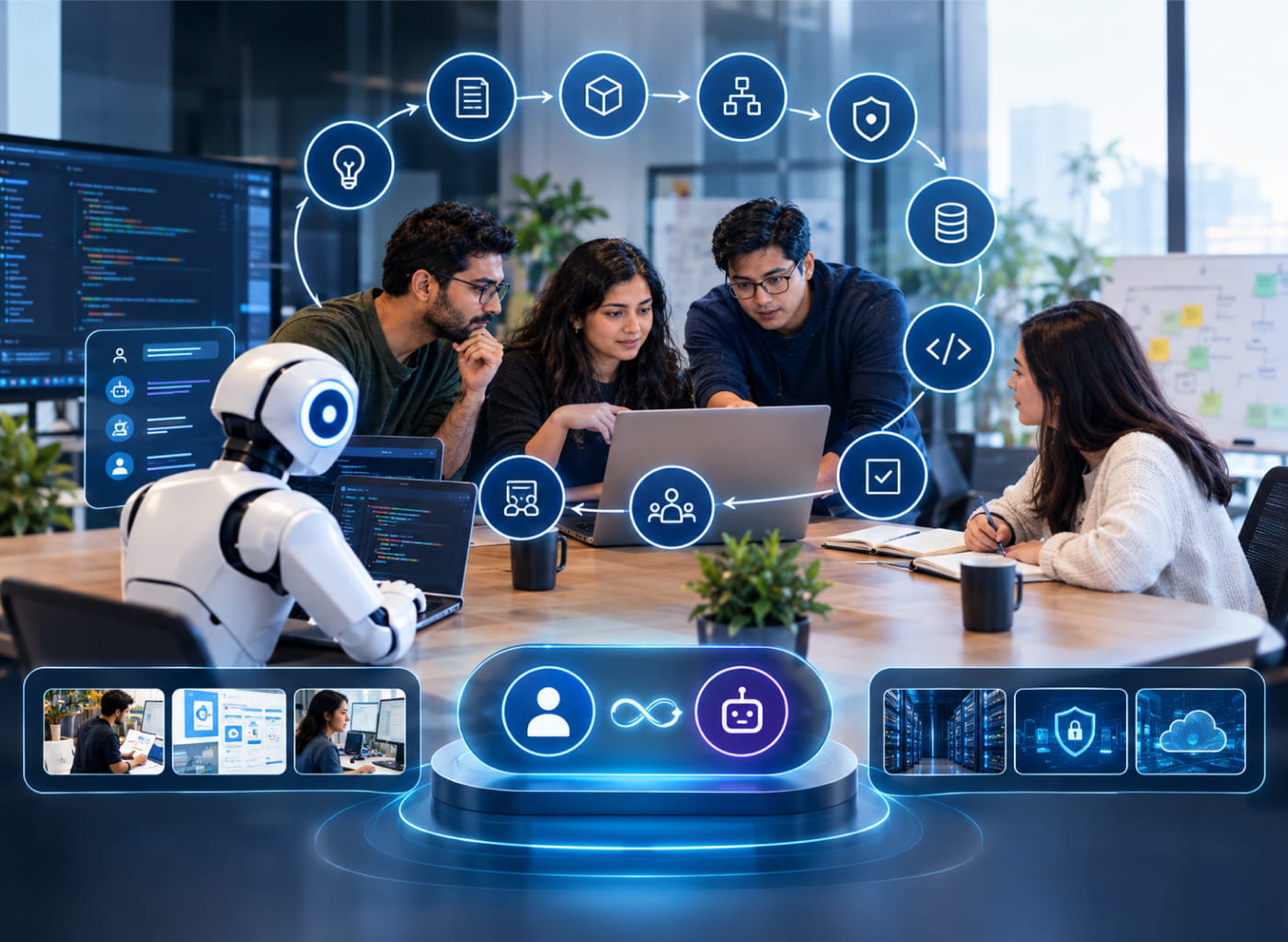
At Prologic Technologies, we view AI-native engineering as a redesign of the engineering lifecycle rather than the addition of a coding assistant to an existing process. The objective is to connect requirements clarification, product definition, architecture, compliance analysis, data modelling, implementation, testing and governance into a system where AI can contribute throughout delivery while humans retain responsibility for decisions that require judgment and accountability.
This thinking underpins PAINE, the Prologic AI Native Engineering framework. It reflects the belief that AI becomes more valuable when it operates within a structured engineering process, with defined context, explicit constraints, and mechanisms for validating its output. The framework’s purpose is not to maximize the amount of code generated by AI. It is to improve how the engineering organization translates intent into reliable software.
The transition will not happen simply because a company gives its developers access to more agents. It requires teams to rethink how work is defined, how knowledge is shared, how responsibilities are assigned, and how quality is established. Some practices will become more automated, while others, especially architecture, review, and accountability, will become even more important.
Software engineering is becoming a team sport between humans and AI because neither human judgment nor machine execution is sufficient on its own. Humans provide product understanding, context, accountability, and the ability to navigate ambiguity. AI agents can contribute speed, breadth of analysis, and sustained execution across well-defined tasks. The engineering system connects those strengths and makes their combined output dependable.
The organizations that recognize this shift early will not merely develop software faster. They will build a more capable way of engineering software, one in which people and AI systems work toward the same outcome without losing control of the quality, integrity, or purpose of the product.
FAQs