










Why Climate AI Platforms Fail Without Engineering-Grade Data Pipelines
Climate AI doesn’t fail because models are weak.
It fails because climate data is hostile to assumptions.
Enterprise leaders investing in AI climate data analysis often expect:
- Forecast accuracy
- Predictive insights
- Automated sustainability reporting
Instead, they get:
- Inconsistent signals
- Delayed insights
- Fragile dashboards
The root cause is rarely the model.
It’s the absence of engineering-grade data pipelines.
Climate intelligence is not an analytics problem.
It’s a systems engineering problem.
The Reality of Climate Data in Production

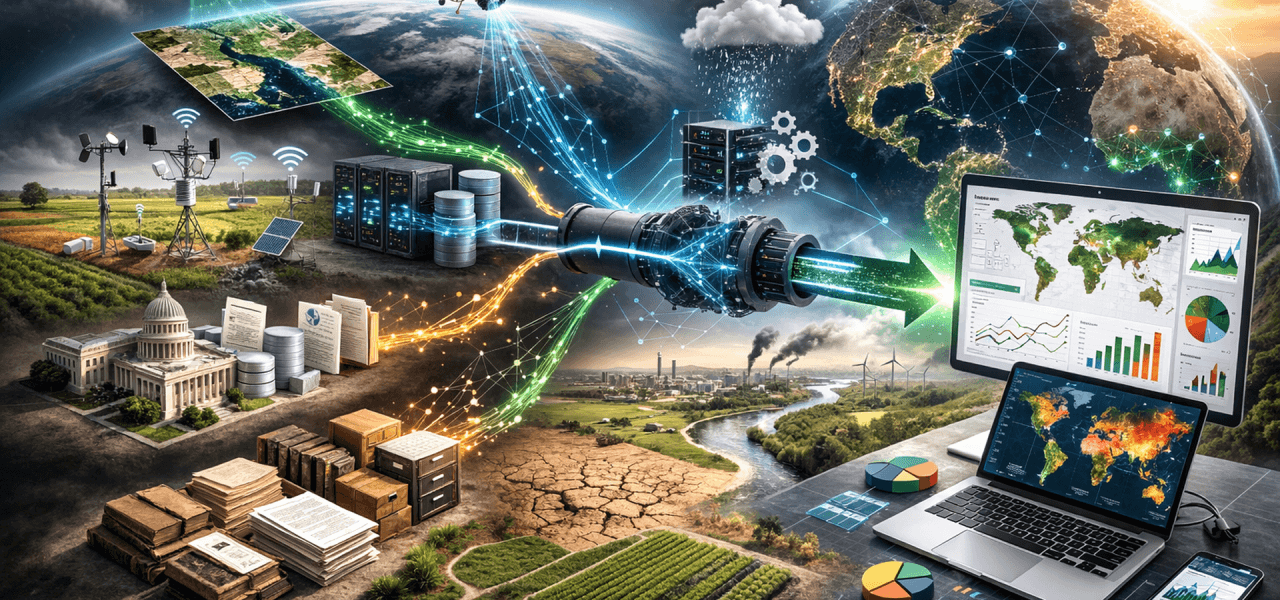
Climate platforms ingest:
- Satellite imagery
- Sensor networks
- Government datasets
- Vendor feeds
- Historical archives
Each source varies in:
- Resolution
- Frequency
- Reliability
- Temporal alignment
Without robust pipelines, AI models amplify noise instead of insight.
Where Most Climate AI Platforms Break
1. Temporal Misalignment
Climate data arrives asynchronously.
Models trained on misaligned timelines generate false correlations.
2. Data Drift Without Detection
Sensor degradation, calibration errors, and environmental changes distort inputs silently.
3. Inference Latency
Climate insights lose value when they arrive after decisions are made.
What Production-Grade Climate AI Systems Do Differently
Deterministic Data Foundations
Before AI:
- Data validation
- Temporal normalization
- Provenance tracking
Only then does ML add value.
Multi-Resolution Intelligence
Successful platforms reconcile:
- High-frequency local signals
- Low-frequency global trends
This allows decision-grade climate intelligence, not static reports.
Explainable Outputs
Enterprise climate decisions require:
- Confidence bounds
- Source attribution
- Scenario sensitivity
Black-box predictions fail regulatory and executive scrutiny.
Deployment Insight
In a climate monitoring deployment:
- False alerts dropped significantly
- Forecast reliability improved
- Regulatory reporting became defensible
AI succeeded because engineering preceded intelligence.
What Sustainability Leaders Must Demand

- Data lineage visibility
- Model uncertainty disclosure
- Audit-ready outputs
Climate AI must be defensible before it is impressive.
Climate / Enterprise
Discuss Climate AI System Architecture