






- Why is the codebase not the complete source of truth?Code records executable behavior, but it may not explain business intent, architectural rationale, security constraints, or operational decisions that affect whether a change is appropriate.
- What belongs in an engineering source of truth?Relevant requirements, domain rules, architecture decisions, interface contracts, tests, security constraints, and operational evidence, connected through clear ownership and versioning.
- Does this require a single documentation platform?No. Different artifacts can remain in appropriate tools, provided they are discoverable, versioned, and linked to the software and decisions they govern.
- How does this help AI agents?It gives agents reliable context and explicit constraints, reducing the need to infer business rules from code alone and making their output easier to evaluate.
- Can AI maintain engineering documentation automatically?AI can identify affected artifacts and propose updates, but authoritative requirements and architectural decisions should have appropriate review and ownership.
- What is the role of traceability?Traceability connects requirements, implementation, tests and approvals so teams can understand why a change was made and how it was validated.
- How does this relate to PAINE?PAINE treats context, requirements, architecture, implementation, testing and governance as connected parts of an AI-native engineering lifecycle.
Reading Time: 13 min
The Codebase Is No Longer the Complete Source of Truth
Why AI-native engineering requires a connected record of requirements, architectural decisions, context, tests and code.
For most of the history of software engineering, the codebase has been the closest thing a team has had to an authoritative description of its product. Requirements explained what needed to be built, architecture documents described the intended design, and technical discussions recorded the reasoning behind important decisions. However, as software evolved, these sources often drifted apart. The code changed, the documentation fell behind, and the reasoning behind a decision remained buried in an old discussion or in the memory of an engineer who had since moved to another project.
Experienced developers learned to navigate this gap. They inspected the implementation, traced dependencies, read tests, questioned colleagues and reconstructed the history of the system. Much of this work was invisible in delivery estimates, but it was essential to understanding what the software actually did and why it behaved that way.
AI is changing the economics of this problem. An AI coding agent can inspect thousands of files, summarize a module, suggest an implementation and generate tests in a fraction of the time a human might need to perform the initial exploration. Yet the agent can still make the wrong change if it does not understand the business rule behind an existing implementation, the architectural decision that constrains a module or the reason a particular test exists. Access to the codebase does not automatically provide access to the knowledge required to change it safely.
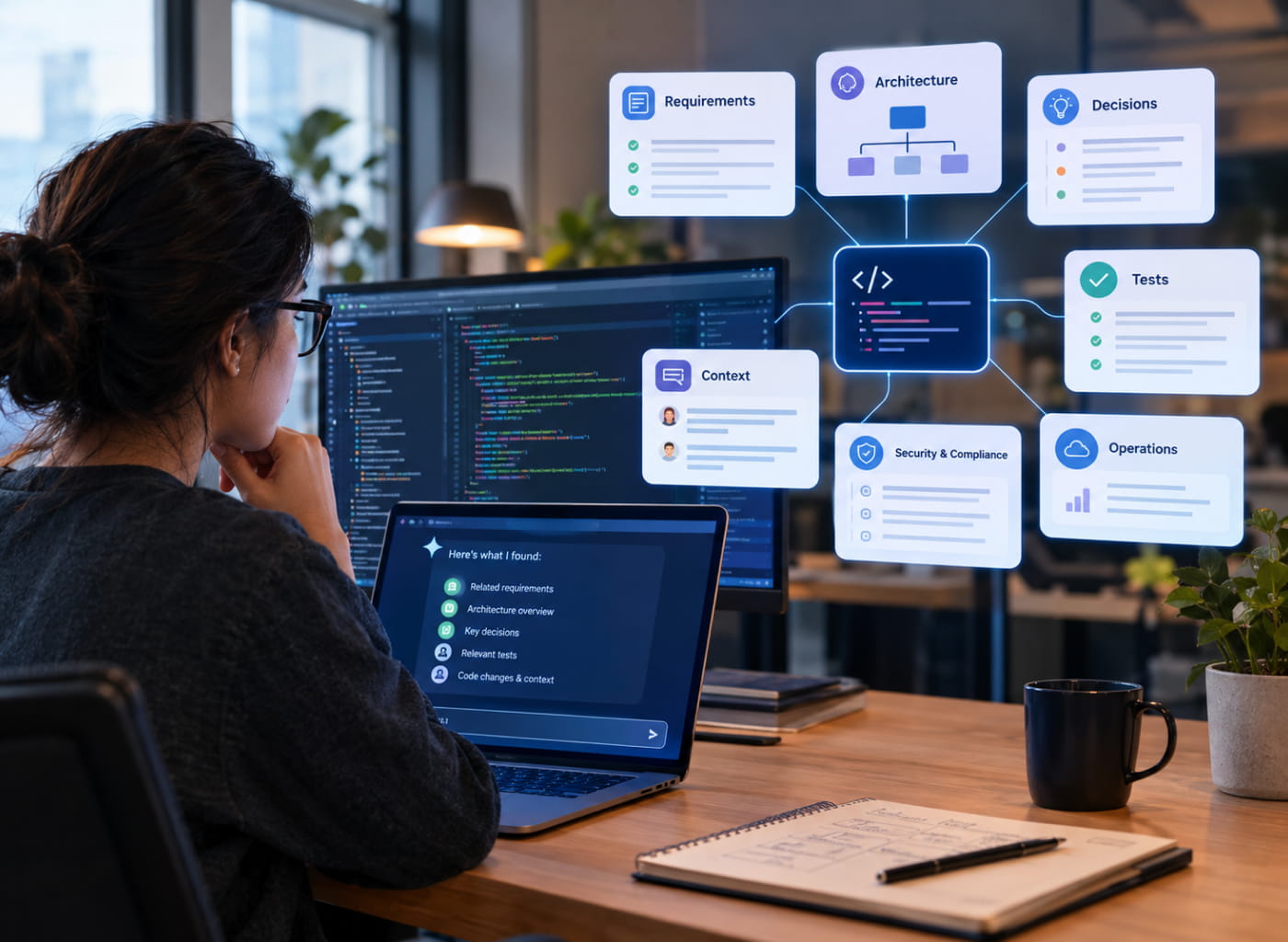
This creates a new requirement for engineering organizations. The codebase remains an essential record of executable behavior, but it can no longer be expected to carry the entire burden of engineering knowledge. Requirements, domain rules, architectural decisions, interface contracts, test expectations, security constraints and operational evidence must also be available in a connected and maintainable form. In an AI-native organization, these are not supplementary documents. They are part of the engineering system that enables humans and AI agents to understand, change and verify software.
1. Code Explains What Exists, but Not Always Why It Exists
A codebase can reveal how a system currently behaves, but it does not necessarily explain the full reasoning behind that behavior. A developer may discover that a payment service retries certain failures but not others. The implementation shows the conditions under which retries occur, while the original rationale may have been to avoid duplicate transactions or comply with a payment provider’s requirements. If an engineer or AI agent changes the retry behavior without understanding that constraint, the result may compile, pass basic tests and still create a serious business problem.
Similar gaps appear throughout mature software systems. A database field may remain because an older integration still depends on it. An apparently redundant validation rule may protect a boundary that is not obvious from the immediate code. A feature may behave differently for a particular customer because of a contractual commitment. These decisions can be embedded in conditionals, configuration files, test cases and integration logic without a clear explanation of their purpose.
The problem is not that developers have failed to document every detail. No practical organization can maintain a perfect narrative of every implementation choice. The problem is that certain kinds of knowledge have a disproportionate influence on whether a change is safe. Business invariants, architectural boundaries, security requirements, data ownership rules and known operational constraints should not have to be rediscovered every time someone modifies the system.
AI makes this distinction more consequential because code generation can happen faster than contextual understanding. An agent may propose a clean refactor that removes duplication while inadvertently removing a behavior that the business depends on. A test-generation agent may reproduce the current implementation’s assumptions without checking whether they match the intended requirement. A code-review agent may focus on local correctness while overlooking a cross-module dependency.
A stronger engineering system makes the important reasoning discoverable. It connects code to the requirements it implements, the decisions that constrain it, the tests that verify it and the operational evidence that shows how it behaves. This does not eliminate the need for investigation or professional judgment. It reduces the amount of engineering work spent reconstructing knowledge that the organization already possesses.
2. The Engineering Source of Truth Must Become a Connected System
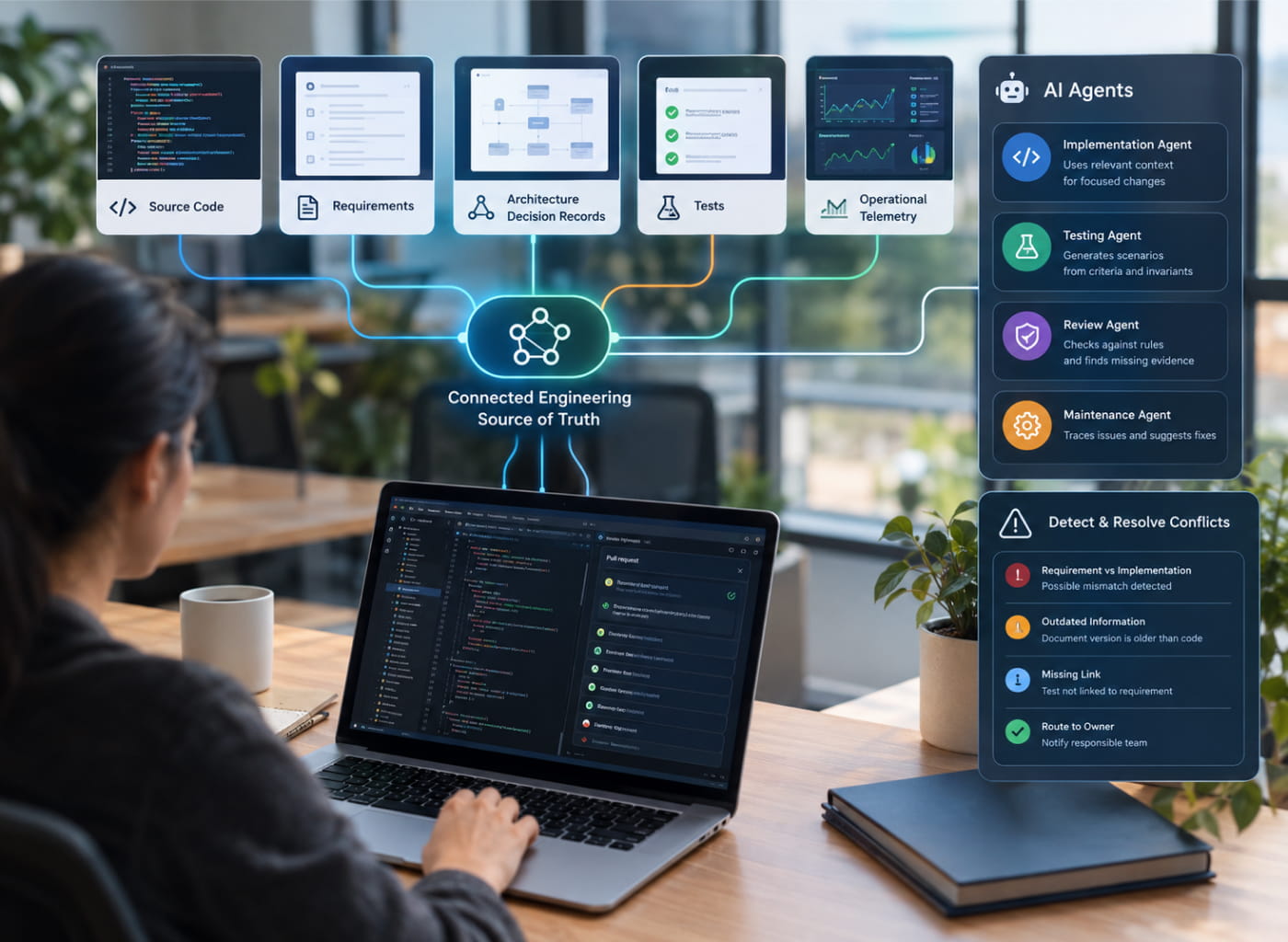
The phrase “single source of truth” is often interpreted as a request to store everything in one document or platform. That is not the objective. Different engineering artifacts serve different purposes, and they need different formats, ownership and update cycles. Source code defines executable behavior, requirements express intended outcomes, architectural decision records explain significant choices, tests establish verifiable expectations, and operational telemetry reveals how the system behaves in production.
The more useful goal is to establish a connected engineering source of truth in which these artifacts can be related, inspected and kept consistent. A requirement should be traceable to the capabilities and interfaces that implement it. An architectural decision should identify the constraints it establishes. Tests should verify important acceptance criteria and invariants. A code change should be reviewable against the requirement and the relevant architectural rules. When a requirement changes, the team should be able to identify which components, tests and decisions may need to be revisited.
This can be implemented incrementally rather than through a large documentation migration. A team might begin with structured requirements, a repository of architectural decision records, explicit API contracts, automated tests and a small set of machine-readable engineering rules. The team can then connect these artifacts through version control, issue references, continuous integration and appropriate metadata. The objective is not to create more paperwork; it is to make the knowledge needed for engineering decisions easier to retrieve and validate.
AI agents can benefit directly from this structure. An implementation agent can receive the relevant requirement, interface contract and architectural constraints instead of being asked to infer them from the entire repository. A testing agent can derive scenarios from acceptance criteria and established invariants. A review agent can check a change against known rules and identify missing evidence. A maintenance agent can trace a defect to the affected component, relevant tests and previous decisions before proposing a fix.
The system must still account for conflicting or outdated information. If a requirement contradicts the current implementation, the agent should not silently assume that one is correct. The discrepancy may indicate an intentional change, an undocumented exception or a defect. A connected source of truth should make such conflicts easier to detect and route to the person responsible for resolving them.
3. Context Engineering Becomes Part of the Delivery Pipeline
Traditional development workflows often treat context as something developers acquire informally while working. An engineer opens the ticket, reads some code, asks questions and begins implementation. This approach can work well when the team is small and the system is familiar, but it becomes less reliable as the codebase grows, knowledge is distributed and AI agents participate in more tasks.
In AI-native engineering, context needs to be prepared as part of the work itself. Before an agent modifies a component, the workflow should identify the relevant requirement, affected modules, data contracts, architectural constraints, test expectations and applicable security or compliance rules. The context should be sufficient for the task without overwhelming the agent with unrelated information. It should also preserve links to authoritative sources so that the agent can distinguish an approved requirement from an informal suggestion or an obsolete document.
This is not simply a matter of writing a longer prompt. Prompts can communicate instructions, but they cannot compensate reliably for missing or contradictory source material. A well-designed context pipeline retrieves relevant information, checks its version and authority, assembles the task boundaries and provides a clear way to report missing evidence. The agent then operates within that prepared context rather than treating the entire codebase as an unrestricted collection of suggestions.
Consider a team adding a new patient appointment workflow to a healthcare platform. The coding task may appear to involve a new API endpoint and a user interface. However, the change may also depend on patient identity rules, appointment status transitions, role-based permissions, audit requirements, notification behavior and integration contracts. If the agent receives only the interface request, it may implement the visible feature while overlooking the operational constraints. If the workflow assembles the relevant requirements and contracts before implementation, the agent has a better foundation for producing a coherent change.
The same principle applies after implementation. The pipeline should verify that the required tests have run, the relevant checks have passed and the change remains traceable to its intended outcome. If the implementation reveals that a requirement is ambiguous or an architectural decision is no longer appropriate, that discovery should feed back into the engineering knowledge system rather than remain buried in the conversation that produced the code.
Context engineering therefore becomes a repeatable engineering capability. It links what the organization knows to the work being performed and helps ensure that generated output can be evaluated against the intended design.
4. Knowledge Must Evolve With the Software

A source of truth becomes unreliable when it describes a system that no longer exists. Engineering documentation often decays because it is created as a separate activity from implementation. A developer changes an interface, merges the code and moves to the next task, while the architecture document, integration guide or operational runbook remains unchanged. Over time, the organization accumulates multiple descriptions of the same system, each accurate for a different moment in its history.
AI-assisted development can make this problem worse if the volume of changes increases without a corresponding improvement in knowledge maintenance. Agents may generate code, tests and documentation quickly, but speed does not guarantee consistency. Automatically generating documentation from code can help describe the implementation, yet it may still fail to capture business intent, unresolved assumptions or the rationale behind a design choice.
The answer is to connect knowledge maintenance to the definition of a completed engineering change. When a change affects an API contract, the contract should be updated and validated. When a business rule changes, the requirement and its tests should reflect the new behavior. When an architectural decision is replaced, the previous decision should remain available as historical context while the current guidance becomes unambiguous. When an operational incident reveals a previously unknown constraint, the organization should determine whether that knowledge belongs in a test, a runbook, an architectural record or a system invariant.
AI can assist with this work by identifying potentially affected artifacts, proposing documentation changes and detecting inconsistencies between requirements, code and tests. However, the workflow must distinguish between proposing an update and approving it. An agent should not automatically rewrite an authoritative requirement simply because the current implementation behaves differently. The discrepancy needs to be evaluated before the organization changes its understanding of the intended system.
Versioning is essential. Engineering knowledge should be associated with the relevant software version or release so that a developer investigating an older incident can reconstruct the constraints that existed at the time. Without this historical connection, a current document may be misleading when used to explain past behavior.
A connected source of truth is therefore not a static repository. It is a maintained relationship between the evolving product and the knowledge used to build, operate and change it.
5. Traceability Is the Foundation of Reliable AI-Native Engineering
As AI agents participate in more of the engineering lifecycle, organizations need to understand not only what changed but also why the change was made and how it was validated. This becomes difficult when requirements, prompts, code modifications, tests and approvals exist in separate tools without meaningful links between them.
Traceability provides those connections. A team should be able to move from a business requirement to the relevant implementation, identify the tests that verify it and determine which review and validation steps were completed. Where AI materially contributed to the work, the organization may also need to retain appropriate records of the task instructions, relevant context references, tool actions and human approvals. The required level of detail should reflect the project’s risk, regulatory obligations and operational needs.
This does not mean preserving every conversational exchange indefinitely or recording information without a clear purpose. Excessive logging can create privacy, security and storage problems. The organization should retain the evidence needed to explain consequential changes, investigate failures and demonstrate that required controls were followed. Sensitive information should be handled according to applicable retention and access policies.
Traceability also improves engineering learning. If an AI-generated change repeatedly fails because it misunderstands a particular architectural convention, the organization can examine the task context, instructions, validation rules and review findings to identify the underlying problem. If a test fails to catch a defect, the team can trace the defect to the requirement and test coverage to determine whether the acceptance criteria were incomplete or the validation strategy was inadequate.
This is where engineering knowledge and governance reinforce each other. The source of truth provides the context for making changes, while traceability records how that context was applied. Validation establishes whether the output met the expected conditions, and operational evidence reveals whether the change behaved as intended after deployment.
The result is a system that can improve through experience. Rather than treating each AI-assisted task as an isolated interaction, the organization can use the evidence from completed work to refine its requirements, context preparation, evaluation methods and engineering standards.
The Prologic Perspective
At Prologic Technologies, we view the engineering source of truth as an essential part of AI-native delivery. PAINE, Prologic AI Native Engineering, is built around the idea that AI should contribute within a structured engineering lifecycle that connects requirements, product definition, architecture, data modelling, implementation, testing and governance. The goal is to make the context and constraints required for reliable engineering available throughout the process.
This approach does not require every artifact to live in one tool, nor does it assume that documentation can replace engineering judgment. It requires a deliberate system of relationships between authoritative information sources. Requirements need clear ownership, architectural decisions need to be discoverable, tests need to verify meaningful expectations and code changes need to remain connected to the outcomes they are intended to deliver.
The practical starting point is to identify the knowledge that most often causes delays, rework or defects when it is missing. For one team, that may be undocumented business rules; for another, it may be inconsistent API contracts, unclear data ownership or security requirements that appear too late in the development process. Connecting those artifacts to implementation and validation provides a measurable improvement without forcing the organization to redesign every process at once.
As AI agents become more capable, the organizations that benefit most will not necessarily be those that generate the most code. They will be those that can provide the right context, preserve architectural intent, detect inconsistencies and validate changes reliably. The codebase will remain central to software engineering, but it will be one part of a broader system of knowledge and evidence.
That is the shift AI-native engineering requires: not replacing code with documentation, but connecting the software with the knowledge that explains what it must do, the constraints under which it must operate and the evidence that shows it works.