









- What is software project discovery?It is the structured process of understanding the problem, users, workflows, constraints, risks and intended outcomes before committing to a solution.
- Does discovery delay development?Focused discovery can shorten delivery overall by reducing avoidable rework and exposing critical risks earlier.
- What should discovery produce?A clear problem statement, prioritised workflows, key decisions, assumptions, constraints, success measures and a plan for unresolved questions.
- How much discovery is enough?Enough to resolve high-impact uncertainties in proportion to the project's risk and complexity.
- Why is discovery especially important for AI projects?AI systems depend on suitable data and context, measurable evaluation criteria, defined decision boundaries and fallback behaviour.
Reading Time: 6 min
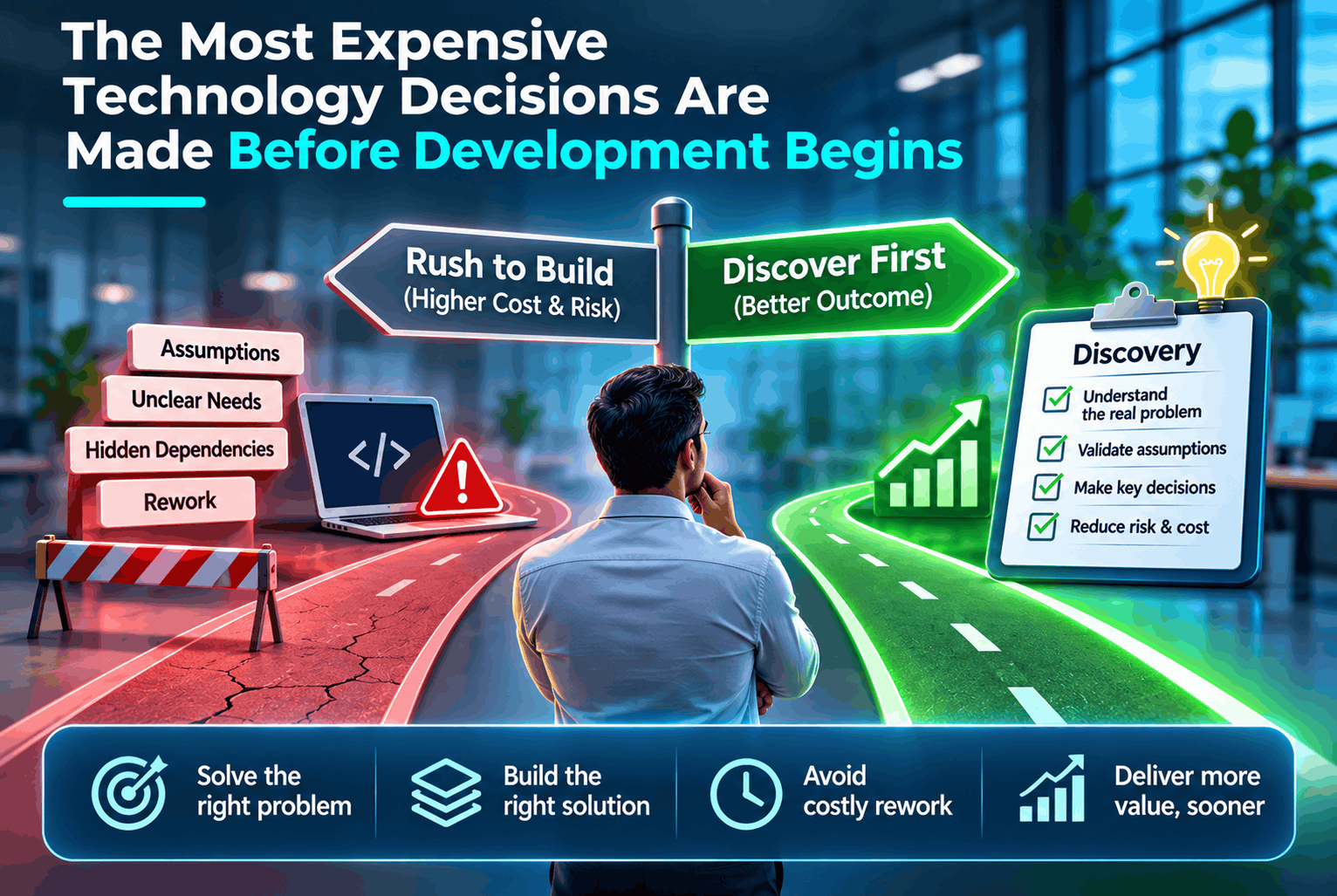
The Most Expensive Technology Decisions Are Made Before Development Begins
When a software project goes wrong, the visible symptoms usually appear during development. Estimates start slipping, features require unexpected rework, integrations become more complicated than expected, and stakeholders begin questioning the original plan. The natural response is to look at execution: Was the team experienced enough? Were the developers productive? Did the project need better management?
Sometimes the problem really is execution. However, in my experience, some of the most expensive mistakes are made much earlier, when the team is still discussing what to build. A business problem is translated too quickly into a feature list, assumptions become requirements, and an early solution is accepted before anyone has properly examined the decisions it will force later.
Once development begins, these assumptions become embedded in architecture, data models, workflows and expectations. Changing them is no longer a simple conversation. It becomes rework.
A feature request is not yet a problem definition
A client might ask for a dashboard, an AI chatbot, a mobile application or an integration with an existing platform. These requests are useful starting points, but they do not explain the underlying problem. A dashboard may be requested because decision-makers cannot access reliable information. A chatbot may be proposed because support teams are overloaded. A mobile application may be the assumed answer to a process that is actually difficult because several systems do not communicate.
If the delivery team accepts the requested feature as the problem itself, it risks building exactly what was asked for while failing to improve the outcome that matters.
Good discovery asks what is happening today, who experiences the problem, how often it occurs, what workarounds exist and what a successful result would look like. It also examines what the client already knows and what remains an assumption. These conversations do not delay engineering; they reduce the chance of engineering the wrong thing efficiently.
Hidden assumptions become expensive dependencies
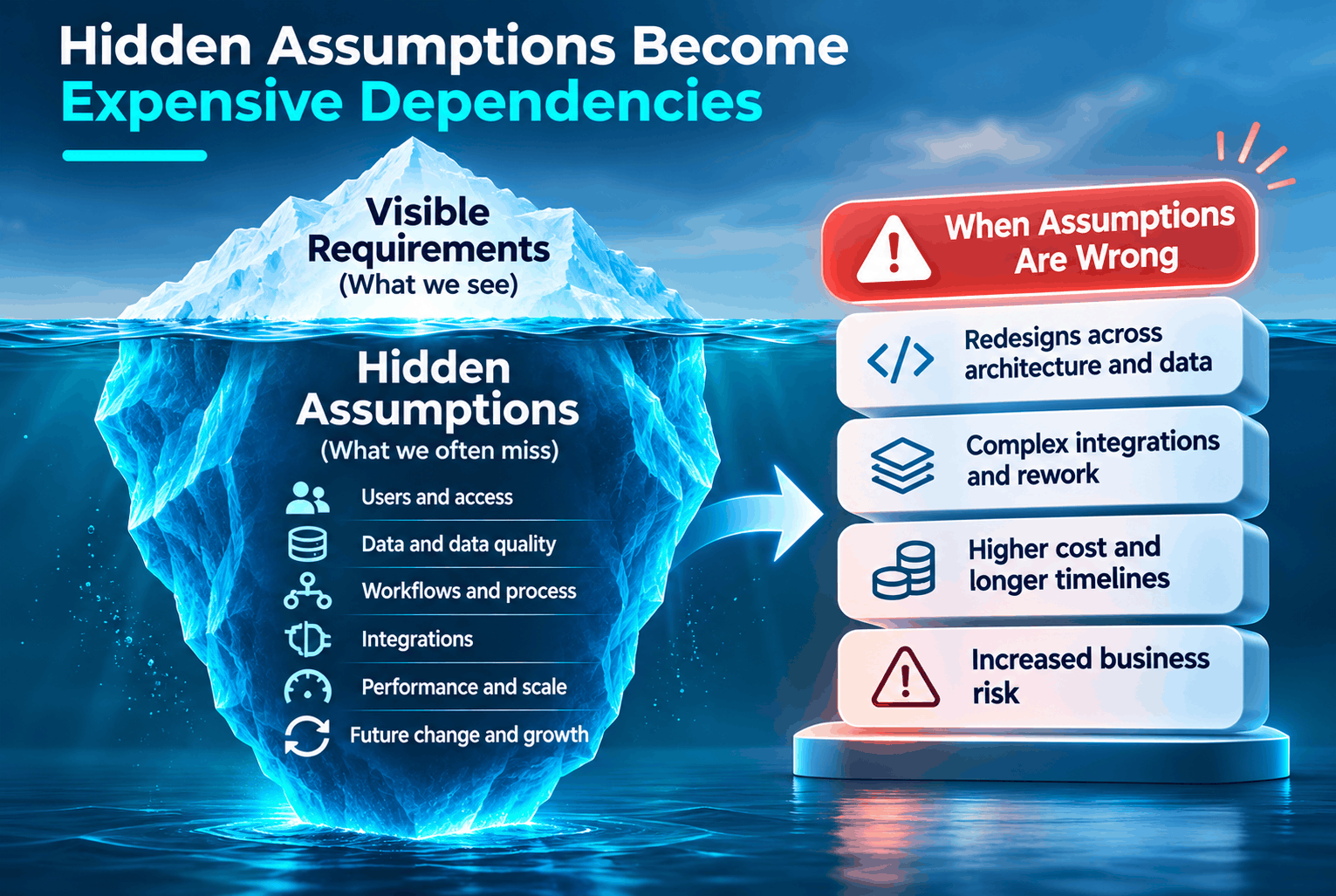
Every project contains assumptions about users, data, workflows, permissions, integrations, performance and future change. Some assumptions are harmless. Others shape the entire system.
For example, a team may assume that one customer corresponds to one account, that inventory is updated in real time, or that a healthcare system can retrieve all relevant records through a single integration. If these assumptions are wrong, the consequences may spread across the architecture. A data model may need redesign, access controls may need rethinking, or an apparently simple integration may require an entirely different workflow.
The challenge is not to eliminate every uncertainty before starting. That is rarely possible. The challenge is to identify which uncertainties could materially change the solution and test them early. A short technical spike, workflow prototype, data-quality assessment or stakeholder interview can be far less expensive than discovering the same issue after several months of implementation.
The right questions are often uncomfortable
Effective discovery requires questions that are not always easy to ask. Who owns this process today? Which system is authoritative when records disagree? What happens when an integration fails? Who can approve a consequential decision? Which requirements are mandatory, and which are preferences? What would make the project unsuccessful even if every agreed feature were delivered?
These questions may expose disagreements that stakeholders have avoided. They can reveal that departments use different definitions, that no one owns a critical data source, or that the desired outcome depends on a policy decision rather than a software feature.
It is tempting to avoid this discomfort and move quickly into estimation. However, an estimate built on unresolved assumptions is not a commitment grounded in evidence. It is a number attached to uncertainty.
A good engineering partner should make uncertainty visible without turning discovery into an endless consulting exercise. The objective is to resolve the decisions that affect architecture, risk, cost and business value, then move forward with explicit assumptions and a plan for validating the rest.
Discovery should produce decisions, not just documentation
Discovery is sometimes treated as a workshop followed by a large requirements document. The document may be comprehensive, yet the team can still be left without clarity on the most consequential choices.
Useful discovery produces decisions that engineers and stakeholders can act on. It clarifies the intended outcome, the primary users, the critical workflows, the systems and data involved, the constraints, the measures of success and the major risks. It also records unresolved questions, the person responsible for answering each one and the point at which the answer is required.
For AI-enabled systems, discovery must go further. Teams need to identify where AI is appropriate, what context it will require, how its output will be evaluated and what should happen when confidence is low. They must distinguish between tasks that can be automated safely and decisions that require human judgment or explicit approval.
The result is not a promise that nothing will change. It is a shared understanding of why the team is building the system, which decisions have been made and how new evidence will change the plan.
Better decisions create better delivery economics
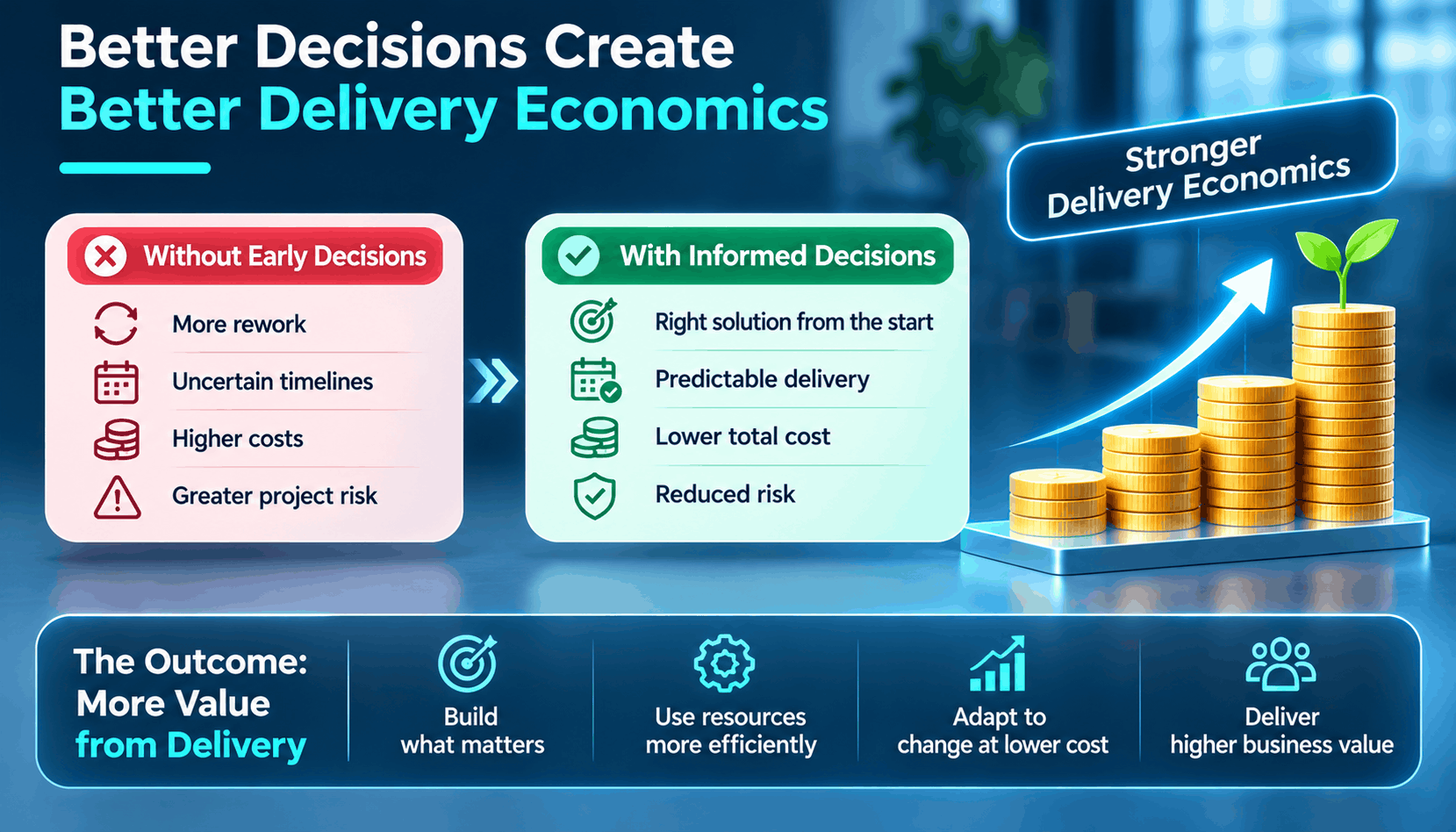
The commercial value of discovery is often underestimated because its benefits are largely invisible. A problem prevented does not appear as a completed feature. An architectural constraint identified early does not show up as a dramatic rescue later. Yet these decisions influence rework, delivery predictability, maintainability and the cost of future change.
This does not mean every project needs weeks of analysis. The appropriate depth depends on risk, complexity and reversibility. A small internal tool may require only a short, structured discovery session. A healthcare platform, financial workflow or multi-system retail operation may require more rigorous analysis because errors can affect sensitive data, business continuity or regulatory obligations.
The principle is to invest proportionately in the decisions that are expensive to reverse. Validate the riskiest assumptions early, make trade-offs explicit and avoid pretending that unknowns are already understood.
I have come to view discovery as part of engineering rather than a phase that happens before engineering. It is where the team begins to shape a solution that can survive contact with real users, real data and real operating conditions.
The strongest projects do not necessarily begin with the most detailed specification. They begin with a shared understanding of the problem, honest treatment of uncertainty and enough discipline to make the important decisions before those decisions become expensive to change.