




Why Architecture Diagrams Lie
July 28, 2026
Architecture diagrams are among the first artifacts created in almost every software project. They help teams visualize systems, align stakeholders, estimate complexity, and communicate technical direction. A well-drawn diagram creates confidence because it appears to explain how everything fits together.
Yet anyone who has spent time building production software knows an uncomfortable truth.
The system that eventually runs in production almost never looks exactly like the architecture that was approved at the beginning of the project.
New integrations appear. Third-party services evolve. Performance bottlenecks emerge. Business priorities shift. Compliance requirements change. Teams discover constraints that were impossible to anticipate during planning.
None of this means the original architecture was wrong.
It simply means that architecture is not the system. It is a hypothesis about the system.
The best engineering organizations understand this distinction. They treat architecture as a living model that evolves with the product, rather than a blueprint that must be defended at all costs.
Walk into the first meeting of any software project and you’ll usually find the same sequence of events.
Someone opens a whiteboard.
Boxes begin to appear.
Lines connect them.
Databases sit neatly below application layers. APIs link services together. Authentication flows in one direction. External systems fit comfortably at the edge of the diagram.
Within an hour, everyone feels remarkably confident.
The solution appears logical. Responsibilities are clearly divided. Risks seem manageable. The project feels tangible.
This is one of architecture’s greatest strengths.
It gives shape to complexity.
But it also creates one of the most dangerous illusions in engineering: the belief that because a system can be explained, it can be predicted.
Real systems rarely behave as neatly as diagrams suggest.
Every software project begins with assumptions.
A payment gateway will respond within acceptable time limits.
A third-party API will remain stable.
Users will follow the intended workflow.
Traffic will grow gradually.
Business rules will remain relatively consistent.
Some of these assumptions hold true.
Many do not.
Production environments have a way of introducing variables that no planning session can fully anticipate. Network latency fluctuates. Vendors deprecate APIs. Regulations evolve. Customer behavior changes. Internal priorities shift. New products introduce entirely different workflows.
None of these events are unusual.
They are the natural consequence of building software that exists in the real world rather than inside diagrams.
The architecture hasn’t failed.
Reality has simply provided more information than the design team initially possessed.
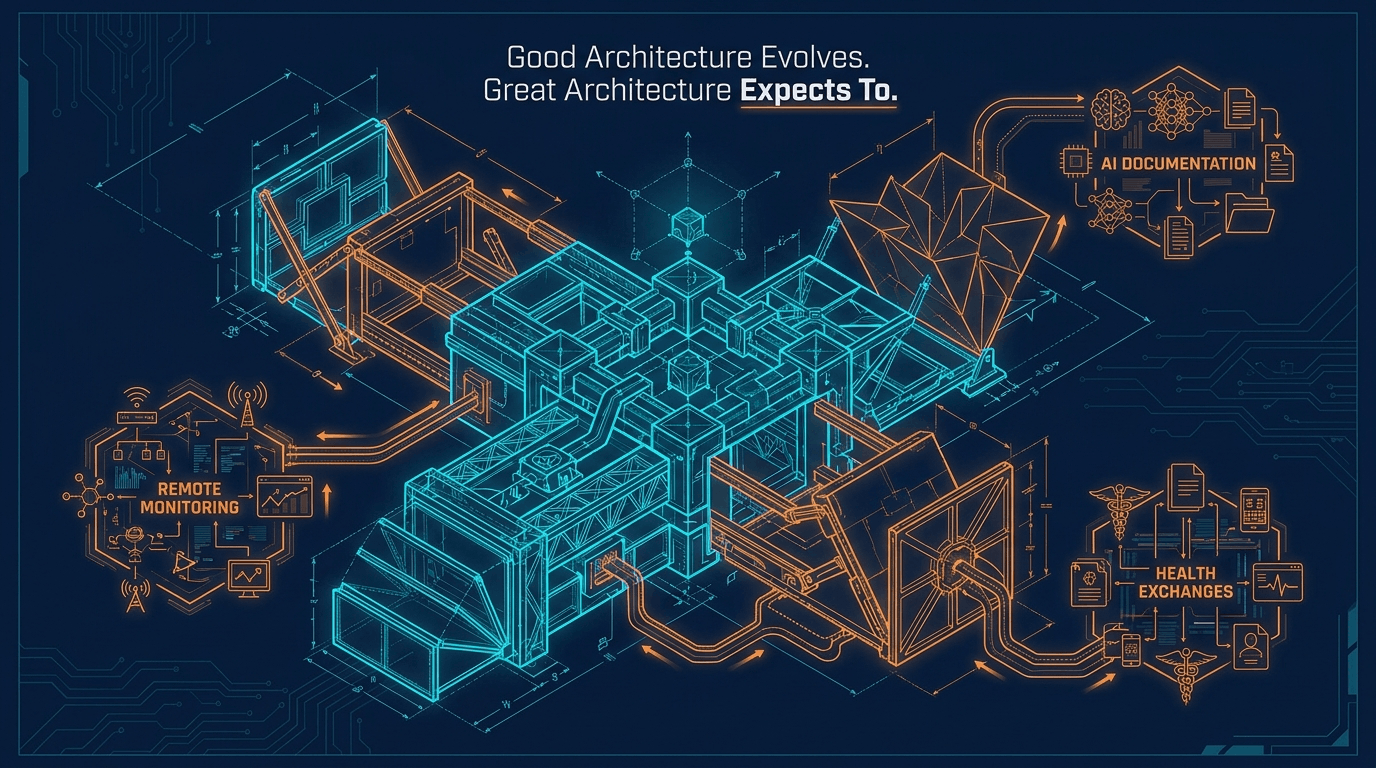
One of the biggest misconceptions in software engineering is that changing architecture is a sign of poor planning.
In practice, the opposite is often true.
Rigid architectures tend to break because they were designed around certainty. Resilient architectures evolve because they were designed around change.
Consider a modern healthcare platform.
A team may initially plan for integrations with electronic medical records, laboratory systems, and patient portals. Six months later, the organization decides to support remote patient monitoring, AI-assisted clinical documentation, wearable devices, and national health information exchanges.
Should the architecture remain unchanged simply because it matched the original diagram?
Of course not.
The architecture should absorb new requirements without forcing the entire platform to be rebuilt.
The measure of a good architecture is not how accurately it predicts the future. It is how gracefully it accommodates the future when it arrives.
Most architecture diagrams focus on components.
Frontend.
Backend.
Database.
Cache.
Message queue.
AI service.
Payment gateway.
Identity provider.
These are important, but they are rarely where complexity lives.
Complexity exists in the relationships between those components.
How does the application behave if authentication becomes unavailable?
What happens when a payment gateway times out halfway through a transaction?
Can an order be processed if inventory updates are delayed?
How does an AI-assisted workflow respond when model confidence is too low?
These questions rarely fit inside architecture boxes, yet they define the reliability of the entire system.
The hardest engineering problems are almost never about building components.
They are about managing the interactions between them.
Many organizations unintentionally freeze architecture after the initial design phase.
The diagram is approved.
Documentation is completed.
Development begins.
Months later, the production system has evolved while the architecture document remains untouched.
Eventually, the diagram becomes a historical artifact rather than a useful engineering tool.
Healthy engineering teams avoid this trap.
They revisit architectural decisions continuously. They challenge assumptions. They document trade-offs. They adjust boundaries as the product matures.
In these organizations, architecture isn’t something that happens before development.
It becomes part of development itself.
At Prologic, architecture is never viewed as a static blueprint.
Whether we’re building a connected healthcare platform, an intelligent commerce ecosystem, or an AI-native application, we expect the system to evolve as new information emerges.
Our architectural reviews are less concerned with preserving the original design and more concerned with preserving the integrity of the system.
Can the platform absorb new capabilities without unnecessary complexity?
Can failures be isolated?
Can services evolve independently?
Can workflows change without disrupting everything else?
Those questions matter far more than whether today’s diagram still resembles the one created six months ago.
Architecture is valuable because it helps engineers make better decisions—not because it predicts every future decision correctly.

Perhaps the most valuable architecture diagram is the one that never gets presented to a client.
It exists inside the engineering team’s collective understanding.
It reflects years of production experience.
It captures lessons learned from failures, scaling challenges, security incidents, performance bottlenecks, and evolving customer needs.
Unlike the polished diagram shown in the kickoff meeting, this mental model is continuously refined.
It grows with every deployment.
Every incident.
Every successful release.
Every difficult decision.
The best engineering teams don’t simply build software.
They build better ways of thinking about software.
Architecture diagrams are indispensable.
They help us simplify complexity, communicate intent, and align teams around a common vision.
But they should never be mistaken for reality.
Production systems are shaped by thousands of decisions made after the first diagram is drawn. Every deployment, integration, customer request, operational incident, and business pivot leaves its mark on the architecture.
That isn’t a flaw in the engineering process.
It’s evidence that the system is alive.
The most successful engineering organizations understand that architecture is not a picture of certainty. It is a framework for navigating uncertainty. The diagram provides direction, but experience determines the destination.
Perhaps that’s why architecture diagrams sometimes appear to “lie.”
They don’t.
They simply tell the story of what we believed at the beginning.
The production system tells the story of everything we learned afterward.