










- What is a patient-centred healthcare architecture?It is an approach that organizes relevant health information and care workflows around the patient's journey across providers, rather than limiting the digital experience to individual institutional systems.
- What is a longitudinal health record?It is a time-aware view of relevant health information across multiple encounters, potentially including diagnoses, medications, investigations, procedures and care plans, while preserving source information and context.
- Does patient-centred architecture require one central database?No. Depending on the requirements, information can remain in institutional systems and be accessed through interoperable, authorized exchange. Centralized, federated and hybrid arrangements may all be appropriate in different circumstances.
- What role does ABDM play?ABDM provides digital health infrastructure and frameworks for identity, consent-based exchange and interoperability in India. These building blocks can support connected health information, but they do not automatically guarantee a complete or clinically useful longitudinal record.
- Why isn't a patient portal enough?A portal can improve access to information, but it cannot by itself resolve fragmented clinical data, incompatible systems or disconnected provider workflows.
- How can AI benefit from longitudinal health records?When authorized and appropriately designed, AI can help summarize relevant history, identify changes over time and surface information for clinical review. Its outputs still require validation, context and professional judgment.
- How should patient information be protected?Systems should implement appropriate identity controls, role- and purpose-based access, consent and authorization mechanisms, audit trails, secure data handling and clear provenance, consistent with applicable requirements.
- What is HealthFabric's role in this model?HealthFabric focuses on connecting healthcare systems and workflows so that relevant information can support decisions across the patient's journey without requiring wholesale replacement of existing applications.
Reading Time: 14 min
The Patient Is Becoming the Most Important System in Healthcare
Why the future of healthcare technology depends on organizing information, workflows, and decisions around the patient’s longitudinal journey.
Healthcare technology has traditionally been organized around the institutions that deliver care. Hospitals implement hospital information management systems. Laboratories operate laboratory information systems. Radiology departments use imaging systems. Clinics maintain electronic medical records, while pharmacies, insurers, and diagnostic networks run their own applications. Each system has a legitimate purpose, and many perform their individual responsibilities well. Yet the patient moves between them, often carrying information from one institution to another and repeating details that the healthcare ecosystem has already collected.
This creates a fundamental mismatch between the way healthcare is experienced and the way healthcare technology is designed. Patients experience a continuing journey that may include prevention, diagnosis, treatment, recovery, chronic disease management, and follow-up. Institutions, however, tend to record discrete encounters within their own operational boundaries. The hospital sees an admission, the laboratory sees a test request, the specialist sees a consultation, and the pharmacy sees a prescription. Each institution records part of the story, but no single system necessarily understands the complete journey.
The next generation of healthcare architecture must address this mismatch. Instead of treating the hospital, clinic or application as the primary organizing unit, technology needs to support a longitudinal understanding of the patient across encounters, providers, and care settings. The patient does not replace the hospital information system, electronic medical record or clinical workflow. Rather, the patient’s journey becomes the connecting structure through which these systems can exchange relevant information and support better decisions.
This is a deeper change than creating another patient-facing application. It requires healthcare organizations to reconsider how identity, records, consent, workflows and clinical decisions fit together across the care continuum.
1. Healthcare Is Organized Around Institutions, but Patients Experience Continuity
Institution-centred systems emerged for practical reasons. Hospitals need to manage admissions, beds, staff, billing and clinical departments. Laboratories need to manage specimens, test orders and results. Clinics need appointment scheduling, consultation documentation and follow-up. Each organization must operate reliably, comply with its obligations and protect the information it holds.
The problem arises when these institutional systems become the boundaries of the patient’s digital experience. A patient may visit a primary care physician, undergo diagnostic testing, consult a specialist, and return to the original physician for treatment planning. Although these activities form one connected clinical journey, the underlying information may be distributed across separate applications, inconsistent identifiers, and different documentation practices. The patient or caregiver then becomes the informal coordinator, carrying reports, explaining previous treatments and trying to ensure that relevant information reaches the next provider.
This fragmentation has consequences beyond inconvenience. A clinician may not have access to a recent investigation, a medication history may be incomplete, or a follow-up recommendation may not reach the person responsible for acting on it. Repeated tests and duplicated documentation can consume resources, while missing context can make clinical decisions more difficult. The degree of impact varies by setting, but the underlying architectural weakness is consistent: the systems are optimized around individual institutional activities rather than the continuity of the patient’s care.
A patient-centred architecture begins by recognizing that a person’s healthcare journey is larger than any one encounter or institution. It connects relevant clinical events while preserving the operational responsibilities of the organizations involved. The hospital still needs its own admission and billing workflows, and the laboratory still needs its specimen-management system. However, their information should be capable of contributing to a more complete view of the patient when appropriate permissions, technical standards, and clinical requirements are satisfied.
This distinction is important because patient-centred architecture does not require every provider to replace its existing systems with one universal platform. It requires those systems to participate in a connected environment where information can follow the patient’s care journey rather than remain trapped within the application that first recorded it.
2. The Longitudinal Health Record Is More Than a Collection of Encounters
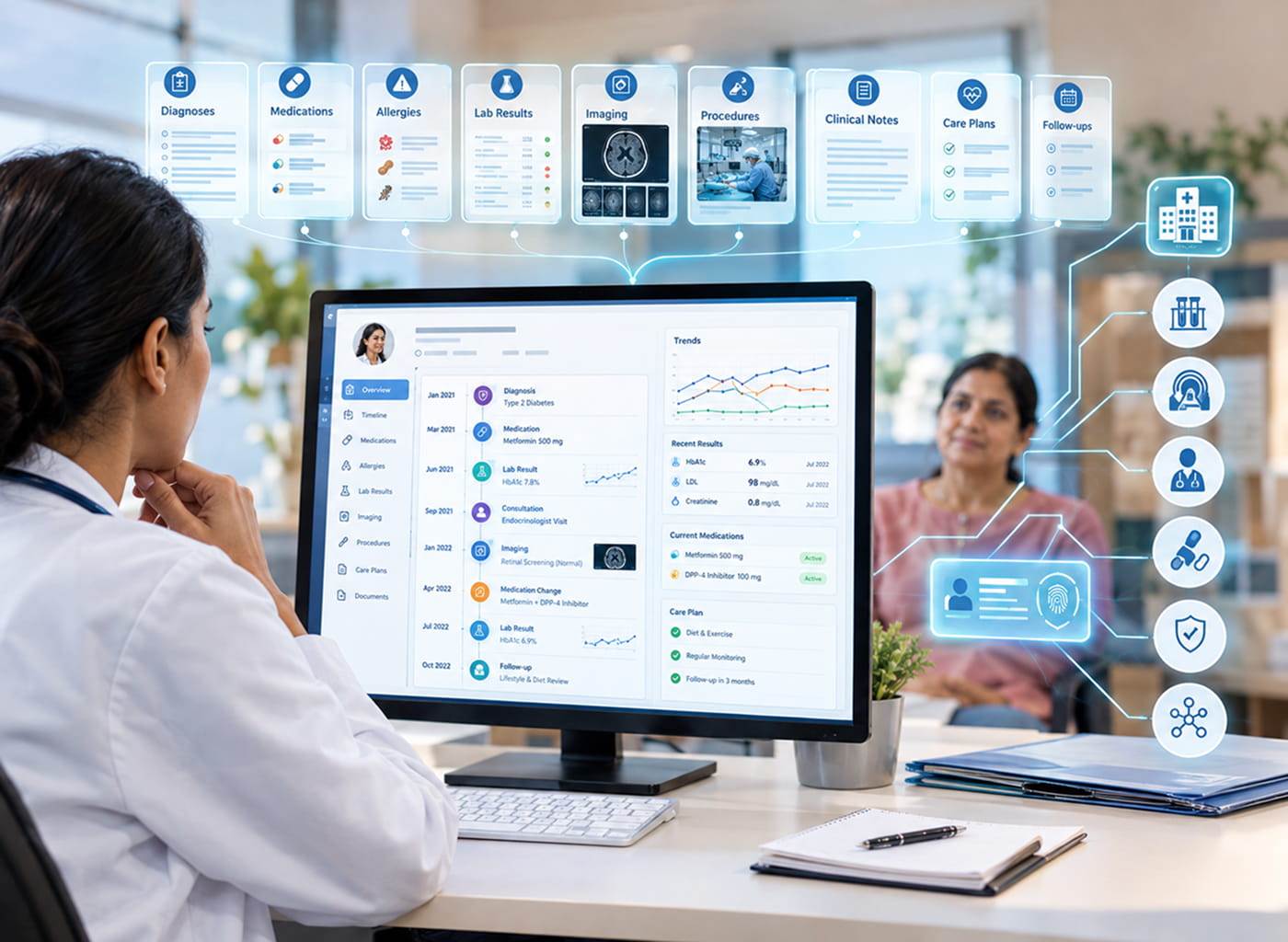
A longitudinal health record brings together relevant information about a patient over time. It may include diagnoses, medications, allergies, laboratory results, imaging reports, procedures, clinical observations, care plans, and follow-up recommendations. Its value lies not simply in storing these items together, but in making their relationships and chronology understandable.
Consider a patient managing a chronic condition across several years. Individual consultations may each contain accurate notes, but the clinical picture becomes more meaningful when changes in symptoms, medication adjustments, test results, and treatment responses can be considered together. A clinician reviewing only the latest encounter may see what happened today. A clinician with access to a reliable longitudinal view can also examine how the patient’s condition has evolved, which interventions were attempted and what information may be relevant to the next decision.
Building this view requires more than aggregating documents. Healthcare information arrives in different formats and may contain inconsistent terminology, missing fields, duplicated records or uncertain dates. A test result without its reference range or clinical context may be difficult to interpret. A medication entry may describe a prescription without confirming whether the patient is still taking it. A diagnosis recorded by one provider may need to be understood alongside subsequent assessments. Therefore, a useful longitudinal record must preserve provenance, timestamps, source information, and the distinction between confirmed facts, historical entries, and unresolved inconsistencies.
This is where interoperability standards and information governance become essential. Structured clinical data, appropriate terminology, consistent patient matching and standards-based exchange can make information easier to interpret across systems. In the Indian healthcare ecosystem, the Ayushman Bharat Digital Mission (ABDM) provides important building blocks for digital health identity, consent-based exchange, and interoperability. ABHA can help establish a digital health identity, while applicable exchange standards and consent mechanisms support the movement of health information between participating systems. However, identity alone does not create a longitudinal record, and connectivity alone does not guarantee clinical usefulness. The receiving system must still understand the information, establish its relevance, and present it appropriately within the care workflow.
The objective is not to produce the largest possible patient file. It is to create a dependable, time-aware clinical history that helps authorized healthcare professionals understand what has happened, what remains relevant, and what may require attention.
3. Patient-Centred Architecture Does Not Mean One Central Database
The phrase “single patient view” can easily be misunderstood as a proposal to place every health record in one enormous central database. That is neither a universal requirement nor necessarily the best architecture for every healthcare ecosystem. Different institutions have different operational needs, legal responsibilities, security requirements, and technology investments. A design that forces all information into one repository may create unnecessary migration costs and introduce a concentrated point of risk.
A more flexible approach separates the logical patient journey from the physical location of the underlying data. Records may remain within institutional systems or approved repositories while interoperable services support discovery, retrieval, and exchange under appropriate authorization. The architecture can maintain references to clinical events, identify their sources, and assemble relevant information when an authorized user or workflow needs it. In some environments, centralized storage may be appropriate for particular data classes; in others, federated or hybrid arrangements may be more suitable. The decision should follow clinical, regulatory, operational, and security requirements rather than an assumption that all information must reside in one place.
Identity management is one of the foundations of this architecture, but identity matching must be handled carefully. Incorrectly linking two people’s records can be more dangerous than failing to link records that belong together. Healthcare systems therefore need reliable matching processes, exception handling, and ways to correct identity errors without losing traceability. Consent and authorization must also be treated as active controls rather than one-time setup activities. The fact that information exists somewhere in the ecosystem does not mean every provider or application should have unrestricted access to it.
The same principle applies to clinical context. A patient may have a complete history spread across multiple sources, but not every event is relevant to every encounter. A clinician preparing for a consultation may need recent medications, significant diagnoses, allergies and important investigations, while another workflow may require a different subset of information. A patient-centred system should therefore make the right information available for the right purpose, while preserving access controls and source attribution.
The architectural goal is connected continuity, not indiscriminate consolidation. Systems should exchange enough information to support care without erasing institutional boundaries, compromising privacy or creating a new source of uncontrolled duplication.
4. The Real Transformation Happens When Information Changes the Workflow
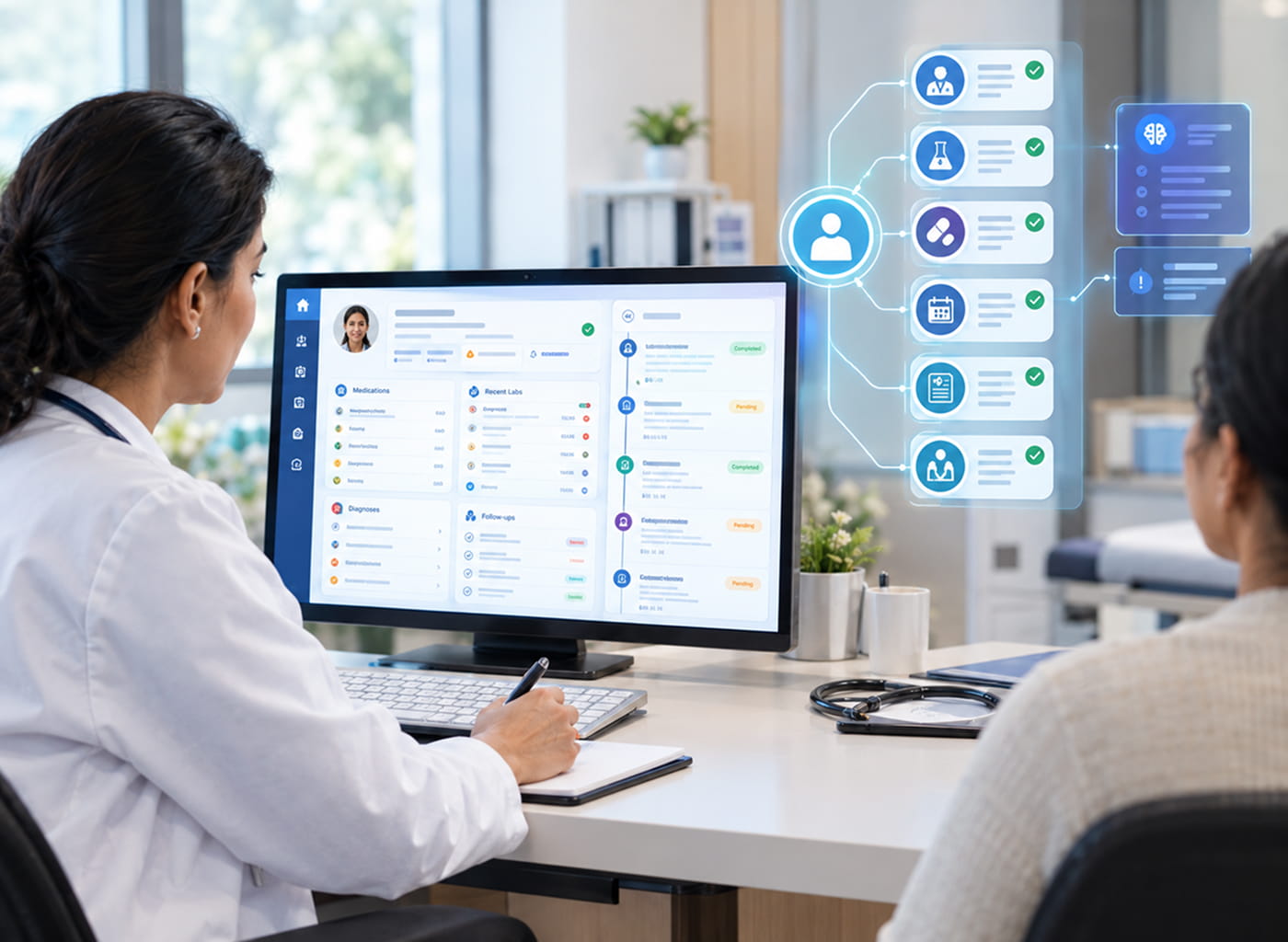
The next challenge is translating connected information into connected healthcare workflows that help care teams coordinate tasks, share relevant updates, and follow through on the actions required across the patient’s journey.
A longitudinal record has limited value if clinicians must leave their normal workflow, search through documents, and manually reconstruct the patient’s history. Healthcare technology becomes more useful when relevant information is presented at the point where a decision or action is taking place.
For example, when a patient arrives for a consultation, the system could assemble the available medication history, recent test results, previous diagnoses, and outstanding follow-up actions. It could identify that a previously ordered investigation has no recorded result or that a follow-up appointment remains incomplete. The clinician would still interpret the information and decide what action is appropriate, but would spend less time locating and reconciling it.
This requires the architecture to connect records with workflows. A clinical event should not be treated merely as a document to store; it may also affect the next action in the care journey. A laboratory result may need to reach the clinician responsible for reviewing it. A discharge plan may create follow-up tasks. A prescription may need to be reconciled with the patient’s current medication list. A referral may require acknowledgment by the receiving provider. These relationships should be represented in the system so that continuity does not depend entirely on someone remembering to send a message or check another application.
Such workflows need clear ownership. Technology can identify that an action is due, route information to the appropriate role, and track whether the task has been completed. However, it must not assume that every clinical situation can be reduced to a fixed sequence of automated steps. Patients miss appointments, conditions change, and clinicians may appropriately alter a care plan. The system should support exceptions, explain why a task remains open, and allow authorized professionals to make decisions that reflect the actual circumstances.
This is also where healthcare AI becomes more useful. A model working with a single isolated note has limited visibility into the broader clinical journey.
An AI system operating with appropriate longitudinal context may be better positioned to summarize relevant history, identify changes over time or help clinicians locate information across encounters. This makes clinical context for healthcare AI essential: outputs must be evaluated against source records, clinical safety requirements and the limits of the available evidence. The presence of more data does not automatically guarantee a correct recommendation.
The value of a patient-centred architecture therefore emerges when it reduces the distance between relevant information and responsible action. The record becomes part of the workflow rather than another destination clinicians must visit.
5. Privacy, Consent and Clinical Accountability Must Grow With Connectivity
Connecting a patient’s information across providers creates real opportunities, but it also increases the importance of responsible data governance. Health information is sensitive, and a system that makes records easier to retrieve must also make it clear who can retrieve them, for what purpose, and under which authorization.
A robust design should apply access controls according to role and purpose, maintain audit trails, protect information in transit and at rest, and support the consent and authorization requirements applicable to the relevant exchange. It should also address practical issues such as revocation, corrections, failed retrievals, and access during exceptional circumstances. The specific controls depend on the operating model and applicable regulations, but privacy cannot be added as a final security review after the architecture has already been chosen.
Clinical accountability is equally important. A longitudinal record may combine information from multiple providers, yet those providers remain responsible for their own clinical documentation and decisions. The system must preserve the source of each item and avoid presenting historical or unverified information as an unquestionable current fact. AI-generated summaries should be distinguishable from original clinical records, and any recommendations should make it possible for professionals to inspect the supporting information.
These safeguards are particularly important as systems begin to use patient history for decision support. A model may identify a pattern that deserves attention, but the clinical team must be able to examine the evidence, understand uncertainty, and decide whether the output is appropriate for the individual patient. When information is incomplete or conflicting, the system should make that limitation visible rather than create an artificial impression of certainty.
Patient-centred architecture should ultimately strengthen trust. It should make care more continuous without turning a person’s health history into an unrestricted pool of data. Better connectivity is valuable only when it remains aligned with privacy, clinical purpose, and accountable use.
6. Building Around the Patient Is an Architectural Shift, Not a Screen Design
Healthcare organizations sometimes approach patient-centred technology by beginning with a patient portal, mobile application or unified dashboard. These interfaces can improve access and communication, but they do not resolve fragmentation if the underlying systems remain disconnected. A patient may be able to view an appointment in one application while the clinician still cannot access the relevant diagnostic history in another. A polished interface cannot compensate for missing data relationships, unclear ownership, or incompatible workflows.
A more durable approach begins with the information and processes that must remain connected across the patient’s journey. Organizations need to understand how patient identity is established, where clinical events are recorded, how information can be exchanged, how consent is enforced, how records are reconciled, and how follow-up responsibilities are tracked. From there, the architecture can define the interoperability services, longitudinal record capabilities, and workflow orchestration needed to support the intended experience.
Implementation should be incremental. A healthcare organization might begin with a limited set of high-value journeys, such as referral-to-consultation, diagnostic-result follow-up or discharge-to-post-discharge care. It can establish the necessary data contracts, access rules, workflow ownership, and measurement before extending the pattern to additional departments or partner institutions. This approach makes integration challenges visible early and allows the organization to demonstrate clinical and operational value without attempting a disruptive replacement of every existing system.
The Prologic Perspective
At Prologic Technologies, this is the direction behind HealthFabric: connecting healthcare systems and workflows so that information can support decisions across the patient’s journey. The purpose is not to eliminate specialized hospital, laboratory, or clinic systems. It is to make them more capable of participating in coordinated care through interoperability, appropriate data exchange, and connected workflows. When combined with standards-based exchange and responsible use of AI, this architecture can create a stronger foundation for longitudinal records and more contextual healthcare services.
The long-term opportunity is to make continuity a property of the healthcare system rather than an additional burden placed on the patient. The patient should not have to function as the only integration layer between otherwise disconnected providers. Technology should help authorized professionals see the relevant history, understand the current situation, and act on what needs attention.
Healthcare will continue to depend on institutions, specialists and specialized applications. What must change is the way those components relate to the person they collectively serve. When the patient’s journey becomes the organizing principle, identity, records, consent and workflows can be designed to reinforce one another. That is how healthcare technology moves from a collection of institutional systems toward a more connected model of care.