










- What is a software-defined store?A software-defined store is a physical retail environment whose operational capabilities are connected through software, allowing transactions, inventory, fulfilment and other events to inform coordinated actions.
- How is it different from a smart store?The terms can overlap. The emphasis here is on the operating architecture connecting retail capabilities, rather than the presence of individual devices or smart technologies.
- Does a software-defined store require replacing existing systems?No. A retailer can connect existing POS, inventory, ecommerce and fulfilment systems through appropriate interfaces, events and shared business rules, introducing new capabilities incrementally.
- What role does AI play?AI can help interpret operational signals, identify unusual patterns, summarize store conditions and recommend actions. The quality of its output depends on data quality, context and appropriate validation.
- Which retail processes should be automated first?Good starting points include inventory updates, availability synchronization, routine order notifications and clearly defined exception workflows. These processes should have measurable benefits and reliable validation.
- Should every retail decision be autonomous?No. Routine, low-risk actions may be automated, while decisions involving ambiguous situations, customer commitments or significant commercial consequences may require human approval.
- How should retailers measure success?Useful measures include inventory accuracy, cancellation rates, fulfilment reliability, time to resolve exceptions, manual reconciliation effort and customer-service performance.
- What is CommerceFabric's role?CommerceFabric supports the connected commerce model by helping retail capabilities and workflows operate across systems and channels, creating a foundation for more intelligent operations.
Reading Time: 14 min
The Store Is Becoming a Software System
How connected data, AI, and automation are transforming the physical store from a collection of separate processes into a programmable commerce environment.
For decades, the physical retail store has been treated primarily as a place where products are displayed, customers make purchases, and employees manage daily operations. Technology has supported these activities through point-of-sale terminals, inventory systems, electronic shelf labels, workforce applications, and security equipment. Each system has improved a particular part of the operation, but the store itself has remained largely organized around separate tools and human coordination.
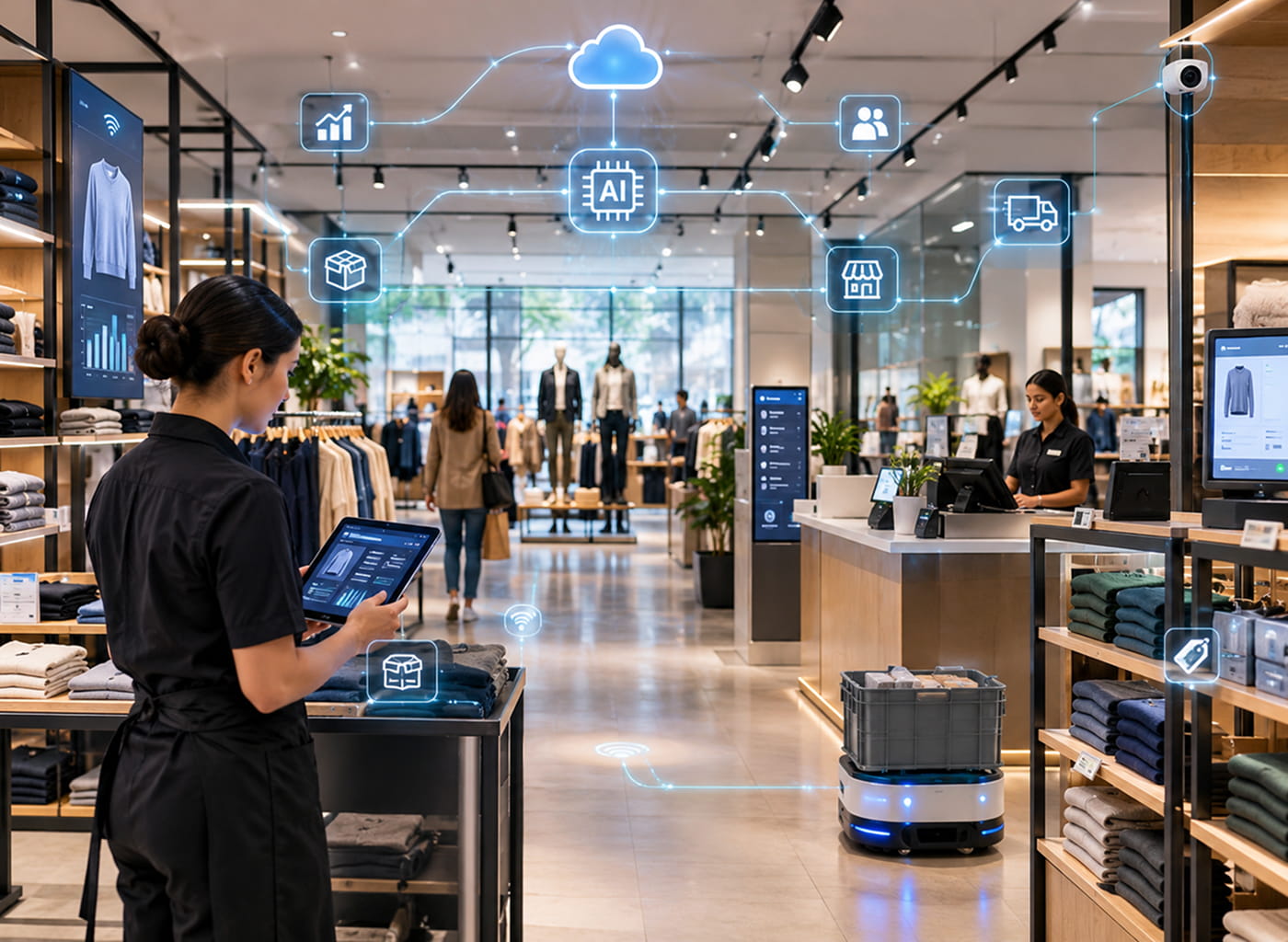
That model is beginning to change. Modern stores increasingly generate operational signals through transactions, inventory movements, customer interactions, connected devices, fulfilment events, and employee workflows. AI and automation can interpret some of these signals, while connected software systems can turn them into coordinated actions. The store is therefore becoming more than a physical location supported by technology. It is becoming a software-driven operating environment in which the physical world and digital systems continuously influence one another.
This does not mean that the store will become a building full of robots or that every decision will be automated. Retail will continue to depend on products, employees, customer relationships, and physical operations. The change is that more of those activities can be represented, monitored, and coordinated through software. A stock movement can influence replenishment, a transaction can update availability across channels, and an operational exception can trigger an investigation before it becomes a customer problem. This shift reflects a broader intelligent commerce operating model, where connected systems, operational data, and coordinated decisions work together across the commerce ecosystem rather than functioning as isolated capabilities.
The strategic opportunity lies in connecting these capabilities into a coherent system. When a store can understand its current state, interpret relevant events, and coordinate appropriate actions, it becomes more responsive to both customer needs and business conditions. That is the foundation of the software-defined store.
1. A Store Has Always Been a System, but Its Components Rarely Worked as One
A retail store already contains the elements of a complex operating system. It has inventory arriving and leaving, employees moving between tasks, customers interacting with products, payments being processed and orders being fulfilled. Managers continuously make decisions about replenishment, staffing, merchandising, customer service, and exceptions. The physical operation is dynamic even when the technology supporting it is not.
Historically, many of these activities have been managed through separate applications and manual procedures. The point-of-sale system records sales, the inventory system maintains stock levels, the workforce application handles schedules, and the ecommerce platform manages online orders. These systems may exchange information, but their timing, data models, and business rules do not always align. Employees and managers compensate for the gaps by checking multiple applications, reconciling discrepancies, and coordinating actions manually.
Consider a product that sells out faster than expected. The point-of-sale system records the transactions, but the inventory system may not immediately reflect the usable stock position. The ecommerce platform may continue accepting orders, while the replenishment process follows a schedule that does not account for the sudden change in demand. A store associate may discover the problem only when a customer asks for the item.
The issue is not that the retailer lacks software. The issue is that the software does not always operate as one connected system.
A software-defined store addresses this gap by establishing relationships between the events, information and decisions that govern retail operations. A sale can become an event that updates inventory availability, influences replenishment and informs fulfilment decisions. A discrepancy can trigger a verification workflow. A delivery delay can change the options presented to a customer. These relationships allow the store to respond to events rather than relying entirely on periodic reporting and manual intervention.
The distinction matters because connecting systems is not simply a technical integration exercise. The purpose is to make the operation behave more coherently, with fewer conflicting states and less unnecessary coordination.
2. The Physical Store Is Becoming Observable Through Software
A system cannot respond intelligently to conditions it cannot observe. In traditional retail operations, many important signals are discovered through employee experience, periodic stock counts, customer complaints or end-of-day reports. These methods remain useful, but they can reveal problems only after they have developed or after someone has noticed them.
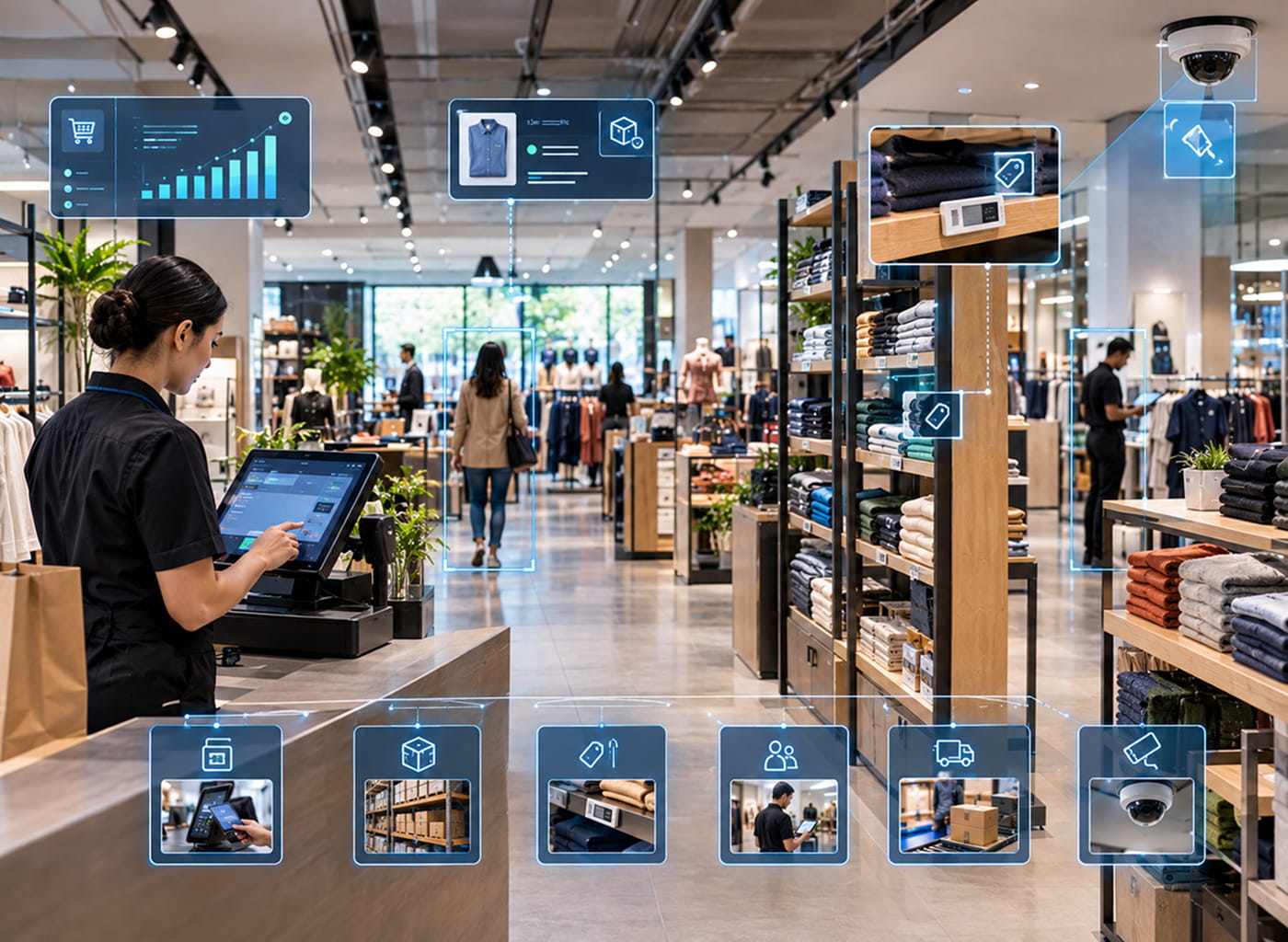
Connected retail technology creates more opportunities to observe the store as it operates. Point-of-sale transactions provide demand signals. Inventory events indicate stock movement. Electronic shelf labels can support centrally managed pricing updates. Sensors and computer vision may help identify certain shelf conditions or movement patterns when appropriate and permitted. Workforce systems can expose task status, while order-management systems provide visibility into fulfilment commitments.
These signals do not all have to be collected through sophisticated new devices. A substantial improvement may come simply from making existing operational data available in a consistent, timely and usable form. The architectural requirement is to understand which events matter, how they should be represented and which systems need to respond.
Observability also requires caution. A transaction record does not necessarily reveal why a customer made a purchase, and an inventory discrepancy does not automatically establish theft or employee error. Sensors can produce incomplete readings, and data may arrive late or conflict with other sources. A software-defined store must therefore distinguish between an observed event, an inferred condition, and a confirmed operational fact.
That distinction becomes particularly important when AI is introduced. A model may detect an unusual pattern and suggest an explanation, but the system should not treat the explanation as established truth without sufficient evidence. The architecture needs mechanisms for confidence assessment, verification, and escalation when the consequences of a mistaken interpretation are significant.
When these principles are applied carefully, store observability allows retailers to move from periodic snapshots toward a more current understanding of operations. Managers can see where attention may be required, and automation can respond to defined conditions without waiting for every issue to be discovered manually.
3. From Connected Devices to Connected Decisions
Retailers sometimes equate a smart store with the presence of connected devices. Sensors, smart shelves, digital signage, and automated checkout can all be valuable, but devices alone do not create an intelligent operating model. Their value depends on whether the information they produce can influence decisions elsewhere in the business.
Imagine a store where connected systems detect that a product is selling faster than expected, shelf availability is declining, and an online order has been promised for collection later that day. If those signals remain in separate applications, the retailer still depends on employees to reconcile the situation. If the systems share appropriate context, the store can assess available stock, reserve inventory for committed orders, recommend replenishment and update customer-facing availability. This depends on connected inventory intelligence that combines stock availability, demand signals, reservations and fulfilment commitments to support more responsive inventory decisions.
The important development is not the sensor or the prediction in isolation. It is the connection between the signal and the decision that follows.
This requires retailers to design event-driven workflows and decision rules that reflect the actual operation. Some responses can be automatic, such as updating an availability record after a confirmed transaction. Other actions may need approval, such as overriding a pricing rule, reallocating constrained inventory, or changing a customer commitment. The system must understand the difference between a routine state change and a decision that carries commercial or customer risk.
AI can contribute by interpreting more complex patterns and helping staff evaluate alternatives. It may identify demand anomalies, summarize store conditions, or recommend a response based on inventory, sales history and operational constraints. However, the reliability of those recommendations depends on the quality of the underlying data, the clarity of the business rules, and the availability of a safe execution path.
The software-defined store is therefore not simply a collection of devices that can communicate. It is an environment where operational events, business policies, human decisions, and automated actions are connected through a deliberate architecture.
4. Retail Automation Needs an Operating Model, Not Just More AI
As stores become more software-driven, retailers will face an important design decision: which activities should be automated, which should be recommended by AI, and which should remain under direct human control.
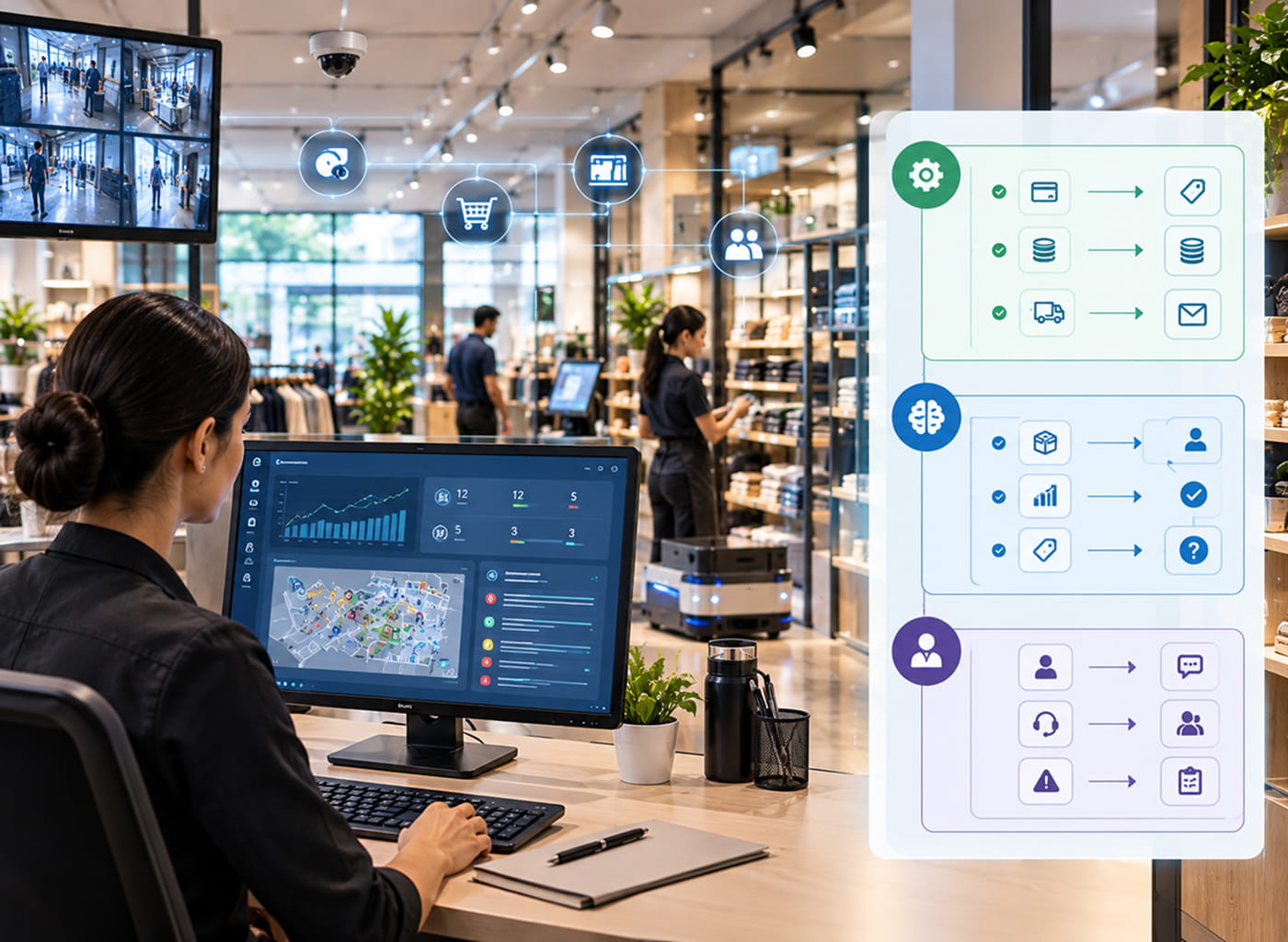
Routine, well-defined actions are strong candidates for automation. A confirmed sale can update stock records, an approved promotion can update eligible prices, and an order-status change can trigger a customer notification. These actions have clear conditions and can be validated against known rules. Automating them can reduce manual effort without introducing unnecessary ambiguity.
More complex decisions require a different approach. A system might detect that a store is running low on an item and recommend reallocating stock from another location. Before executing that action, it may need to consider existing reservations, transfer costs, delivery commitments, and local demand. AI can help evaluate the situation, but the organization must define the constraints and decide whether the action can be executed autonomously or requires approval.
This is where a governed operating model becomes essential. Each automated workflow needs a defined trigger, the information it can use, the actions it is permitted to take, and the conditions under which it must stop or escalate. The system should also record what happened so that managers can investigate errors and refine the workflow over time.
Human employees remain important within this model. They handle ambiguous situations, resolve customer-sensitive exceptions, and make judgments that cannot be reduced safely to a fixed rule. Retail automation should make those responsibilities easier by providing context and reducing repetitive coordination, rather than adding another layer of technology for employees to manage. The goal is retail automation that removes operational friction, reducing repetitive coordination while giving employees the context and time they need to handle customer needs and complex exceptions.
A software-defined store is therefore not necessarily an autonomous store. It is a store where software coordinates more of the operational work, while responsibility and autonomy are allocated according to the nature and risk of each decision.
5. Architecture Determines Whether the Store Can Evolve
Retailers rarely operate in a greenfield environment. They may have established POS platforms, legacy inventory applications, ecommerce systems, warehouse software, payment integrations and store-specific equipment that cannot all be replaced at once. A software-defined store must therefore be designed to work with a heterogeneous technology landscape.
A useful architecture separates business capabilities from the individual systems that implement them. Inventory availability, pricing, promotions, customer identity, order orchestration and fulfilment should have clear interfaces and ownership. Events and API-based interactions can connect those capabilities while preserving the operational responsibilities of the underlying systems. Where real-time processing is necessary, the architecture should support timely event propagation; where eventual consistency is acceptable, it should handle delayed updates and reconciliation explicitly.
This approach also makes change more manageable. A retailer can introduce a new shelf-monitoring capability without redesigning the entire POS environment, or add a new fulfilment option without embedding all its logic into the customer-facing application. The architecture becomes a platform for evolving store capabilities rather than a collection of tightly coupled projects.
However, technical connectivity alone is not sufficient. The systems need consistent business definitions. One application may interpret available inventory as physical stock, while another treats it as stock that can be promised to a customer after reservations and safety buffers are considered. Unless those definitions are reconciled, an apparently connected architecture can still produce contradictory decisions. Data contracts, ownership rules, reconciliation mechanisms and explicit handling of failure are therefore central to the design.
Security and resilience must also be built into the operating model. Retail operations cannot assume that every network connection will remain available or that every event will arrive exactly once. Systems need appropriate authentication, authorization, idempotency, retries, monitoring, and recovery procedures. When a connected service fails, the store must have a safe way to continue essential operations and reconcile changes when connectivity returns.
The strongest architecture is not the one with the most components. It is the one that allows the retailer to introduce new capabilities without repeatedly rebuilding the foundation, while preserving correctness, resilience, and operational control.
6. The Business Case Is Better Operations, Not Technological Spectacle
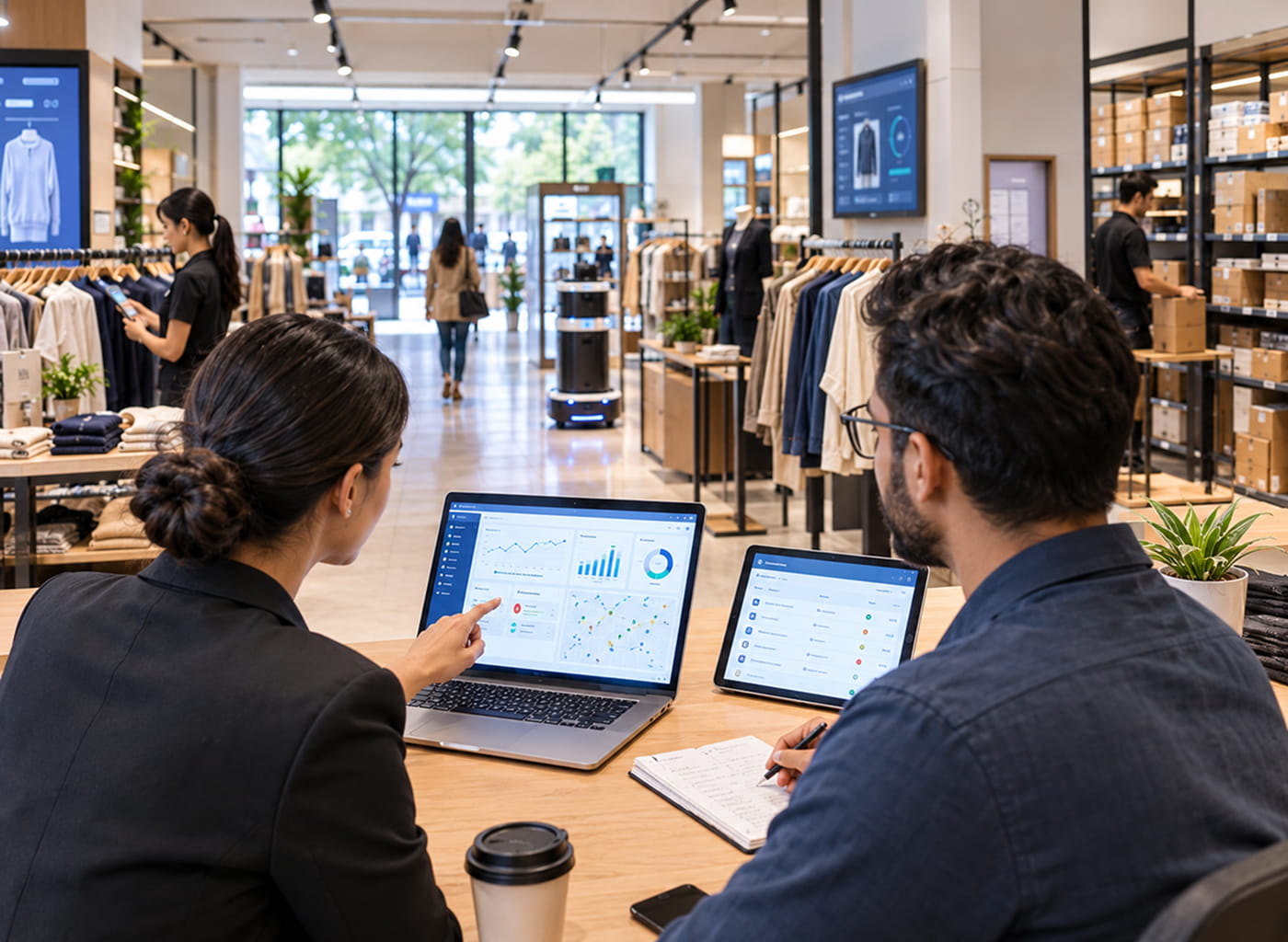
Retail technology investments can easily become focused on what is most visible. A futuristic checkout, a robotic device, or an interactive display creates an obvious demonstration. Yet some of the most valuable improvements may be less visible because they reduce the friction that customers and employees encounter every day.
More accurate availability can prevent customers from ordering products that cannot be fulfilled. Better coordination between online orders and store inventory can reduce cancellations. Earlier detection of operational exceptions can help employees resolve issues before they affect service. More contextual information can reduce the time managers spend assembling reports and help them prioritize attention. These improvements may not make a store look dramatically different, but they can change how reliably it operates.
Retailers should evaluate the software-defined store through operational outcomes rather than the number of connected devices or AI features deployed. Useful measures include inventory accuracy, order cancellation rates, fulfilment reliability, time required to resolve exceptions, manual reconciliation effort, and the proportion of routine workflows completed without unnecessary escalation. Customer experience and employee workload should also be considered, because an automation project that improves one metric while making everyday work more difficult may not produce a sustainable benefit.
Implementation should begin with a specific operational problem and a measurable baseline. A retailer might first connect inventory events to online availability or introduce a workflow for resolving order exceptions. The team can measure the results, address integration and governance issues, and then extend the pattern to additional capabilities. This incremental approach creates practical learning without requiring the retailer to automate the entire store at once.
The goal is not to make every store behave identically. Retailers operate in different formats, markets, and customer environments, and the appropriate level of automation will vary. The goal is to create a flexible operating foundation that can adapt to local conditions while preserving a consistent view of the business.
The CommerceFabric Perspective
At Prologic Technologies, we see the physical store as an increasingly important part of the wider intelligent commerce system. Its inventory, transactions, customer interactions, fulfilment operations and employee workflows should not be treated as isolated functions. They need to participate in a connected architecture that allows information to move between channels and operational decisions to reflect the current state of the business.
CommerceFabric’s role in this model is to support the capabilities that connect commerce operations across systems and channels. The objective is not to replace every retail application or to make every decision autonomous. It is to help retailers build a more coherent operating environment in which systems can exchange information, workflows can respond to events, and AI can contribute where it provides meaningful value.
This perspective also changes how retailers should think about innovation. A new capability becomes more valuable when it can participate in the existing operating model instead of creating another isolated application. A store that can incorporate new intelligence without rebuilding its entire technology foundation will be better positioned to adapt as customer expectations, fulfilment models and automation technologies evolve.
The physical store is becoming a software system because more of its operations can be observed, coordinated, and improved through software. Yet the purpose of that transformation is not to turn retail into an abstract technology exercise. It is to make the business more responsive, the operation more reliable, and the customer experience more consistent.
The store will remain a physical place where people discover products, seek advice, and make purchases. What changes is the intelligence of the system supporting those experiences. As connected architecture, AI, and automation mature, the store will increasingly behave like a software-defined environment: one that can sense relevant changes, coordinate appropriate responses and evolve without requiring every new capability to begin from scratch.
FAQs