






- What does FHIR stand for?FHIR stands for Fast Healthcare Interoperability Resources, a modern standard developed by HL7 International for exchanging healthcare information through standardized APIs.
- Is FHIR replacing HL7?No. FHIR is the latest interoperability standard developed by HL7 International. It complements existing standards such as HL7 v2, CDA and DICOM rather than replacing them.
- Is FHIR only for hospitals?No. FHIR is used across hospitals, clinics, laboratories, pharmacies, telemedicine platforms, health insurers, public health agencies and digital health applications.
- Does FHIR require replacing our EHR?No. FHIR typically extends existing EHR systems by providing standardized APIs for secure information exchange.
- Why is FHIR important for AI?FHIR structures healthcare data in a consistent, machine-readable format, making it easier for AI systems to access trusted clinical information.
- Is FHIR mandatory for ABDM?FHIR is one of the foundational interoperability standards used within India's Ayushman Bharat Digital Mission to enable secure health information exchange.
- Can small healthcare organizations implement FHIR?Yes. FHIR is scalable and can be adopted incrementally, allowing organizations of all sizes to modernize interoperability over time.
- What is SMART on FHIR?SMART on FHIR is an open standard that enables secure authentication and authorization for applications accessing FHIR APIs.
FHIR in the Real World
From Interoperability Standard to Healthcare Innovation Platform
SMART on FHIR
Enabling a New Generation of Healthcare Applications
FHIR defines how healthcare information is exchanged. SMART on FHIR defines how modern applications securely access that information.
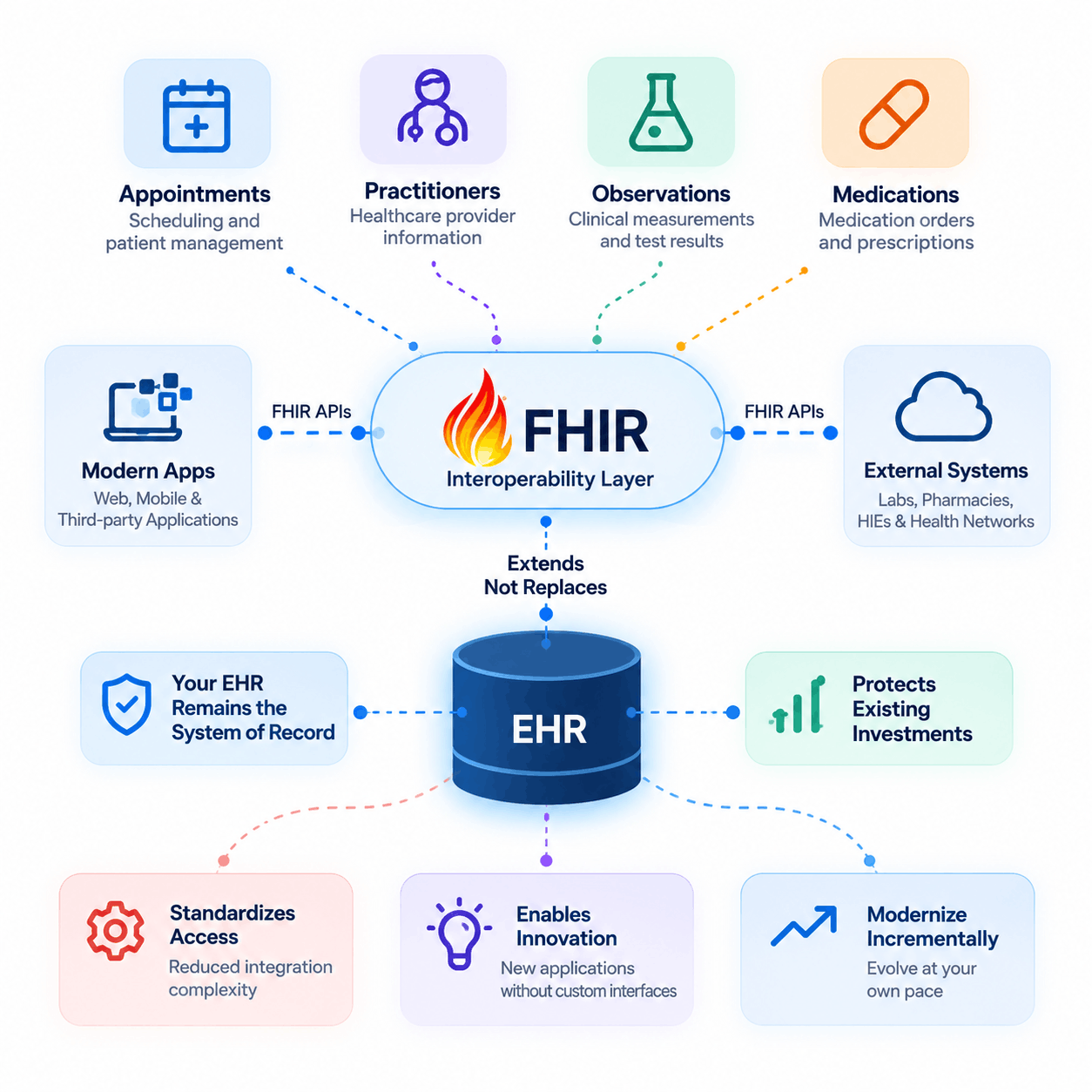
Why SMART on FHIR Matters
Without SMART on FHIR, each application would require a unique integration for every EHR vendor and hospital system. SMART on FHIR dramatically reduces this complexity by providing a single, secure way to connect. This accelerates innovation while maintaining strong security and governance.
Prologic Perspective
"FHIR standardizes healthcare data. SMART on FHIR standardizes how innovative applications securely access that data. Together, they create the foundation for an open healthcare innovation ecosystem."
Why FHIR Is the Foundation for AI in Healthcare
Artificial Intelligence is transforming healthcare- but AI cannot operate effectively without trusted, structured and interoperable data. This is where FHIR becomes indispensable.
Healthcare AI systems depend on accurate clinical context: Patient demographics, Medical history, Diagnoses, Medications, Laboratory results, Allergies, Procedures, and Clinical observations. FHIR provides a consistent, machine-readable structure for this information, enabling AI models to retrieve and interpret healthcare data more reliably.
Without interoperability, AI systems often spend more effort locating and cleaning data than generating meaningful insights. FHIR shifts that balance by making healthcare information more accessible and standardized.
FHIR Enables AI Across the Care Continuum
FHIR helps healthcare applications exchange structured information through standardized resources, APIs and implementation patterns.
AI Needs More Than FHIR
FHIR is the foundation - but responsible AI requires a complete
digital health ecosystem.
Prologic Perspective
"AI succeeds when it learns from connected, trustworthy healthcare data. FHIR provides the interoperability foundation that allows intelligent systems to operate consistently across clinical, operational and patient-facing workflows."
FHIR Around the World
Powering National Digital Health Ecosystems
FHIR has become the cornerstone of national digital health strategies worldwide, providing the standardized language necessary for large-scale interoperability and patient-centered care.

United States
Acceleration through ONC Cures Act regulations, mandatory patient access APIs, and broad EHR vendor support.

United Kingdom
NHS expansion for Integrated Care Systems (ICS) and Shared Care Records, utilizing FHIR for regional data liquidity.

Australia
Modernizing My Health Record with FHIR-based secure information sharing and national terminology services.

United Arab Emirates
Rapid modernization initiatives, AI adoption in clinical workflows, and patient-centered digital experiences.

India (ABDM)
The Ayushman Bharat Digital Mission foundation utilizes FHIR for a unified health interface.
A Shared Global Direction
How HealthFabric Leverages FHIR
FHIR provides the standard. HealthFabric provides the engineering platform. Rather than treating FHIR as a standalone API layer, HealthFabric integrates it into a broader interoperability architecture that connects healthcare systems, orchestrates workflows and prepares organizations for AI-driven innovation.
Why This Matters
Instead of creating dozens of custom integrations between systems, HealthFabric provides a reusable interoperability foundation. Organizations can:
Most importantly, healthcare organizations can continue evolving without
replacing their existing technology investments.
Prologic Perspective
"FHIR defines the language of interoperability. HealthFabric engineers the ecosystem where that language delivers real-world value through connected workflows, trusted governance and AI-ready healthcare platforms."
Executive Checklist
Is Your Organization Ready for FHIR?
Before beginning a FHIR implementation, healthcare leaders should assess whether their organization has the right technical and operational foundations in place.
Organizations that answer 'yes' to most of these questions are well positioned to leverage FHIR as a strategic enabler rather than simply another technology initiative.
Chapter Directory
Frequently Asked Questions
Continue Your Learning
Explore our healthcare interoperability resources, including FHIR, ABDM, SMART on FHIR, connected healthcare, and hospital architecture.
Ready to Build Interoperable, AI-Ready Healthcare?
FHIR is more than a technical standard - it is the foundation for connected, patient-centric and intelligent healthcare. But successful interoperability requires more than APIs. It demands thoughtful architecture, secure governance and a platform designed to evolve with the healthcare ecosystem. Whether you're planning an ABDM implementation, modernizing legacy systems, enabling virtual care or preparing for AI, Prologic Technologies can help you design and engineer a future-ready healthcare platform.