







Moving Beyond the Basics
The Modern Healthcare Ecosystem requires interoperability that is as dynamic as the care it supports. This chapter breaks down the architectural shifts necessary for true digital transformation.
FHIR vs HL7 - The Evolution of Exchange
One of the most common misconceptions is that FHIR replaces HL7.
It doesn't.
FHIR is actually the latest standard developed by HL7 International.
To understand the relationship, it helps to view healthcare interoperability as an evolution rather than a replacement.
Typical examples include:
Healthcare organizations could exchange entire clinical summaries such as:
It may only need:
Common Misconceptions About FHIR
FHIR helps healthcare applications exchange structured information through standardized resources, APIs and implementation patterns.
MYTH
FHIR Is a Software Product
FHIR is not an application.
It is not a database.
It is not an Electronic Health Record.
FHIR is an interoperability standard.
Think of it like HTTP for the web.
HTTP enables websites to communicate.
FHIR enables healthcare systems to communicate.
Organizations still need applications, infrastructure and business logic that use the standard effectively.
MYTH
FHIR Automatically Solves Interoperability
FHIR provides the language.
It does not solve governance.
Successful interoperability also requires:
Identity management
Consent management
Data governance
Clinical workflows
Master patient indexing
Security policies
Information quality
FHIR enables interoperability.
Good engineering delivers it.
MYTH
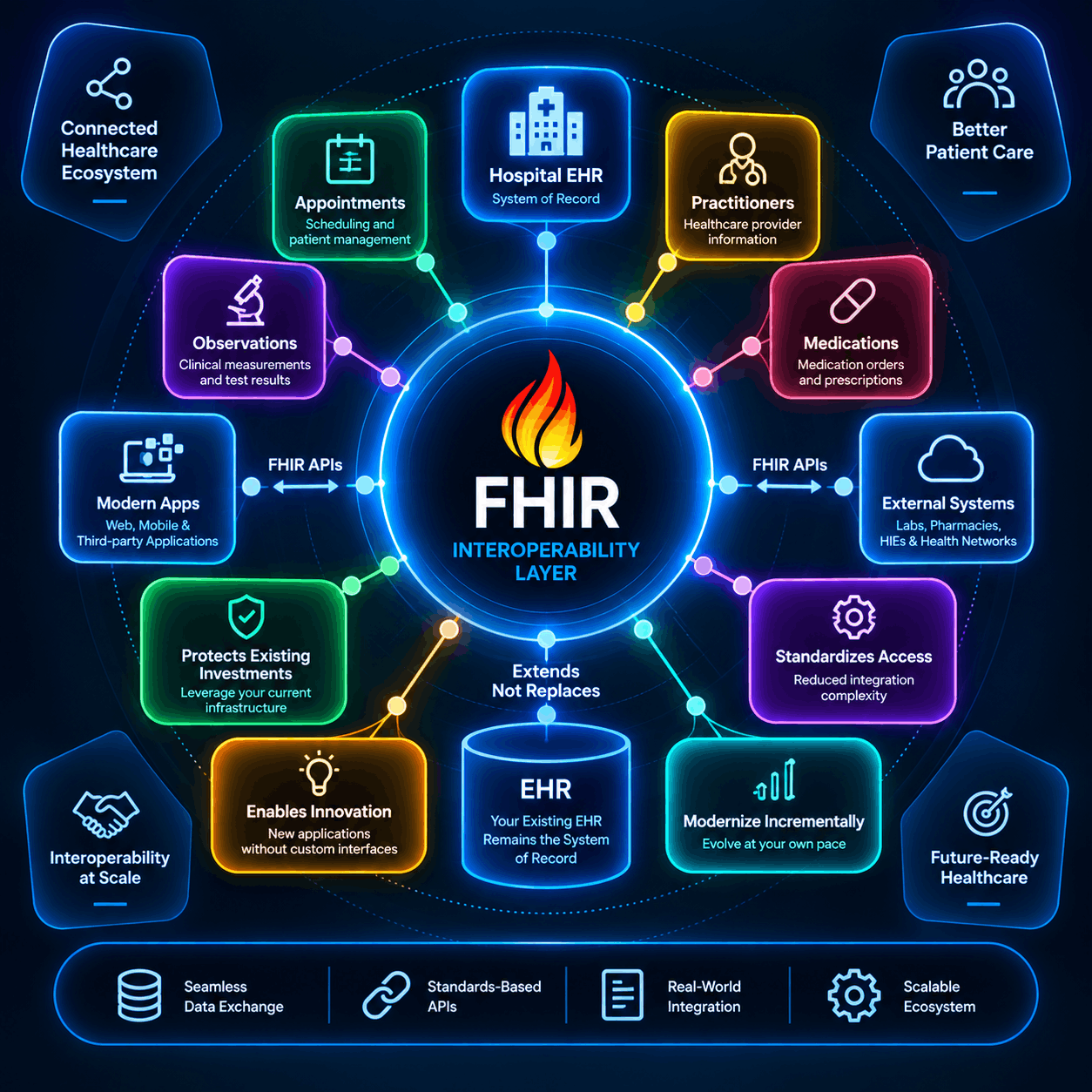
FHIR Replaces Existing Hospital Systems
Hospitals often worry that adopting FHIR means replacing their existing Electronic Health Record.
In reality, FHIR typically sits alongside existing systems.
It exposes standardized APIs that allow external applications to access approved healthcare information without replacing the underlying EHR.
This allows organizations to modernize gradually rather than undertaking risky system replacements.
MYTH
FHIR Is Only for Developers
Although FHIR is implemented by technical teams, its impact extends far beyond software engineering.
Hospital executives use FHIR to support digital transformation.
Clinicians benefit from better information sharing.
Patients experience more seamless care.
Government agencies rely on FHIR to support national interoperability initiatives.
FHIR is a business enabler as much as a technical standard.
MYTH
FHIR Guarantees Plug-and-Play Integration
FHIR dramatically simplifies interoperability—but it does not eliminate implementation effort.
Organizations still need to:
Map data models
Validate clinical terminology
Manage API security
Govern access permissions
Handle version compatibility
Test workflows thoroughly
Interoperability remains an engineering discipline, even with modern standards.
Prologic Perspective
"FHIR reduces the complexity of integration, but it doesn't remove the need for sound architecture. Organizations that treat FHIR as a strategic engineering capability- not simply an API standard- are far more likely to achieve sustainable interoperability."
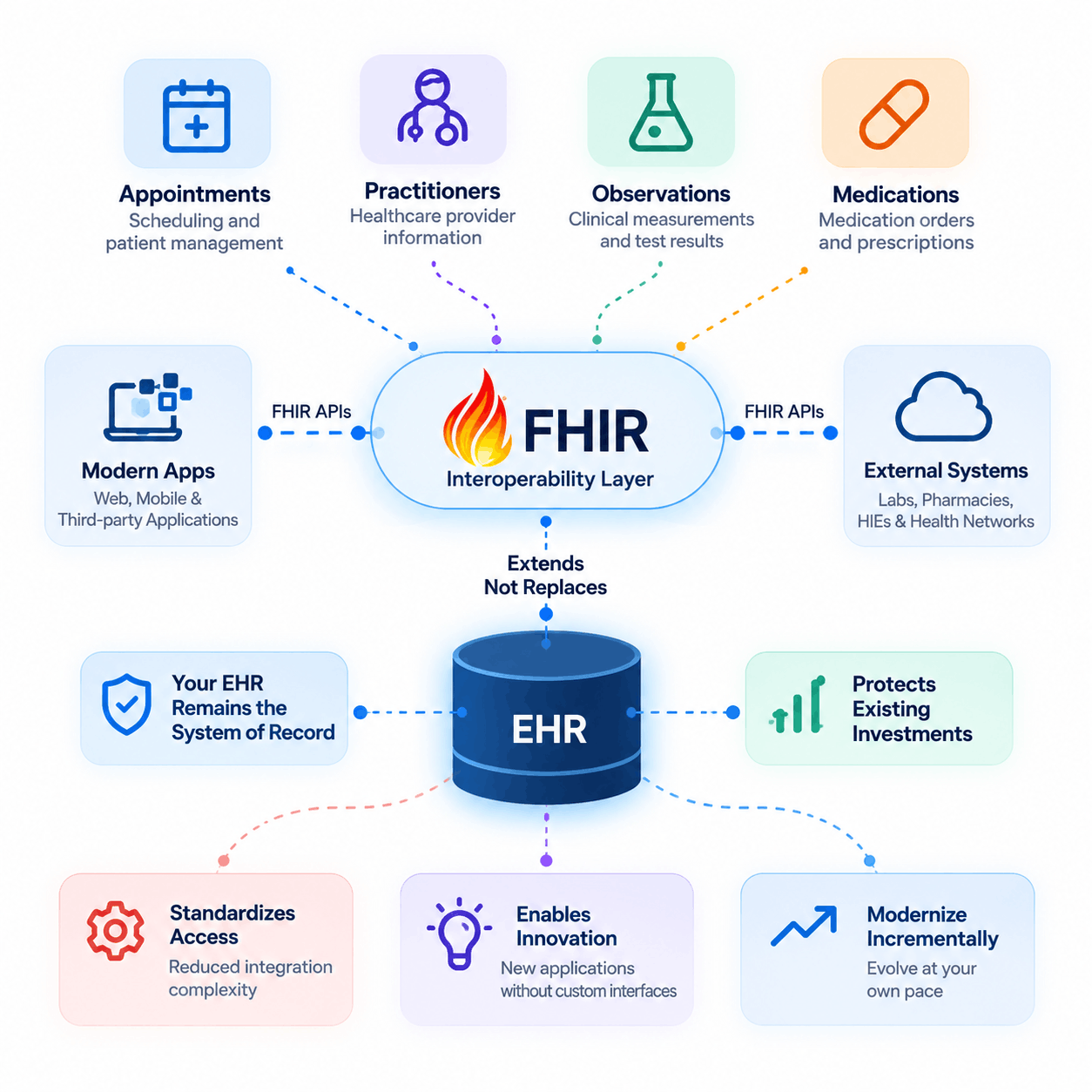
Does FHIR Replace Your EHR?
One of the first questions hospital executives ask is:
"If we implement FHIR, do we need a new Electronic Health Record?"
The answer is almost always no.
FHIR is designed to extend the value of existing systems - not replace them.
Your Electronic Health Record remains the system of record for clinical information.
FHIR acts as a secure interoperability layer that enables other authorized systems to access and exchange that information using standardized APIs.
This approach protects previous technology investments while enabling new digital capabilities.
The Biggest Challenges in FHIR Implementations
Implementation Challenges
Keys to a Successful FHIR Journey
Organizations consistently achieve better outcomes when they:
FHIR is most effective when treated as the foundation of a long-term interoperability strategy rather than a one-time integration project.
Chapter Directory
Ready to See FHIR in Action?
Move beyond interoperability and explore what FHIR makes possible.
Discover how FHIR can support connected healthcare applications, AI-driven innovation, and scalable digital health ecosystems.