










Consent, Intelligence & Connected Ecosystems
Interoperability creates enormous value, but healthcare data cannot simply flow wherever technology permits. Learn how consent, APIs, and AI reshape the connected healthcare landscape.
Consent Will Become the Control Plane
Interoperability creates enormous value, but healthcare data cannot simply flow wherever technology permits. It must flow where it is authorized to flow. This makes consent one of the most important architectural capabilities of connected healthcare.
The future is therefore not about building bigger data lakes and opening more APIs. It is about building trusted data flows. A patient should be able to understand what information is being shared, why it is being shared and with whom. Organizations need the ability to enforce those permissions consistently. Every important interaction should leave an auditable trail.
“Consent cannot remain a checkbox buried inside a registration workflow. It needs to become an architectural capability spanning identity, access, data exchange, applications and audit. The more connected healthcare becomes, the more sophisticated its trust architecture must become.”
This changes how consent should be designed. That is particularly important as healthcare ecosystems become increasingly interconnected across hospitals, clinics, labs, telemedicine providers, and national health networks.
From Interoperability to Intelligence
This is where the story becomes particularly interesting. The ultimate purpose of interoperability is not to move more data. It is to make better healthcare possible.
Once information can move reliably between systems, another possibility emerges: intelligent systems can begin to work across that information:
But there is an important architectural prerequisite: AI is only as useful as the healthcare information available to it. An intelligent model connected to fragmented, incomplete or poorly standardized data will produce limited value. An intelligent model operating on trusted, permissioned and interoperable healthcare data has a fundamentally different potential.
The Strategic Healthcare Doctrine
“The future of healthcare is not simply AI-powered. It is interoperability-powered AI.”
The Rise of the Healthcare API Economy
The next phase of healthcare technology will increasingly resemble an ecosystem rather than a collection of applications. Hospitals will connect to specialist platforms. Digital health companies will connect to hospitals. Labs will connect to care platforms. Pharmacies will connect to patient journeys. Insurance workflows will connect to clinical and administrative systems. AI agents will connect to multiple sources of authorized information.
The common denominator will be APIs and standardized data models. This creates what can be thought of as a Healthcare API Economy.
The competitive advantage will increasingly belong to organizations that can connect new capabilities into their ecosystem without rebuilding their technology stack every time. This is where composable architecture becomes important. Instead of asking:
“Which single platform should run everything?”
organizations can increasingly ask:
“How do we create an architecture in which the best capabilities can work together?”
That is a much more powerful question. It allows healthcare organizations to adopt best-in-breed tools without creating brittle technical dependencies.
India Has a Unique Opportunity
India's healthcare interoperability journey is particularly significant because the country is attempting to establish a digital public infrastructure for health at national scale.
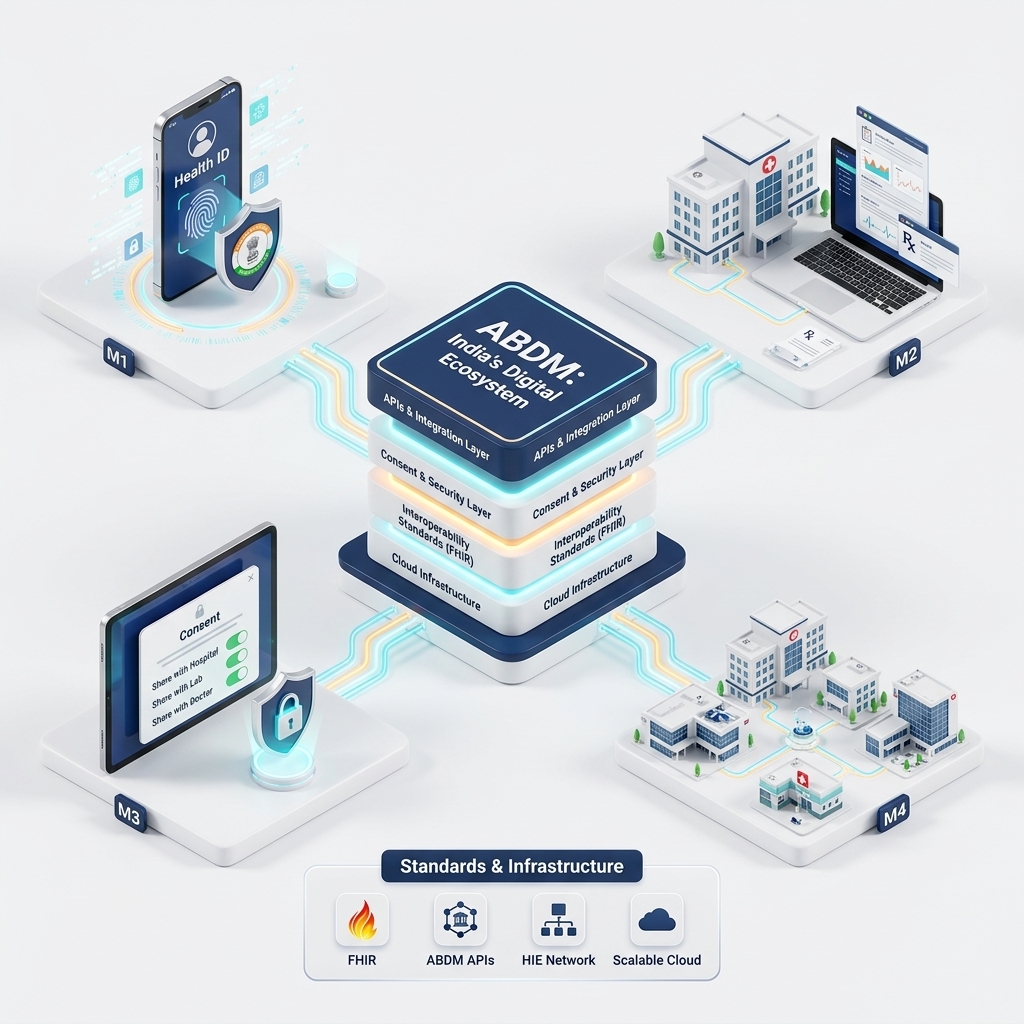
ABDM (Ayushman Bharat Digital Mission) brings together identity, registries, consent and interoperable health information exchange into a broader ecosystem. For healthcare organizations, this creates both an opportunity and a challenge:
The opportunity is enormous: participate in a national digital health ecosystem in which healthcare information can become more portable, accessible and connected across more than a billion citizens.
The challenge is architectural: implementation is not simply a matter of connecting an API. Organizations need to understand their existing architecture, identity flows, data models, consent requirements, FHIR implementation, operational workflows and milestone readiness (M1 through M3).
This is precisely why ABDM implementation needs to be approached as an engineering transformation, rather than a compliance checkbox. And as India's digital health ecosystem matures, the organizations that build interoperability correctly today will be considerably better positioned for the intelligent healthcare ecosystem of tomorrow.
What Healthcare Architecture Looks Like in 2030
By 2030, we expect healthcare architecture to become increasingly layered. Instead of applications sitting as isolated islands, they become connected components within a broader healthcare ecosystem:
5. Intelligence Layer
How can AI transform clinical decisions, workflows, predictive alerts, and patient experiences?
4. Applications & Workflows Layer
How does that information support actual clinical and administrative healthcare operations?
3. Consent & Trust Control Plane
Who is allowed to access what information, under which conditions, and with what auditable record?
2. Interoperability Layer
How does standardized information move between disparate systems safely and seamlessly?
1. Identity Layer (Foundation)
Who is the patient, practitioner or healthcare organization? (Persistent ABHA / HPR / HFR)
This creates a fundamentally different architecture from the traditional hospital-centric model. That is the architecture we believe healthcare organizations should begin designing for today.
Chapter Directory
About Prologic Technologies
Prologic Technologies is an AI-Native Healthcare & Commerce Engineering company helping organizations build, modernize and connect complex digital platforms.
Through HealthFabric™, Prologic brings together healthcare interoperability, ABDM engineering, AI-powered workflows and digital care into an integrated technology vision.
Our approach is deliberately engineering-led: understand the existing ecosystem, connect what matters, modernize what needs to evolve, and create an architecture capable of supporting what comes next.
Because the future of healthcare will not be built by replacing every system.
It will be built by connecting them intelligently.