









Engineering the Healthcare Ecosystem of 2030
The most interesting healthcare organizations in 2030 will not necessarily be those that replace everything they have today. They will be those that can connect what they already have to what they need tomorrow.
The Real Challenge: Connecting the Past to the Future
The most interesting healthcare organizations in 2030 will not necessarily be those that replace everything they have today. They will be those that can connect what they already have to what they need tomorrow.
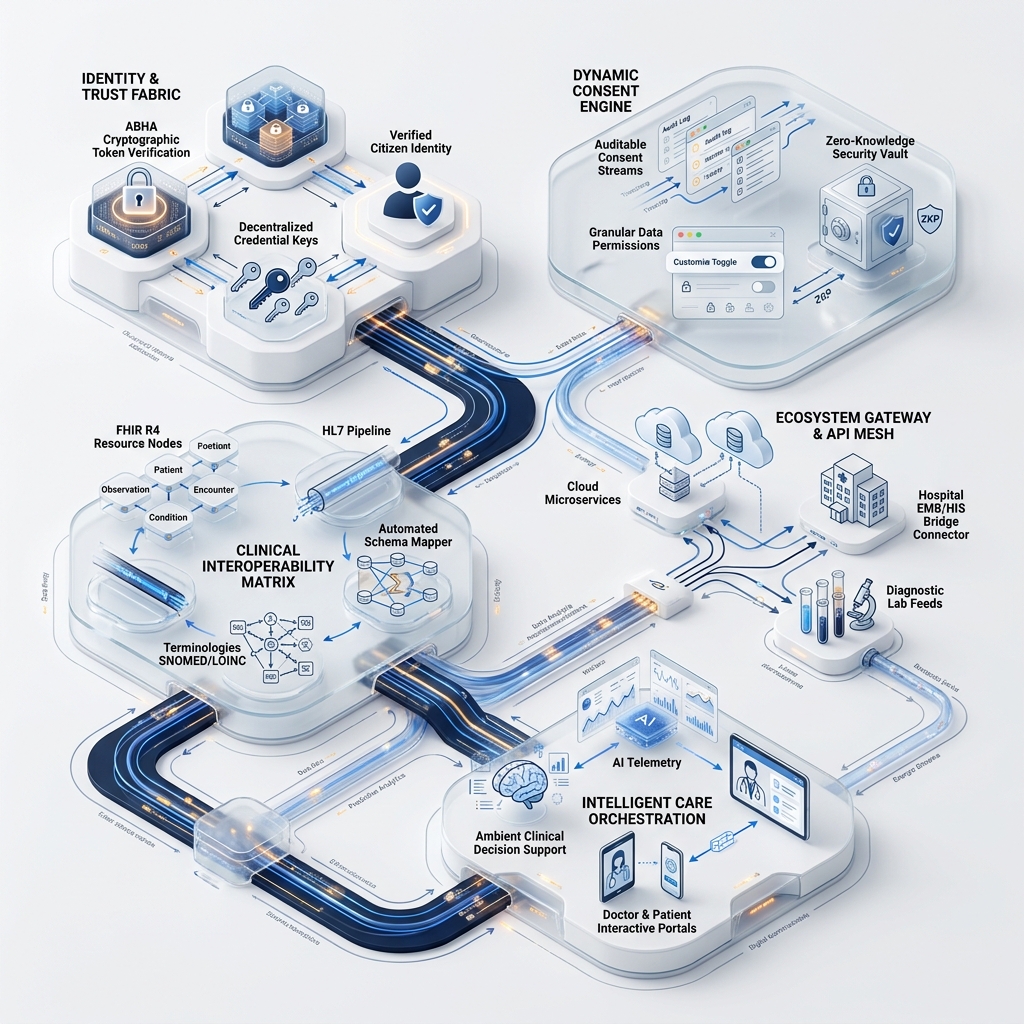
Most hospitals cannot simply discard their existing HIS, EMR, laboratory systems, PACS, billing platforms and other operational software. Nor should they. The engineering challenge is to create an interoperability layer that allows existing systems to participate in a modern digital ecosystem. This requires pragmatic architecture, where:
Legacy Coexistence
Legacy systems must coexist with modern APIs
Data Model Coexistence
FHIR must coexist with existing departmental data models
Infrastructure Coexistence
Cloud services must coexist with on-premise systems
Workflow Coexistence
New AI capabilities must coexist with established clinical workflows
And all of it must operate within an environment where security, privacy and patient consent are non-negotiable.
“The winners will not be those who build the most futuristic architecture. They will be those who build the most practical bridge from today's healthcare systems to tomorrow's healthcare ecosystem.”
The Prologic Perspective
We see interoperability differently from traditional software integration. Integration connects systems. Interoperability connects healthcare journeys.
That distinction sits at the heart of our HealthFabric™ vision. HealthFabric™ brings together four complementary engineering capabilities:
ProABDM
The foundation for participating in India's ABDM ecosystem-connecting identity, consent, FHIR-based exchange and ABDM workflows.
ProHealth Connect
The interoperability layer connecting healthcare systems, applications, APIs and data across a fragmented technology landscape.
ProHealth AI
The intelligence layer that turns connected healthcare information into AI-assisted workflows, automation and decision support.
ProTele Care
The care-delivery layer enabling secure digital consultations, virtual care and patient-provider interactions.
The HealthFabric™ Engineering Progression
“Connect the identity. Connect the data. Connect the workflow. Then make it intelligent.”
That is the larger idea behind HealthFabric™.
The 2030 Interoperability Checklist
Healthcare leaders preparing for the next decade should ask a different set of questions:
“And perhaps the most important question: Are we building today's healthcare technology for today's workflows-or tomorrow's healthcare ecosystem?”
The Road to 2030 Starts Now
Healthcare interoperability will not arrive as a single technology launch. It will emerge through thousands of architectural decisions made by hospitals, healthcare networks, technology providers, governments and digital health companies.
Some organizations will start with ABHA. Others will begin with FHIR. Some will modernize their APIs. Others will redesign consent. Some will introduce AI.
The important thing is not where the journey begins. The important thing is whether the architecture is designed to connect the next capability without breaking the previous one.
That is the real promise of interoperability. Not simply more connected software. Not simply standardized data. Not simply compliance. But a healthcare ecosystem in which the right information can reach the right person, at the right time, with the right authorization-and increasingly, with the right intelligence.
The 2030 Strategic Conclusion
“By 2030, interoperability will no longer be something healthcare organizations implement. It will be something they build their digital healthcare strategy around. And the organizations that understand that shift early will have a significant advantage.”
Related Prologic Resources
ABDM Implementation Guides
ABDM M1 Implementation Guide
Build the foundation for ABDM participation with digital identity, patient consent, health records, and secure information exchange across healthcare systems.
ABDM M2 Milestone Implementation Guide
Connect healthcare systems through interoperable APIs, standardized data exchange, consent workflows, and secure integration across hospitals and digital health platforms.
ABDM M3 Milestone Implementation Guide
Enable intelligent healthcare operations with AI-assisted workflows, connected health data, automation, and decision support for improved care delivery.
Explore the HealthFabric™ ecosystem

ProABDM
Simplify ABDM compliance with digital identity, consent management, FHIR-based health information exchange, and seamless integration with India's digital health ecosystem.
ProHealth Connect

Connect patients, providers, and healthcare systems through interoperable applications, secure data exchange, and coordinated digital healthcare experiences.
ProHealth AI

Transform healthcare operations with AI-powered insights, intelligent automation, predictive analytics, and data-driven support for clinical and administrative workflows.
ProTele Care

Deliver accessible virtual healthcare through remote consultations, digital patient engagement, care coordination, and connected telehealth experiences.
Interoperability is not the destination. It is the foundation on which intelligent healthcare will be built.
Chapter Directory
About Prologic Technologies
Prologic Technologies is an AI-Native Healthcare & Commerce Engineering company helping organizations build, modernize and connect complex digital platforms.
Through HealthFabric™, Prologic brings together healthcare interoperability, ABDM engineering, AI-powered workflows and digital care into an integrated technology vision.
Our approach is deliberately engineering-led: understand the existing ecosystem, connect what matters, modernize what needs to evolve, and create an architecture capable of supporting what comes next.
Because the future of healthcare will not be built by replacing every system.
It will be built by connecting them intelligently.