









Healthcare Doesn’t Need More Apps. It Needs Connected Workflows.
Why Digital Healthcare Still Feels Fragmented Despite Hundreds of New Solutions Executive Summary Healthcare has never had more software. Ho...

The healthcare industry talks about artificial intelligence as if doctors are waiting for a better diagnostic model, a more sophisticated clinical assistant, or a system that can answer increasingly complex medical questions.
Those capabilities matter. However, they don’t necessarily address the problem that clinicians feel most acutely every day.
Doctors are busy.
They spend time reviewing records, documenting consultations, searching for information, completing administrative tasks, coordinating with other providers, reviewing reports, responding to messages, and navigating systems that were often designed around institutional processes rather than clinical thinking. The actual consultation is only one part of the working day.
This changes how we should think about healthcare AI.
The most valuable AI system may not be the one that demonstrates the most impressive model capability. It may be the one that gives a physician back twenty minutes of fragmented attention every day.
That time matters because clinical care depends on attention. A doctor who spends less time searching, typing, copying information, and navigating disconnected systems has more capacity to listen, reason, explain, and make decisions.
The opportunity, therefore, is not simply to put AI in front of doctors.
It is to remove the unnecessary work that stands between doctors and patients.
Consider a typical consultation.
The patient enters the room, and the doctor needs to understand what has happened since the last visit. That sounds simple until we consider where the information may be distributed.
Previous consultation notes may sit in one system. Laboratory reports may have arrived through another channel. Imaging may exist elsewhere. Medication history may require additional review. The patient may mention something that isn’t recorded anywhere. A referral from another provider may contain important information that hasn’t yet been incorporated into the current record.
Before making a clinical decision, the physician may already have spent several minutes reconstructing the patient’s story.
Then comes documentation.
Then prescriptions.
Then follow-up instructions.
Then another patient.
None of these tasks are necessarily clinical decisions. Yet they consume clinical time.
This is one of the most important opportunities for healthcare AI: not replacing the physician’s judgment, but reducing the amount of work required to support that judgment.

Healthcare discussions often focus on data.
We need more data.
We need better interoperability.
We need longitudinal records.
We need structured clinical information.
All of these statements are valid. But there is another resource that receives much less attention.
Clinical attention is finite.
A physician can only review so many documents, interpret so many signals, and make so many decisions before cognitive fatigue begins to affect the quality of work.
More information doesn’t automatically solve that problem.
In fact, poorly organized information can make it worse.
Imagine giving a doctor access to ten years of a patient’s medical history but requiring them to manually identify the three events that are relevant to today’s consultation.
Technically, the information is available.
Operationally, the problem remains.
Healthcare AI becomes valuable when it can help transform large amounts of information into useful clinical context without taking control away from the person responsible for the decision.
The traditional healthcare software model often looks like this: collect information, store it, and provide screens through which users can retrieve it.
AI allows us to imagine a different model.
Instead of asking a physician to search through a patient’s history, the system can identify relevant patterns and present them in context. Instead of requiring a doctor to manually reconstruct recent events, the system can summarize the clinical journey while preserving links back to the underlying records. Instead of making clinicians repeatedly document the same information, AI can help structure the conversation into appropriate clinical documentation.
The distinction is important because the objective isn’t to generate more information.
It is to reduce the distance between information and action.
A useful healthcare AI system should help a clinician reach the information that matters, understand why it matters, and decide what to do next.
That is much more valuable than simply adding an AI chatbot to an existing application.
Clinical documentation has become one of the most discussed applications of healthcare AI, and for good reason.
Doctors spend significant amounts of time documenting encounters. AI can assist by converting conversations and clinical inputs into structured notes, identifying relevant information, and reducing repetitive typing.
But documentation is only one layer of the opportunity.
Once AI understands the context of a consultation, it can potentially support other parts of the workflow. It can help identify missing information, surface relevant historical events, prepare follow-up tasks, organize investigation results, and support communication between members of the care team.
The important shift is from AI as a documentation tool to AI as workflow intelligence.
That shift makes the technology much more valuable because the physician doesn’t experience healthcare as a collection of documentation tasks. They experience it as a continuous sequence of decisions and responsibilities.

There is a tendency to measure AI products by how visible the AI is.
A large conversational interface looks impressive. A sophisticated assistant that answers complex questions attracts attention. A system that announces every recommendation feels intelligent.
Clinical environments may require something different.
A doctor may not want to have a conversation with an AI every time they see a patient. They may simply want the relevant information to appear when they need it. They may want the system to prepare a summary automatically, identify an unusual result, draft documentation, or remind them about an unresolved issue without forcing them into another workflow.
In those situations, the most useful AI is almost invisible.
It becomes part of the environment in which the clinician works rather than another application competing for attention.
That is a much harder engineering problem.
It also has the potential to create much greater value.
A highly capable model does not automatically make a good healthcare AI system.
The model may be excellent at reasoning in isolation. However, clinical decisions rarely happen in isolation.
A physician needs the patient’s history, current symptoms, medications, investigations, previous interventions, relevant clinical guidelines, and the context of the current encounter. They also need to understand the limitations of whatever recommendation the system produces.
This is where healthcare AI depends heavily on context.
The same clinical observation can mean different things for different patients. A recommendation that makes sense in one situation may be inappropriate in another. A missing piece of information can materially change the decision.
Therefore, healthcare AI needs more than a powerful model.
It needs reliable patient context, appropriate data access, workflow awareness, strong governance, and clear boundaries around what the AI can and cannot do.
The intelligence of the model matters.
The intelligence of the surrounding system matters just as much.
Trust becomes especially important when AI participates in clinical workflows.
A physician needs to know where a recommendation came from, what information informed it, and where uncertainty remains.
An AI-generated summary should not quietly omit important information.
A recommendation should not appear authoritative simply because it is presented in a polished interface.
A system should make it possible for clinicians to inspect the underlying context when necessary.
This is particularly important because healthcare AI operates in an environment where the cost of an incorrect decision can be significant.
The goal isn’t to make AI appear certain.
The goal is to make its uncertainty understandable.
That distinction will become increasingly important as healthcare organizations move from experimentation toward production-scale AI adoption.

There is a persistent question in discussions about AI and medicine:
Will AI replace doctors?
It is an interesting question, but it is not the most useful one for designing healthcare systems today.
A more practical question is:
How can AI help doctors spend more of their time doing the work that requires doctors?
Clinical judgment includes much more than recognizing patterns in data. Doctors communicate with patients, understand context, weigh competing priorities, interpret uncertainty, consider patient preferences, and take responsibility for decisions.
AI can support many parts of that process.
It can organize information.
It can identify patterns.
It can summarize history.
It can assist documentation.
It can surface relevant information.
It can support decision-making.
But the system should preserve an appropriate role for human judgment, particularly when the consequences of an incorrect decision are significant.
The objective is not to make the doctor unnecessary.
It is to make the doctor more effective.
At Prologic, we see healthcare AI as part of a larger connected-care architecture rather than as an isolated feature.
A useful AI capability needs access to the right context. That context depends on interoperable health information, longitudinal patient records, consent, identity, clinical workflows, and reliable integration across healthcare systems.
This is why AI cannot be bolted onto healthcare as an afterthought.
If the underlying systems are fragmented, the AI inherits that fragmentation. If patient information is incomplete, the AI operates with incomplete context. If workflows are disconnected, AI recommendations may arrive at the wrong point in the care journey.
The real opportunity lies in connecting these layers.
Interoperability provides access to information. Longitudinal records provide context. AI provides intelligence. Workflow orchestration turns that intelligence into useful action.
Together, these capabilities can reduce the administrative and cognitive burden that prevents clinicians from spending more time on care.

Healthcare AI discussions often focus on accuracy, model performance, and automation rates.
Those metrics are important.
However, healthcare organizations should also ask a more practical question:
What did the technology give back to the clinician?
Did documentation take less time?
Did the physician spend less time searching through records?
Did the system reduce repetitive data entry?
Did it make relevant information easier to find?
Did it reduce unnecessary administrative work?
Did it allow the clinician to spend more time speaking with the patient?
These measurements connect AI investment to the actual purpose of healthcare delivery.
If an AI system becomes more sophisticated but adds another interface, another alert, another workflow, and another source of information for the physician to manage, it may be technically impressive while operationally disappointing.
The best healthcare AI should make the clinical environment simpler, not more complicated.
Healthcare will continue to adopt AI.
The question is no longer whether AI belongs in healthcare. It is where AI creates meaningful value and how safely organizations can integrate it into real clinical workflows.
The strongest systems will not treat AI as a destination.
They will treat it as an intelligence layer woven into the healthcare journey.
The patient record provides context.
Interoperability connects information.
Workflow systems coordinate action.
AI helps interpret, summarize, predict, and assist.
Clinicians remain responsible for decisions that require human judgment.
When these components work together, AI stops looking like a separate technology initiative and starts becoming part of the healthcare infrastructure itself.
That is where the real opportunity lies.
Doctors don’t need another screen asking them to interact with technology.
They need technology that removes the unnecessary work surrounding clinical care.
They need less searching, less copying, less repetitive documentation, less fragmented information, and fewer administrative tasks that consume time without improving the patient experience.
That is why the most valuable healthcare AI may not be the system that performs the most impressive demonstration.
It may be the quiet system that prepares the right information before the consultation, helps document what happened during it, surfaces what deserves attention afterward, and then gets out of the way.
The objective is not to put more intelligence between doctors and patients.
It is to remove the unnecessary work that keeps doctors away from them.
Because in healthcare, one of the most valuable things technology can give back is not data.
It is time.
Why Digital Healthcare Still Feels Fragmented Despite Hundreds of New Solutions Executive Summary Healthcare has never had more software. Ho...
Why Digital Identity Alone Doesn't Create Connected Healthcare Executive Summary When people first hear about the Ayushman Bharat Health Acc...
Why Sharing Data Isn't Enough to Transform Healthcare Executive Summary For years, digital health initiatives have focused on one primary ob...
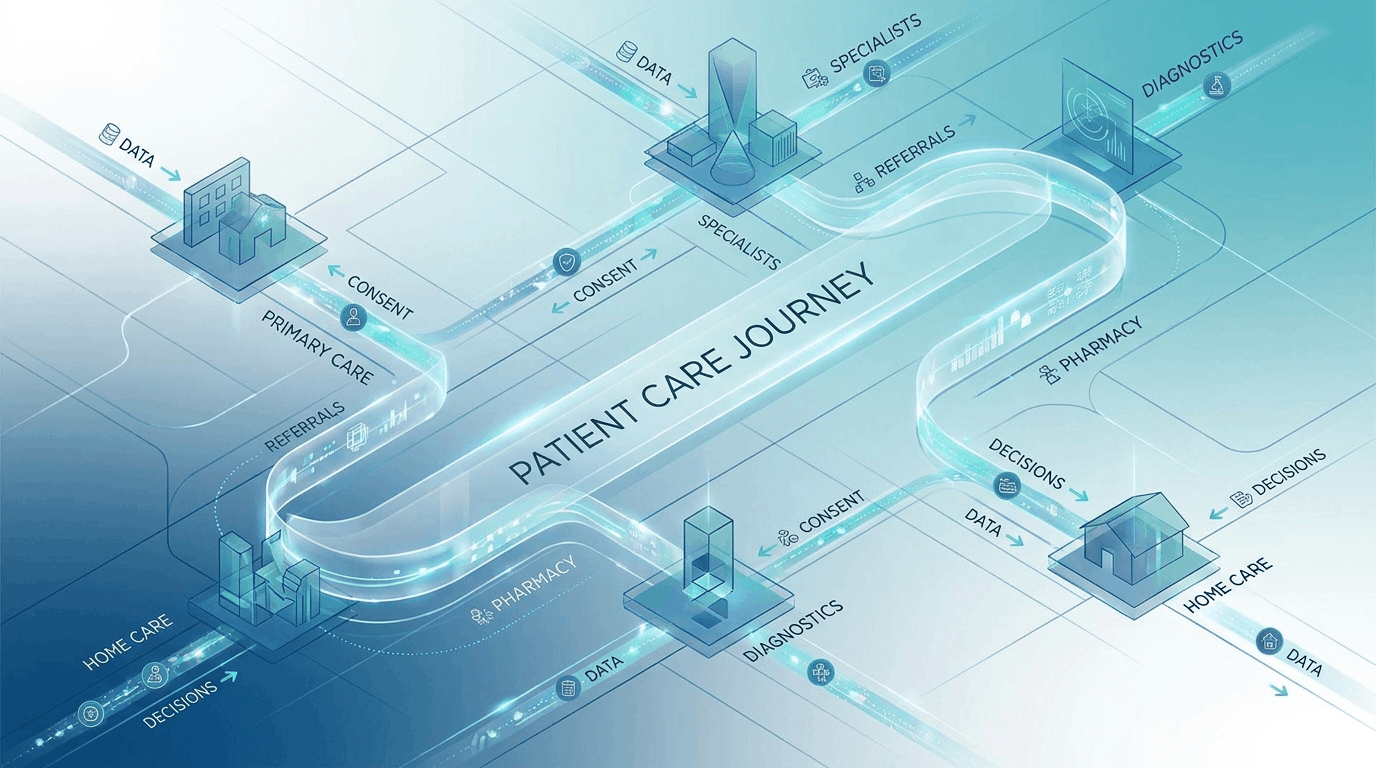
Healthcare Doesn’t Need More Apps. It Needs Connected Workflows.
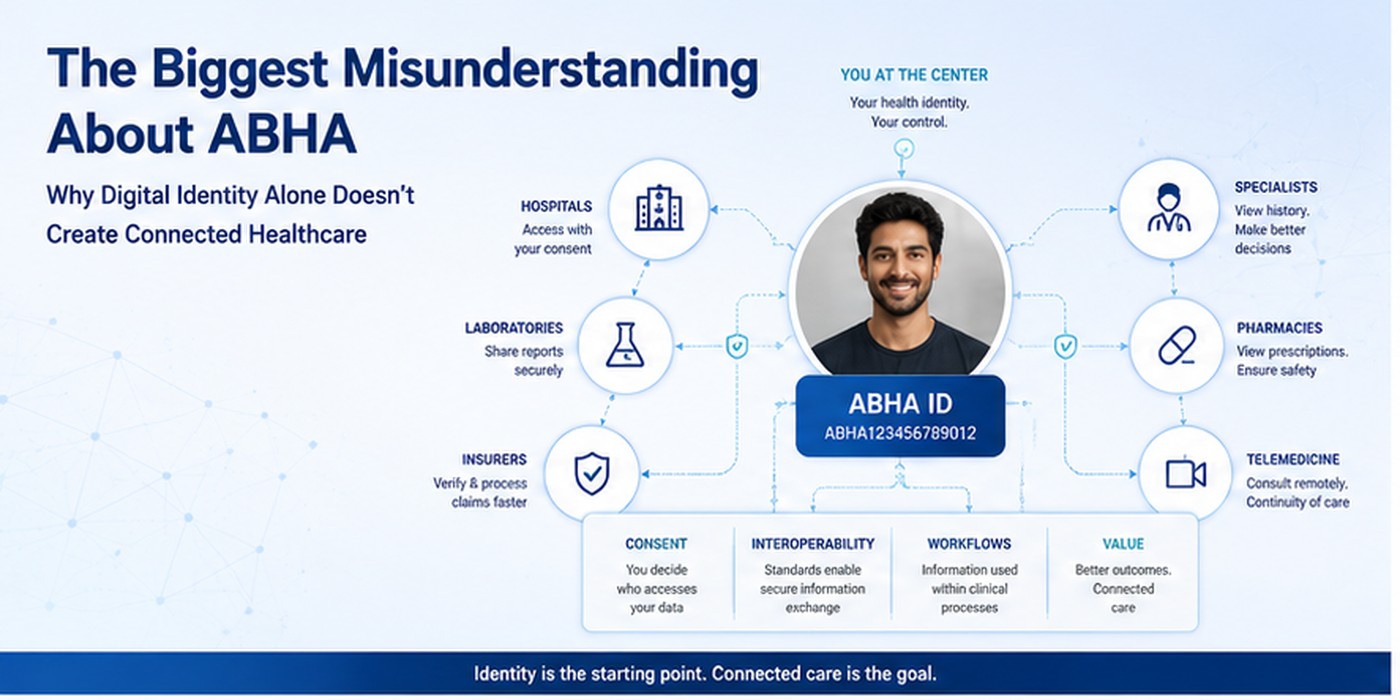
The Biggest Misunderstanding About ABHA

Connected Care Is Really Connected Decisions
