









Engineering Future-Ready Healthcare Platforms
Building Healthcare That Can Adapt, Scale and Evolve
The Future of Healthcare Cannot Be Engineered with Yesterday's Architecture
Many healthcare systems still operate on technology decisions made ten or even twenty years ago. Monolithic applications. Department-specific databases. Point-to-point integrations.
Batch data synchronization. Vendor-specific interfaces. These architectures were designed for an era where healthcare was largely delivered within the walls of a single hospital.
Today's Environment
Today's healthcare environment is fundamentally different. Patients move across providers, clinicians collaborate remotely, and virtual care is becoming mainstream. Wearables continuously generate health data, governments require interoperable information exchange, and Artificial Intelligence expects real-time, contextual information.
"The architecture supporting healthcare must evolve accordingly. Future-ready healthcare is no longer defined by the applications it runs. It is defined by the engineering principles upon which it is built."
Engineering Principles for Connected Healthcare
Healthcare organizations should avoid technology ecosystems that restrict interoperability or create long-term vendor lock-in.
Open standards such as FHIR, HL7 and RESTful APIs enable healthcare systems to exchange information more effectively while preserving flexibility for future innovation.
Open architecture creates resilience.
Every new capability should be designed as a reusable service rather than an isolated feature.
API-first architecture enables clinical systems, mobile applications, AI services and external healthcare platforms to interact through standardized interfaces.
This approach significantly reduces integration complexity while accelerating future development.
Artificial Intelligence should not exist as a standalone application.
It should become an intelligent layer embedded throughout the healthcare ecosystem.
Clinical workflows.
Documentation.
Decision support.
Patient engagement.
Operational analytics.
Predictive intelligence.
Organizations that engineer AI into their platform architecture achieve far greater long-term value than those deploying isolated AI tools.
Healthcare demand is unpredictable. Pandemics, seasonal illness, population growth and expansion into new regions can rapidly change infrastructure requirements. Future-ready platforms must scale without requiring complete infrastructure redesign. Cloud-native engineering provides elasticity, resilience and operational flexibility.
Healthcare data demands one of the highest levels of trust in any industry. Security cannot be an afterthought. Identity management, consent, encryption, auditability, access controls and regulatory compliance must be integrated into the architecture from the very beginning.
Healthcare will continue changing. New regulations, new clinical practices, new technologies and new patient expectations require platforms that continuously evolve. The most successful healthcare organizations treat software as an evolving capability - not a completed project.
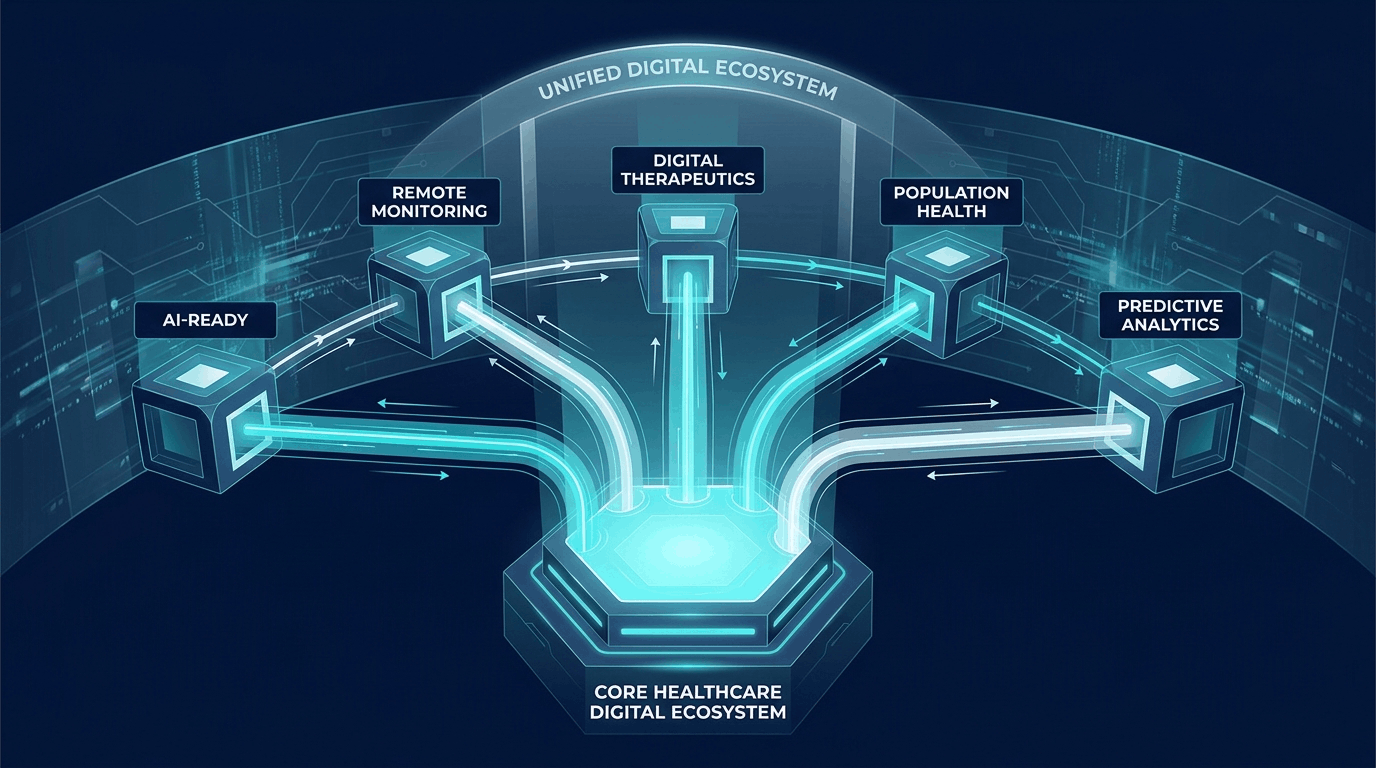
Healthcare Platforms Are Becoming Digital Ecosystems
The traditional view of healthcare technology focused on implementing applications. The modern view focuses on enabling ecosystems.
"Instead of asking: 'Which software do we need?' Leading organizations ask: 'How do we enable every participant in the healthcare journey to collaborate through a shared digital platform?'"
That shift changes the role of technology entirely. Platforms become the foundation upon which innovation happens. Every future capability- AI, remote monitoring, digital therapeutics, population health, predictive analytics- builds upon the same connected engineering foundation.
Prologic Perspective
Digital transformation projects often fail because organizations optimize individual systems rather than redesigning the ecosystem.
Sustainable innovation begins with platform engineering- creating a foundation where every future capability strengthens the entire healthcare network instead of adding another isolated application.
Chapter Directory
CONTINUE THE JOURNEY