









- What is AI beyond software?It is the application of AI to systems that interpret or influence physical-world conditions, including connected devices, computer vision, industrial operations, and edge computing.
- Why is real-world AI difficult?Physical environments introduce changing conditions, unreliable signals, connectivity constraints, and consequences that cannot be solved by model accuracy alone.
- What is edge AI?Edge AI runs some inference or processing close to where data is generated, potentially reducing latency and dependence on continuous cloud connectivity.
- How should organisations measure success?Use operational measures such as reduced downtime, faster response, fewer manual checks, and acceptable false-alert rates, alongside model performance.
- Should AI make every decision autonomously?Autonomy should be bounded by risk, confidence, policy, safety requirements, and the availability of human review.
Reading Time: 8 min
AI Beyond Software: The Hardest AI Problems Don’t Look Like AI Problems
For years, software innovation was largely measured by what happened on a screen. A better interface, a faster workflow, a more intelligent recommendation or a more efficient database could create a meaningful advantage. Artificial intelligence is changing that equation. Increasingly, the most valuable opportunities emerge when software has to understand and respond to what is happening in the physical world.
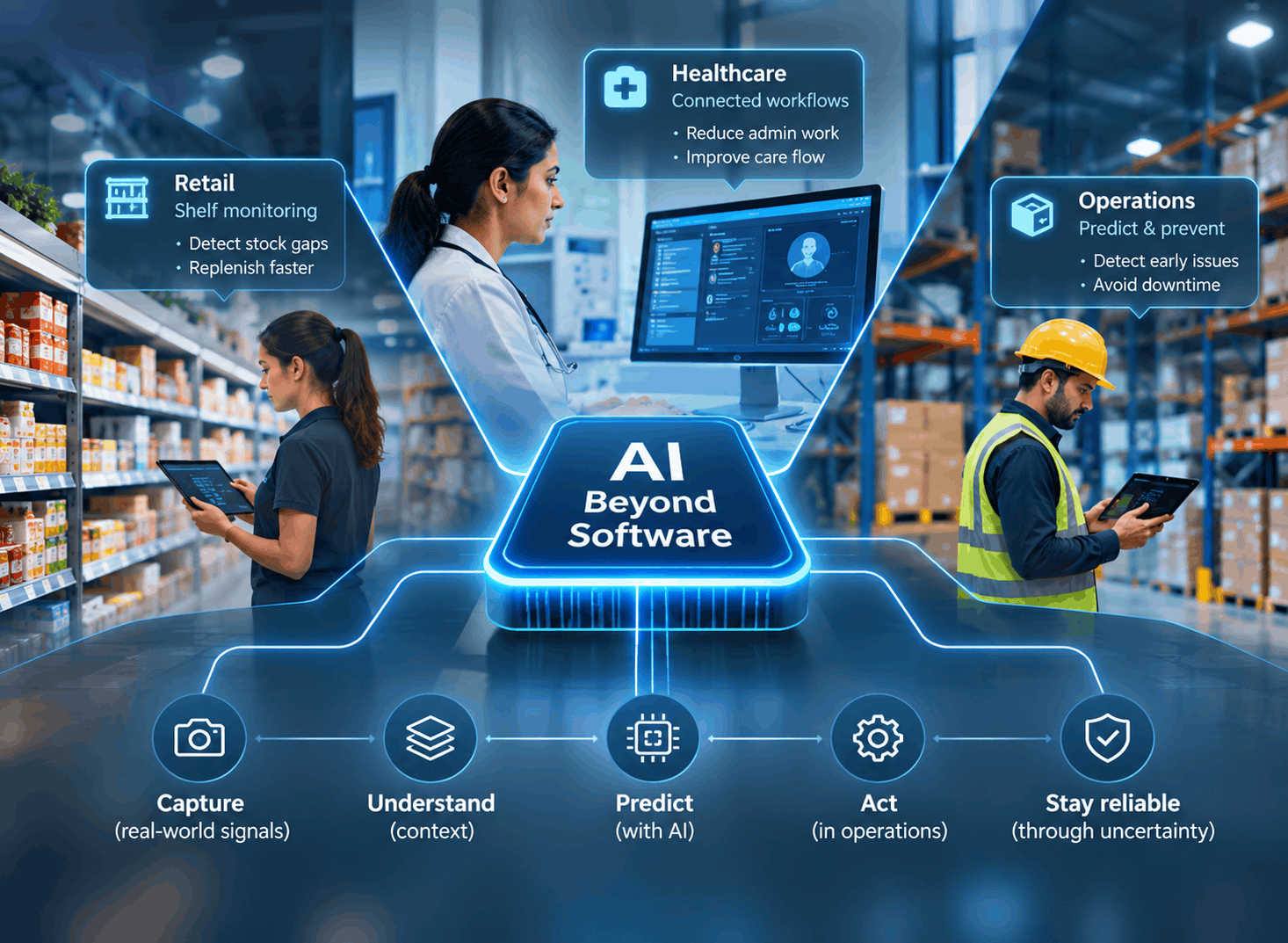
Consider a retail store where a product is frequently out of stock, a hospital where clinical staff spend valuable time navigating disconnected systems, or a warehouse where a small delay in one operation affects several downstream activities. Each situation could benefit from AI. Yet the model itself may be the least difficult part of the solution. The real challenge is understanding the environment, capturing reliable signals, interpreting context and translating a prediction into an action that people and operational systems can trust.
This is where AI beyond software becomes important. It is not simply about putting a language model into a physical device. It is about engineering systems that connect digital intelligence to real-world conditions.
The physical world does not behave like a clean dataset
Software systems often operate within boundaries that engineers can define. An API has a contract, a database has a schema, and an application has an expected workflow. Physical environments are less predictable. Lighting changes, sensors drift, people behave differently, equipment ages, networks become unreliable and operating conditions vary from one location to another.
A computer vision model may perform well during testing but struggle when a camera is repositioned or lighting conditions change. A sensor may report a plausible but inaccurate value. A machine may operate outside the assumptions used to train a predictive model. Even when the AI produces a correct interpretation, the surrounding system may lack the permissions or operational capability to act on it.
These are not unusual edge cases. They are normal characteristics of the physical world. Consequently, an AI system intended for real-world use must be designed around uncertainty, not merely evaluated against a clean benchmark.
The engineering challenge is therefore broader than model accuracy. It includes data acquisition, device reliability, network conditions, environmental variation, human behaviour, system integration and recovery when one component fails. A successful model inside an unreliable operational system will still produce an unreliable outcome.
Intelligence begins with context, not sensors
Sensors, cameras, connected devices and operational software can generate enormous volumes of information. However, collecting more data does not automatically create better decisions. A camera can detect movement without knowing whether that movement is normal, risky or relevant. A temperature sensor can report a reading without understanding whether the equipment is operating under expected conditions. A retail system can identify a shelf gap without knowing whether the product is temporarily unavailable, deliberately removed or awaiting replenishment.
The difference between a signal and a useful decision is context. That context may include location, time, operating rules, historical patterns, current workload, confidence levels and the consequences of taking action. It may also include information that is not available directly from a sensor, such as a maintenance schedule, an inventory policy or a human operator’s assessment.
This is why real-world AI projects need deliberate context engineering. Teams must decide which information matters, how it will be validated, how different sources will be reconciled and what uncertainty the system should communicate. The goal is not to feed every available data point into a model. It is to provide enough reliable, relevant context for the system to make a bounded decision.
The model is only one component of the system
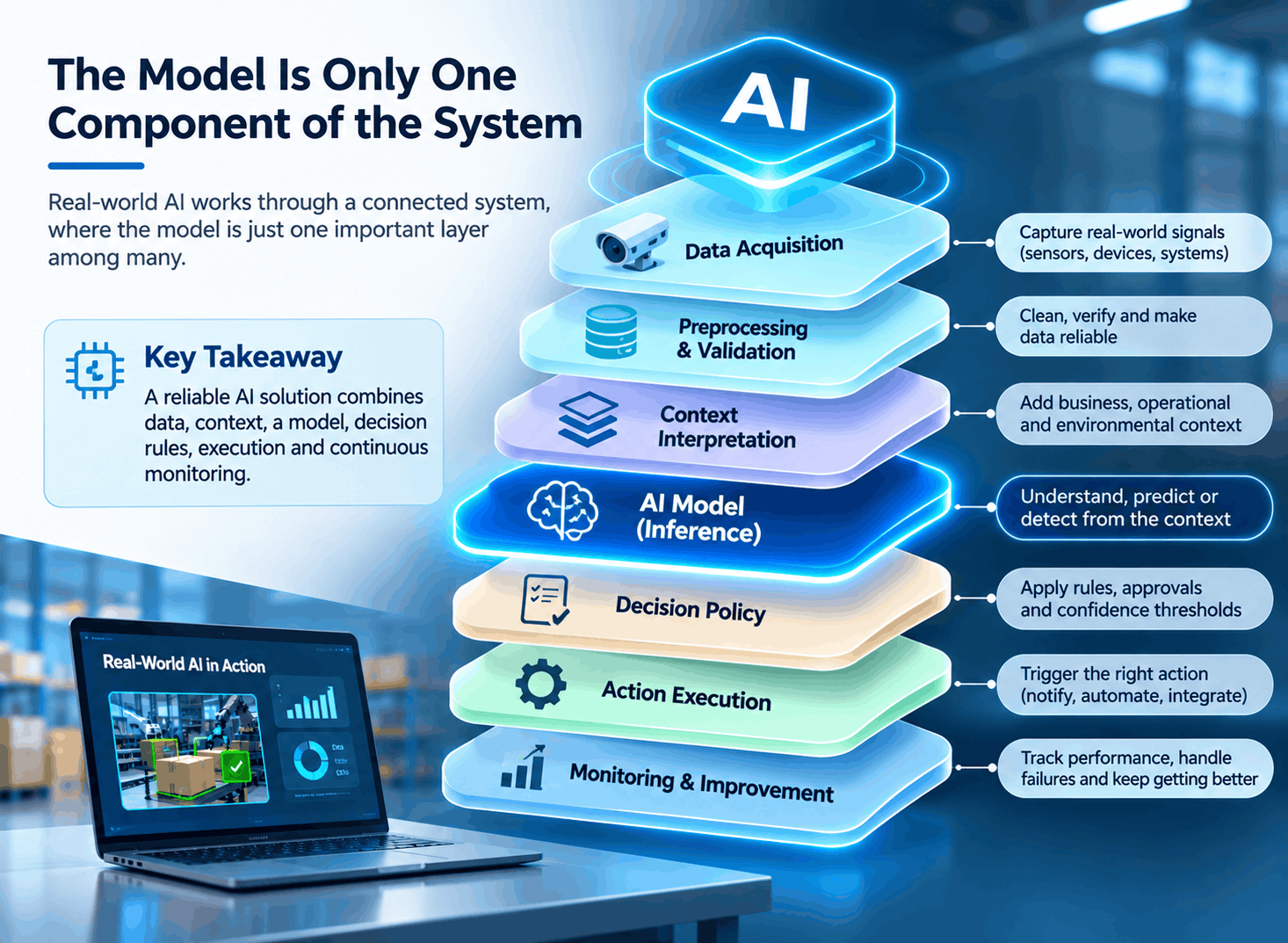
A useful real-world AI architecture typically contains several connected layers: data acquisition, preprocessing and validation, contextual interpretation, inference, decision policy, action execution and monitoring. Depending on the use case, some of these functions may run on a device, while others operate at the edge or in the cloud.
This distribution matters. An application that must respond immediately may not be able to depend on a distant cloud service. A system handling sensitive information may need to keep certain data local. A remote site may experience intermittent connectivity. In such circumstances, edge computing can reduce latency and improve resilience, but it also introduces constraints around device capacity, model updates, security and observability.
The architecture must also distinguish between a prediction and an authorised action. An AI model might predict that a machine is likely to fail, but maintenance scheduling still needs to consider safety procedures, available parts, operational priorities and approval rules. A vision system might identify a potential safety violation, but the response must be proportionate to the confidence of the detection and the consequences of a false alarm.
The most dependable systems therefore separate intelligence from control. AI can interpret conditions and recommend actions, while deterministic policies, access controls and human approvals govern what the system is allowed to do. As confidence and evidence improve, more actions may be automated, but that progression should be deliberate.
Reliability must be designed around failure
In physical environments, a wrong decision can have consequences beyond a disappointing user experience. It may interrupt an operation, waste inventory, create a safety concern or trigger unnecessary intervention. For that reason, real-world AI requires a failure-first approach.
Engineers should ask what happens when the camera is obscured, a sensor stops reporting, a network connection disappears, the model returns a low-confidence result or the same event is detected repeatedly. They should define safe defaults, fallback workflows, escalation paths and recovery procedures before deployment. Where appropriate, the system should abstain from making a decision rather than invent certainty.
Testing must reflect operating conditions, not just ideal conditions. Teams should evaluate model performance across different environments, monitor changes in input data, measure false positives and false negatives, and test the complete workflow from signal capture through to operational response. A model that achieves a strong laboratory score may still be unsuitable for deployment if it creates too many interruptions for the people expected to use it.
This is also where human factors become an engineering requirement. If frontline staff cannot understand an alert, do not trust its timing or have no practical way to challenge it, the system may be ignored. Adoption depends on whether the technology improves the work people are actually trying to complete.
Start with an operational problem, not an AI demonstration
A common mistake is to begin with a technology capability and search for somewhere to deploy it. A team discovers a promising computer vision model, an edge device or a new AI platform, then looks for a business problem that can justify the investment. This approach often produces impressive demonstrations without establishing measurable operational value.
A better starting point is a specific failure, delay or recurring decision. What is happening today? How often does it occur? What does it cost? Which signals would help identify it earlier? What action could realistically change the outcome? What happens when the system is wrong? These questions establish whether AI is appropriate and what the surrounding architecture must support.
The first deployment should usually have a bounded scope and a measurable objective. A retailer might test whether shelf-gap detection reduces the time between an out-of-stock event and replenishment. A manufacturer might evaluate whether predictive maintenance identifies actionable faults early enough to avoid downtime. A healthcare operator might investigate whether automation reduces administrative friction without disrupting clinical judgment or exposing sensitive information.
The evaluation should measure the operational outcome, not just the model output. Detection accuracy is useful, but so are response time, avoided downtime, reduction in manual checks, staff workload, false-alert burden and the cost of maintaining the system. These measures determine whether the technology is improving the real-world process.
The future belongs to systems that connect intelligence to action
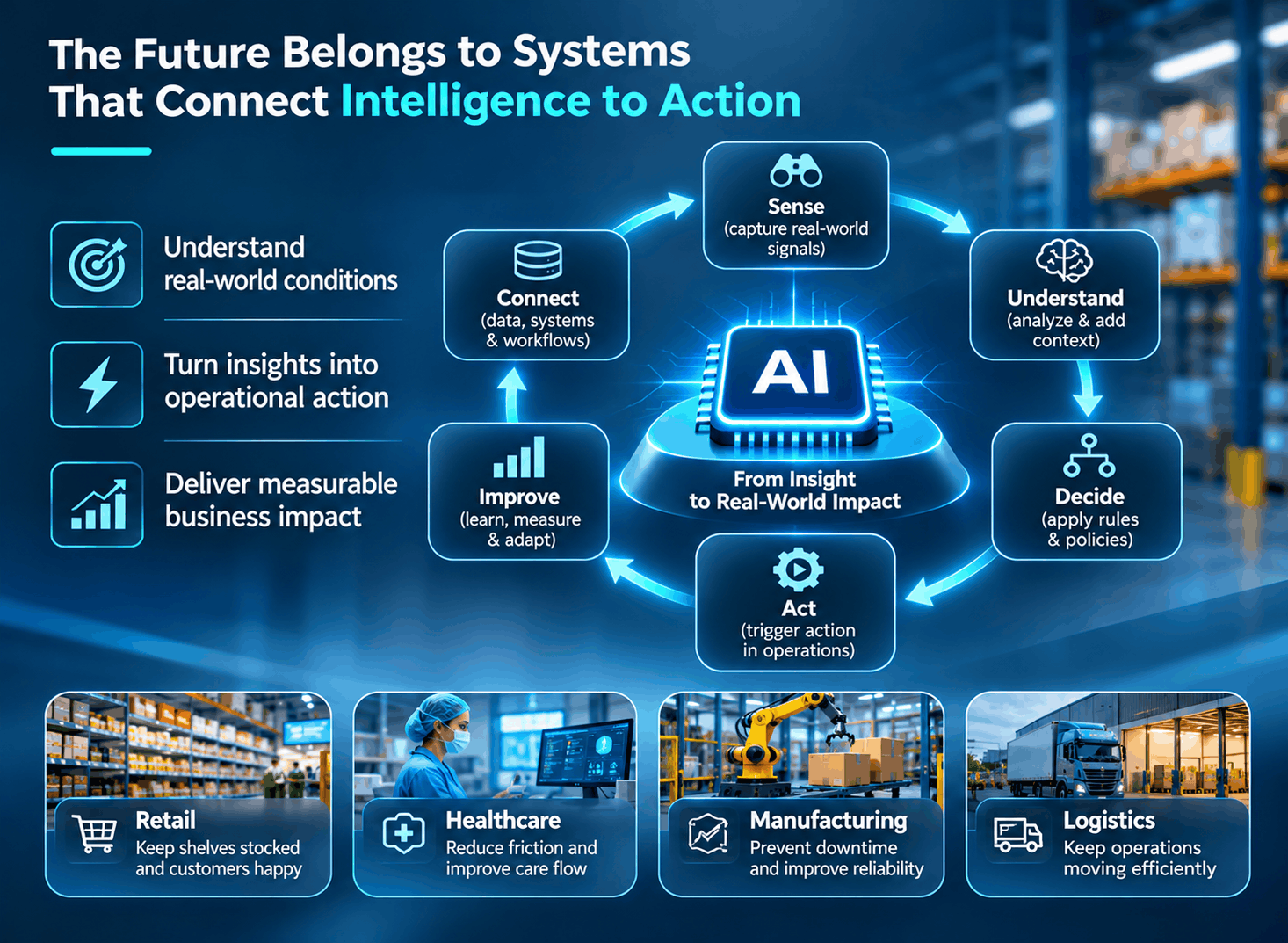
AI beyond software is not a separate category of innovation reserved for robotics laboratories or large industrial companies. It is an engineering discipline that becomes relevant whenever digital decisions depend on changing real-world conditions. Retail, healthcare, logistics, manufacturing and connected environments all contain opportunities, but they also expose the limitations of treating AI as an isolated feature.
The advantage will not necessarily go to the organisation with the most sophisticated model. It may go to the team that understands the operational environment, selects the right signals, handles uncertainty honestly and integrates intelligence into a workflow that can recover when things go wrong.
For engineering leaders, the implication is straightforward: do not ask only whether AI can recognise a pattern. Ask whether the complete system can turn that recognition into a reliable, safe and useful outcome. That is the difference between demonstrating intelligence and engineering it into the real world.