











- What does clinical context mean in healthcare AI?Clinical context is the relevant patient history, current encounter information, timing, source evidence, clinical purpose and uncertainty needed to interpret information appropriately for a healthcare task.
- Why can a powerful AI model still produce an unsuitable clinical answer?The model may lack relevant history, receive outdated or conflicting information, or operate without understanding the purpose and constraints of the clinical workflow.
- Does healthcare AI need the patient's entire medical record?Not necessarily. It needs the information relevant to its intended task, retrieved under appropriate authorization and presented with sufficient context to support verification.
- How does a longitudinal health record improve AI usefulness?It can provide relevant information across encounters and time, helping systems identify changes and relationships that are not visible in a single note.
- Is interoperability enough to create clinical context?No. Interoperability makes information exchange possible, but the receiving system must also interpret the information, preserve provenance, identify discrepancies, and connect it to the intended workflow.
- How should clinical AI handle missing information?It should distinguish missing information from a confirmed negative finding, communicate uncertainty and request clarification or human review when the missing evidence affects the task.
- What role should clinicians retain?Clinicians remain responsible for professional judgment and clinical decisions. AI should support their work within defined boundaries, with validation and oversight appropriate to the intended use.
- How does HealthFabric support context-aware healthcare AI?HealthFabric focuses on connecting healthcare systems and workflows so authorized, relevant information can support clinical and operational tasks across the patient's journey.
Reading Time: 14 min
Healthcare AI Will Fail Without Clinical Context
Why useful healthcare intelligence depends on understanding the patient, the clinical situation, and the decisions clinicians need to make.
Artificial intelligence is becoming increasingly capable of processing medical information, summarizing clinical notes, interpreting patterns and supporting professional decision-making. Healthcare organizations are exploring these capabilities across documentation, diagnostics, patient engagement, care coordination, and operational management. Yet a recurring problem remains: a model can produce a technically convincing answer without having enough information to produce a clinically useful one.
Imagine a patient visiting a physician with persistent fatigue. The patient mentions a recent change in medication, but the information is recorded in another system. Previous laboratory results are available in a separate record, and the patient’s history includes an earlier diagnosis that may affect the interpretation of current symptoms. An AI system reviewing only the latest consultation note may produce a fluent summary and a plausible list of possible explanations. However, it cannot reliably account for information it has not received, and it may overlook relationships that a clinician would consider important.
The problem in this situation is not necessarily the model’s ability to reason. It is the gap between the information available to the model and the clinical situation in which its output will be used. Healthcare decisions depend on more than the words in a single note. They depend on the patient’s history, current condition, medication exposure, previous investigations, relevant guidelines, uncertainty, and the purpose of the encounter. Even when the underlying information exists digitally, it may not be available in a form that the AI system can interpret safely.
This is why clinical context must be treated as a foundational part of healthcare AI architecture. The objective is not simply to make a model more intelligent or provide it with more data. It is to ensure that the system receives the right information, understands its limitations, and produces outputs appropriate to the clinical task. Without that foundation, adding AI to healthcare can create the appearance of intelligence without delivering dependable clinical value.
1. Clinical Information Is Not the Same as Clinical Understanding
Healthcare systems generate enormous amounts of information, including symptoms, diagnoses, laboratory results, medication records, imaging reports, observations, and treatment plans. However, the presence of these data points does not automatically produce a meaningful understanding of the patient. Clinical information becomes useful when it is interpreted in relation to the person’s circumstances, the chronology of events, and the question that needs to be answered.
Consider a laboratory result that falls outside a reference range. The result may deserve attention, but its significance depends on the clinical situation. The patient’s age, medical history, medication use, previous results, and reason for testing may all influence how a clinician interprets it. A single measurement can represent a new development, a long-standing pattern, a temporary variation, or a result that needs confirmation. An AI system that sees the number without the relevant context may describe the abnormality accurately while still offering an incomplete interpretation.
The same problem appears in medication-related tasks. A list of medicines does not necessarily tell the system which medicines the patient is currently taking, which were prescribed historically, whether a recent change has occurred or whether the list has been reconciled. Similarly, a diagnosis in a record may be provisional, historical, or superseded by a later assessment. If an AI system treats every recorded item as equally current and authoritative, its output may be misleading even when the underlying data were originally entered correctly.
Clinical context therefore includes several connected dimensions: the patient’s longitudinal history, the current encounter, the source and timing of information, the clinician’s purpose, relevant clinical knowledge and the uncertainty surrounding the available evidence. It also includes workflow context, because the information required to summarize a consultation is not necessarily the same as the information required to support medication reconciliation or prepare a discharge plan. Reliable clinical context for connected decisions helps ensure that information is interpreted according to the patient’s situation, the purpose of the encounter and the clinical action being considered.
For healthcare AI, the challenge is to construct a task-specific understanding from these dimensions without losing the provenance of the underlying evidence. The system must distinguish between what is known, what is inferred, what is missing, and what remains uncertain. That distinction is essential because a confident explanation cannot compensate for an incomplete clinical picture.
2. The Patient’s History Must Become Part of the AI’s Working Context
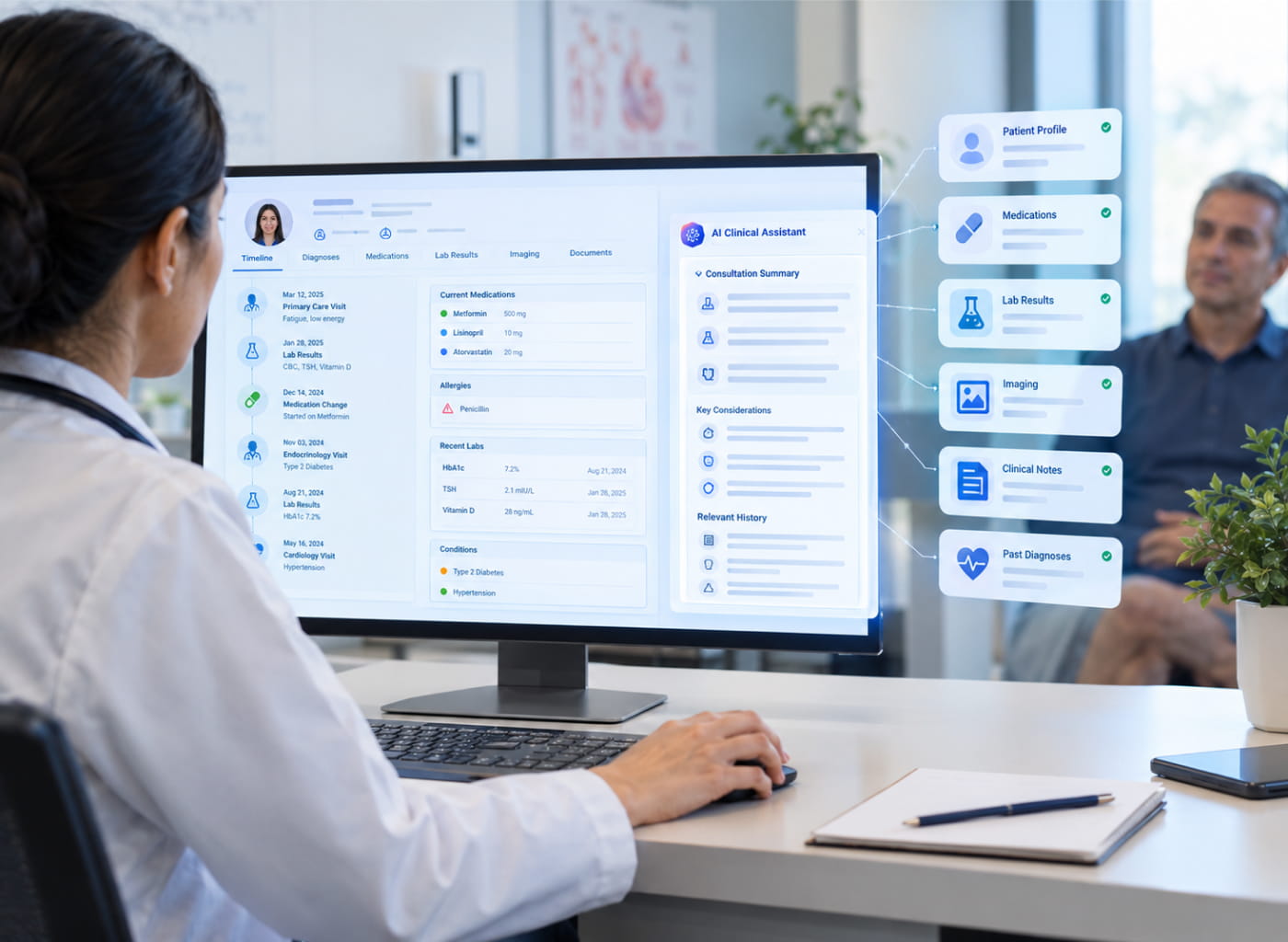
Many healthcare AI applications begin with a single document or encounter. A clinical note is submitted for summarization, a report is analyzed, or a clinician asks a question about a particular result. These tasks can be useful, but they represent only a limited part of the opportunity. Healthcare decisions often depend on relationships across time, and those relationships cannot be understood reliably when every encounter is treated as an isolated event.
A longitudinal clinical context can help an AI system identify changes that would be difficult to recognize from one record alone. A sequence of test results may reveal a trend. A medication change may explain why a later observation requires closer review. Repeated symptoms across consultations may indicate that the current encounter should be interpreted alongside earlier assessments. The value comes from understanding the relationship between events, not simply retrieving a larger number of documents. A longitudinal patient health record provides the broader view needed to connect relevant encounters, test results, medication changes, and previous assessments, helping AI systems interpret the current clinical situation in context.
Building that context requires more than feeding an entire medical record into a model. Longitudinal records can contain duplicates, inconsistent terminology, missing dates, conflicting entries and information that is no longer current. Sending everything into a model may increase noise, obscure important evidence, and create unnecessary privacy exposure. A more reliable architecture identifies the clinical task first and retrieves the relevant information according to that purpose.
For example, an AI assistant preparing a consultation summary may need the current reason for the visit, relevant diagnoses, medication history, allergies, recent investigations, and unresolved follow-up actions. It should also preserve the source and date of each important item so the clinician can verify the summary. If two records disagree, the system should make the discrepancy visible instead of silently selecting one as correct. If a key piece of information is unavailable, it should communicate that limitation rather than inventing a complete narrative.
This approach turns clinical context into an engineered capability. It requires reliable patient matching, interoperable data access, clinical terminology, temporal reasoning, source attribution and retrieval policies appropriate to the task. The system must also enforce access controls and applicable consent requirements before retrieving sensitive information. Context engineering in healthcare is therefore not simply a prompt-writing exercise; it is the process of making the right evidence available to the right AI workflow under appropriate clinical and governance constraints.
3. Clinical Context Must Be Designed Into the Workflow
Even a well-informed AI system can be ineffective if its output arrives at the wrong time or in the wrong place. A summary that requires a clinician to leave the consultation workflow, open another application, and manually reconcile the result may add work rather than reduce it. Similarly, a recommendation that appears after the relevant decision has already been made has limited practical value.
Clinical context must therefore connect information to the workflow in which it will be used. During a consultation, an AI assistant might prepare a draft summary from the encounter and relevant history. During medication reconciliation, it might identify differences between a recorded medication list and the information supplied during the current visit. Before discharge, it might help assemble the documented follow-up plan and identify missing administrative steps. Each task requires a different combination of information, rules, output format, and validation.
This is why connected clinical workflows matter: relevant information must reach the right professional at the point of action, in a format that supports the task without creating additional manual work.
The workflow must also define what happens when the AI encounters uncertainty. If the available records do not establish whether a medicine is current, the system should request clarification or flag the issue for review. If a clinical instruction conflicts with a relevant documented allergy, the workflow should surface the conflict rather than attempt to resolve it through unsupported inference. If an important result is missing, the system should distinguish that absence from a confirmed negative finding.
These behaviors need to be designed and tested, not left to the model’s general ability to respond cautiously. Healthcare workflows require explicit acceptance criteria, defined escalation paths, and clear boundaries around what an AI system may do independently. A system that drafts documentation may operate with a different level of autonomy from one that recommends a treatment change or initiates a clinical action. The risk of the task should determine the strength of the controls.
Human oversight is most effective when it is built into the workflow with a clear purpose. Clinicians should be able to inspect the supporting evidence, correct the output, and understand which information influenced the result. The system should preserve appropriate audit trails and distinguish AI-generated summaries from original clinical records. These controls allow AI to support professional judgment without creating confusion about who is responsible for the final clinical decision.
4. Interoperability Is a Prerequisite, but It Is Not Enough

Clinical context cannot be assembled reliably when relevant information remains trapped in disconnected systems. A patient’s consultation history may sit in an electronic medical record, laboratory results in a laboratory information system, imaging reports in a radiology platform, and prescriptions in another application. Healthcare interoperability helps make these records accessible across system boundaries, but technical connectivity is only the first step.
Connected data must also be interpretable. Systems may represent the same clinical concept differently, use different terminology, or disagree about whether an event is current. A data exchange interface can successfully transfer a record while leaving the receiving application uncertain about its meaning. Consequently, healthcare AI needs both interoperable access and a reliable semantic layer that helps establish what the information represents, when it was recorded, which source produced it, and how it relates to the current task.
Standards-based exchange, structured clinical data and consistent terminology can reduce these problems, although they do not eliminate every ambiguity. Source provenance, timestamps, data-quality checks and reconciliation mechanisms remain necessary. The architecture must preserve the distinction between an original observation, a derived interpretation, and an AI-generated summary. It should also account for information that cannot be retrieved, records that may be outdated, and discrepancies that require professional review.
In India, ABDM provides an important foundation for digital health identity and consent-based information exchange. Understanding ABDM and interoperable health information is essential for designing healthcare AI systems that can access relevant records through authorized, standards-based exchange while respecting consent and data governance requirements. However, an ABDM-connected application does not automatically have a complete clinical context for every AI task. The availability of records depends on participation, permissions, data quality, and the exchange arrangements in place. Even when relevant records can be retrieved, the receiving system must still determine which information is appropriate for the task and how it should be presented to the clinician.
The architecture must therefore connect interoperability to clinical workflow and context construction. Identity establishes which patient the information belongs to, authorized exchange makes relevant records accessible, and clinical interpretation determines how those records can support the task at hand. Treating these as separate but coordinated responsibilities creates a stronger foundation than assuming that access to more data will automatically produce better AI.
5. Clinical AI Needs Evidence, Evaluation and Boundaries
A healthcare AI system should not be evaluated solely on whether its responses sound medically plausible. It must be assessed according to the task it performs, the evidence it uses, and the consequences of an incorrect output. A summarization system may be evaluated for factual consistency, completeness, and preservation of important details. A retrieval assistant may need to demonstrate that it returns the correct source information and clearly identifies gaps. A clinical decision-support application requires a more demanding evaluation appropriate to its intended use and risk.
Testing should include ordinary cases as well as incomplete, contradictory and unusual situations. The system should be challenged with outdated medication lists, missing investigations, ambiguous clinical notes, conflicting diagnoses, and records that belong to similar but different patient identities. It should also be evaluated for whether it distinguishes a documented fact from an inference and whether it communicates uncertainty when the evidence is insufficient. These tests help reveal failure modes that may remain hidden when evaluation relies on clean examples.
Traceability is equally important. For a consequential output, the organization should be able to determine which information was retrieved, which sources supported the summary or recommendation, what model and workflow were used, and whether a human reviewed the result. Where appropriate, the system should allow the clinician to inspect the original evidence rather than relying entirely on an AI-generated explanation. Monitoring should continue after deployment because data quality, clinical workflows, and model behavior can change over time.
Healthcare organizations must also define clear limits on autonomy. AI may be suitable for preparing a draft or surfacing relevant history while requiring human approval before a clinical action is taken. More consequential applications need stronger safeguards, formal evaluation, and oversight appropriate to their intended use. Privacy, security, applicable regulation, and clinical accountability must be considered throughout the lifecycle rather than treated as final implementation checks.
These controls are not obstacles to innovation. They are what make healthcare AI usable in environments where mistakes can affect patient care. A system that acknowledges missing information, exposes uncertainty, and remains within its intended role is more valuable than one that produces a confident answer regardless of the evidence.
6. The Prologic Perspective: Build the Context Before Scaling the Intelligence

At Prologic Technologies, we believe healthcare AI should be designed around the clinical work it is expected to support, rather than added as a standalone feature to an existing application. HealthFabric’s opportunity is to connect healthcare systems, records, and workflows so that authorized information can support the next decision in the patient’s journey. This includes the interoperability foundations, data relationships, and workflow integration that make clinical context available when it is needed.
That approach begins with a specific clinical or operational task. The team identifies the decision or workflow to be supported, determines which information is required, establishes how that information can be retrieved and validated, and defines what the AI is permitted to produce. The workflow then needs evaluation criteria, human review where appropriate, and a mechanism for handling missing or conflicting evidence. Only after these foundations are established does it make sense to optimize the model or expand the scope of autonomy.
This sequence matters because AI performance depends on the system surrounding the model. Better retrieval cannot compensate for incorrect patient matching, and a capable model cannot safely resolve every contradiction in the medical record. Similarly, an accurate summary has limited operational value if it does not reach the clinician at the appropriate point in the workflow. Clinical context must connect data access, interpretation, presentation, and action.
The broader lesson is that healthcare AI is not simply a model-selection problem. It is an engineering problem involving clinical information, interoperability, context, workflow design, governance and evaluation. Organizations that treat these elements as part of one system will be better positioned to build AI capabilities that are useful, verifiable, and appropriate for their intended purpose.
Healthcare AI will not succeed merely because models become more capable. It will succeed when the systems around those models provide the right context, preserve uncertainty, and connect useful intelligence to responsible clinical action. In healthcare, understanding the situation is not an optional enhancement to intelligence. It is one of the conditions that makes intelligence useful.